How long will it take to say?
Type the word count of your draft. We use 130 words per minute as our assumption for speaking pace.
Each example below has its own Copy button.
You may not be on the program at all, and that is fine. If someone hands you the microphone, three sentences are enough: thank the guests, say one true thing about your daughter, raise a glass. If you do want a full speech, aim for two to three minutes. Below are both, with seconds for each part, eight openings and a list of what to leave out.
Do you need to speak at all?
Many mothers of the bride never give a speech, and nobody counts it against them. Traditional US order has the hosting parents speaking after the best man and maid of honor, and mothers of the couple may speak too. Whether you do is the couple’s call, not a rule.
Use this quick test:
- Did your daughter ask you? Then yes, and the rest of this page is for you.
- Do you want to, but nobody asked? Ask her first. A speaker who is not scheduled should check with the couple before standing up.
- Are you hosting with a partner or spouse? Decide together who speaks. One joint speech beats two that repeat each other.
- Would you rather not? Then sit this one out, and give her something private instead: a note she reads that morning.
If the answer is “maybe, only if it comes up,” carry the three-sentence toast on a card in your bag. It costs nothing and it covers the surprise microphone.

Outline table: a three-sentence toast and a full speech
Table: Time for each part of a toast and a full speech (our estimate, assumptions below)
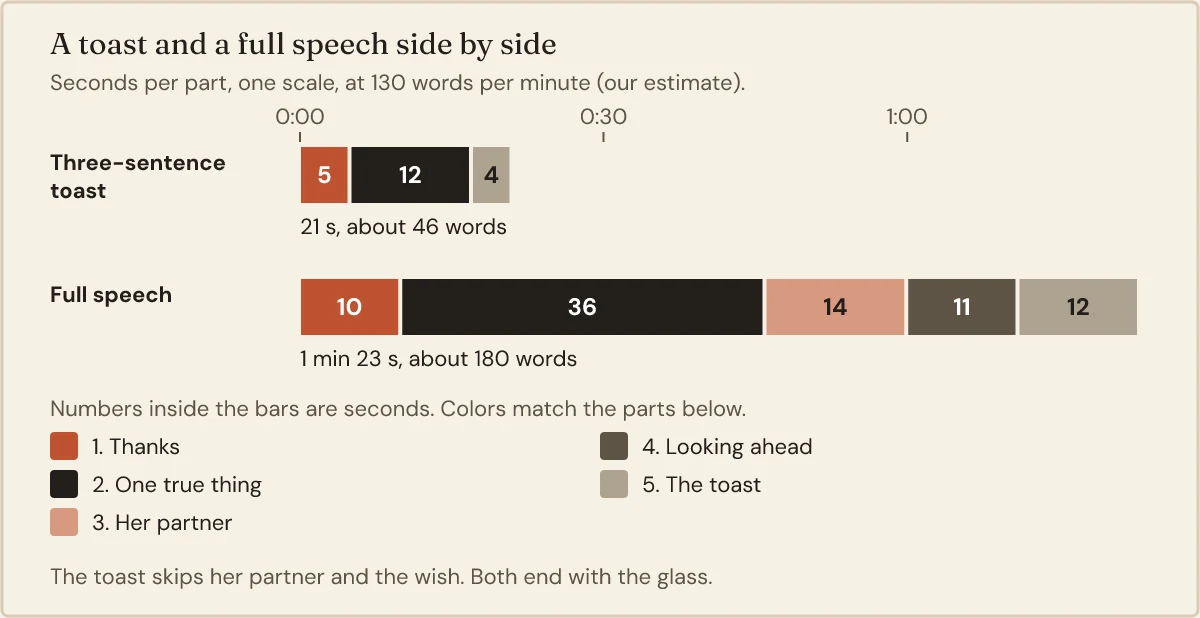
| Part | What goes in it | Toast | Full speech |
|---|---|---|---|
| Thanks | Greet the room, say who you are, thank the guests | 5 sec | 10 sec |
| One true thing | A single short story or trait, not a list | 12 sec | 36 sec |
| Her partner | Welcome them in, name one thing you have seen | none | 14 sec |
| Looking ahead | One wish, kept small and specific | none | 11 sec |
| The toast | Ask everyone to stand and raise a glass | 4 sec | 12 sec |
| Total | about 21 sec | about 1 min 23 sec |
Assumptions: 130 words per minute, which is our own pace for a toast with pauses. The toast column times the example toast below, and the full speech column times Speech 1 below (178 words). Your real time depends on your pauses and on any laughter. Read yours aloud once with a timer, then trim.
The three-sentence toast
Thank you all for being here to celebrate [Daughter] and [Partner]. [Daughter], I have watched you turn every small task into something done well, and today I get to watch you choose someone who notices it too. Please raise a glass to [Daughter] and [Partner].
Word count: 45. Speaking time at 130 words per minute: about 21 seconds.
Change one thing only: the trait. “Turn every small task into something done well” is a placeholder. Swap in whatever you have watched her do, in your own words. The shape stays: thanks, one true thing, toast.
A three-sentence toast takes about 21 seconds, and the full speech adds her partner and a wish to reach about 1 minute 23.
Two full speeches to copy and change
Both speeches are examples written for this page. Every detail is made up, so replace the names, the story and the numbers with yours. Word counts are ours.
Speech 1: you are hosting and speaking first (about 2 minutes)
Good evening, everyone. I’m [Name], [Daughter]‘s mom, and I was told I could have two minutes. [Husband] says that is optimistic.
When [Daughter] was nine, she decided our kitchen needed a menu. She wrote it in marker, taped it to the fridge and charged her brother a quarter per pancake. He paid. I learned something that morning. She sees what people need, and she makes it happen, politely but firmly.
She still does. When Grandma broke her hip, [Daughter] drove four hours on a Tuesday and moved everything in the pantry to hand height. Nobody asked her to.
[Partner], the first time we met, you let her finish her sentences. Then you asked a follow-up question. That is rarer than you think, and it is why I stopped worrying.
So here is what I know. She will plan the trip, you will remember the tickets, and between you the pancakes will get made.
Please stand and raise a glass. To [Daughter] and [Partner]: may your kitchen always be loud and your fridge always have a menu on it.
Word count: 178. Speaking time at 130 words per minute: about 82 seconds, so closer to two minutes with pauses and laughter.
Speech 2: you are a guest of honor, not the host (about 90 seconds)
Hello, everyone. I’m [Name], the bride’s mother, and I promised her this would be short.
I won’t tell you about the day she was born. I’ll tell you about last spring, when she called me from a parking lot to say she had found the person she wanted to build a life with. She was not asking for advice. She was telling me, and she sounded sure.
[Partner], to your family: thank you for raising someone she admires. We will be there for the Sunday dinners, the broken sinks and the holidays that run too long.
To [Daughter] and [Partner]. Cheers.
Word count: 101. Speaking time at 130 words per minute: about 47 seconds.
Eight openings that avoid the cliches
Cliches to retire: “I’m not good at public speaking,” “Webster’s dictionary defines marriage as,” and “I never thought this day would come.” Try one of these instead and carry on into your own story.
- “For those who do not know me, I’m [Name], [Daughter]‘s mother, and I promised her I would keep this short.” (20 words)
- “Before anything else, thank you. Some of you traveled a long way, and every one of you is part of how she got here.” (24 words)
- “When [Daughter] was six, she announced she would marry someone who could carry her backpack. [Partner], I see you brought your own.” (22 words)
- “[Partner], two years ago you were a name she kept mentioning. Tonight you are my family, and I could not be happier about it.” (24 words)
- “I have thought about what to say for months. The shortest true thing I have is this: I am proud of her.” (22 words)
- “Her grandfather is not here, but I know what he would say. He would tell her to eat something first.” (20 words)
- “In our family, the mother gets one line and the father gets a ten-minute story. I’m using my line.” (19 words)
- “My daughter gave me three notes on this speech. Note one: do not cry. Note two: do not tell the swimming story. I’m already off to a bad start.” (29 words)
Pick the one that sounds like you out loud. If you would never say it at your kitchen table, do not say it at the microphone.
Six things to leave out, and why
- Her past partners. Even a kind comment makes people look at someone in the room.
- Comparisons with her siblings. Praise that ranks the children lands as a verdict on the others.
- Embarrassing stories about her body, dating or school. The guests are laughing at her, and she cannot walk away.
- Advice about marriage, children or money. It reads as a lecture, and she did not ask for it at her own party.
- Remarks about who paid or what it cost. It turns a gift into a bill.
- A grievance, a hint, or a dig at the other family. Nobody has ever fixed one at a reception.
Make it yours in four questions
Write one or two plain sentences for each question. Then pick the best answer as your story and use the others as the closing line.
- What is one small thing she did as a child that she still does as an adult?
- When did you stop worrying about her, and what happened?
- What have you seen her partner do that made you like them?
- What do you wish for them that fits on one line?
Tell the story in the order it happened: where you were, what she did, what you said. Stop when the point is clear, then say the point in one sentence. If you cannot say it in one sentence, the story is two stories, and one of them goes in the drawer.
What to leave for the couple to say
Mothers often feel pressure to speak for everything: the childhood, the courtship, the future. You do not need to. The couple will thank guests, name the people who helped and tell their own story. Your job is narrower. Say what only a mother can say, and leave the rest.
If the father or a stepparent is also speaking, divide the material before the day. One person takes childhood, one takes the partner. If you are co-hosting with another parent or a partner of your own, you can open and close together instead. See the father of the bride version for how he might cover his share.
Words to minutes for your speech
Table: Speech length in words and minutes at 130 words per minute (our estimate, assumptions below)
| Words | Minutes | Fits |
|---|---|---|
| 65 | 0.5 | A toast with a short story |
| 130 | 1 | A toast with a thank-you |
| 260 | 2 | A full speech, brisk |
| 325 | 2.5 | A full speech with one laugh |
| 390 | 3 | A full speech with two stories |
Assumptions: 130 words per minute, before pauses. Typical conversational speech runs faster, around 150 words per minute, so we assume a slower pace for a toast. For comparison, UK guidance for the mother of the groom runs about three to five minutes, and general US advice is to keep any wedding speech under five minutes. See the full words-to-minutes chart for other roles.
Send it to your daughter first
Surprise helps a gift, not a speech. Send her the toast a day or two before. She can tell you if a story is off limits, or if another speaker is covering the same ground. It also helps you: reading it aloud to someone else is the fastest way to trim it.
Here is wording you can copy:
I wrote a short toast for the reception. It runs about [N] seconds. Can you read it and tell me if any line should go? I would rather cut something now than say it on the day.
Where does your speech fit in the evening? The speech order guide shows who speaks and when, and the fill-in speech template works for any speaker. For another parent’s view, read the mother of the groom’s outline. If you want a plainer, shorter form, a simple wedding toast follows the same three steps.

Save for later
Pin it now and find it when you are ready to plan.
Questions people ask
What should the mother of the bride say?
Say thank you, tell one short true story that shows who your daughter is, welcome her partner into the family, and raise a glass. Leave the full life story, advice about marriage and any jokes at her expense out. If you only have time for three sentences, thanks, one true thing and a toast is a complete speech.
Does the mother of the bride give a toast?
It depends on the couple and on who is hosting. Many mothers are never on the program, and that is fine. Others are asked, or want to speak. Guides on toast etiquette say to confirm the list in advance and, if you are not scheduled, to ask the couple before you stand up.
How long should a mother of the bride speech be?
For a toast, one minute or less is plenty. For a full speech, aim for two to three minutes. At our assumed 130 words per minute, that is about 260 to 390 words. General advice is to keep any wedding speech under five minutes, and shorter is easier on everyone, including you.
Should I speak if my husband is already giving a speech?
Only if you and your daughter both want it. A joint speech often works better: he opens, you close with the toast, and each of you takes one story. Agree who covers what so you do not repeat the same anecdote. If you split, keep your part to the one thing only you can say.
What if I cry or lose my place?
Stop, breathe out slowly and look at your card. Guests wait with you, and a pause reads as feeling, not failure. Mark the hardest line with a slash on your card so you know where to rest. Practice that sentence aloud a few times before the day, and keep a glass of water within reach.
Can I read my speech from paper?
Yes. Most people at a wedding read from a card or a phone, and nobody minds. Print it in large type, double spaced, with the toast line in bold. Hold the card at chest height so you can look up at the couple on the key lines instead of staring down at the page.
Sources
- weddingwire.com/wedding-ideas/who-gives-a-speech-at-a-wedding (opens in a new tab) : Traditional US order in which the hosting parents speak after the best man and maid of honor, and the advice to keep any wedding speech under five minutes.
- www.insideweddings.com/news/expert-advice/the-must-know-rules-for-making-a-wedding-toast/1622 (opens in a new tab) : Mothers of the couple may speak, speakers should confirm the list and order in advance, and a speaker who is not scheduled should ask the couple first.
- bridebook.com/uk/article/how-long-should-a-wedding-speech-be (opens in a new tab) : UK editorial guidance on speech lengths by speaker, used only as a comparison point. US toasts tend to run shorter.
- virtualspeech.com/blog/average-speaking-rate-words-per-minute (opens in a new tab) : Typical conversational speaking rate of about 150 words per minute. Our 130 words per minute is our own slower assumption for a toast with pauses.
Updated by bigdaydesk editorial
Keep planning
-
Wedding toast from mother of the groom
Gives a short welcome-to-the-family frame and two examples, one for a short toast and one for a full speech.
-
Father of the groom speech
Centered on welcoming the bride's family and a single story about the son, which is the usual gap in this speech.
-
Curious about quotes?
Every quote is either public domain with a linked source or an original line labeled as ours, never an unsourced attribution.
-
Write your vows from the bible
Pairs each vow with the verse behind it, quoted from a public-domain translation with a link to the source.