
How long will it take to say?
Type the word count of your draft. We use 130 words per minute as our assumption for speaking pace.
Each example below has its own Copy button.
A father of the groom speech has four parts: a welcome to the bride’s family, one story about your son, a turn toward the couple, and a toast. At three minutes that is about 390 words, using 130 words per minute as our assumption. Use the table, copy a welcome line, then add your own story.
Most speeches by fathers of the groom skip the welcome and run long on stories. This one does the reverse. Start with the new family.
Outline table: four parts, 180 seconds
Table: seconds and words for each part of a three-minute speech by the groom’s father (our estimate, assumptions below)
| Part | What goes in it | Seconds | Words (est.) |
|---|---|---|---|
| 1. Welcome the other family | Thank the hosts, name your son’s partner’s parents, one specific kind word | 45 | 98 |
| 2. One story about your son | A single scene with a place, an age and a small detail | 75 | 162 |
| 3. The turn | One thing you have seen change or deepen since the partner arrived | 30 | 65 |
| 4. The toast | One wish, then ask the room to stand and raise a glass | 30 | 65 |
| Total | 180 | 390 |
Assumptions: 130 words per minute, words rounded so the rows add to 390, and no time for laughter or applause. A real room adds ten to twenty seconds. The welcome gets a quarter of the time on purpose, since the partner’s family is hearing from you for the first time.
Welcoming the other family and one story about your son fill 120 of the 180 seconds.
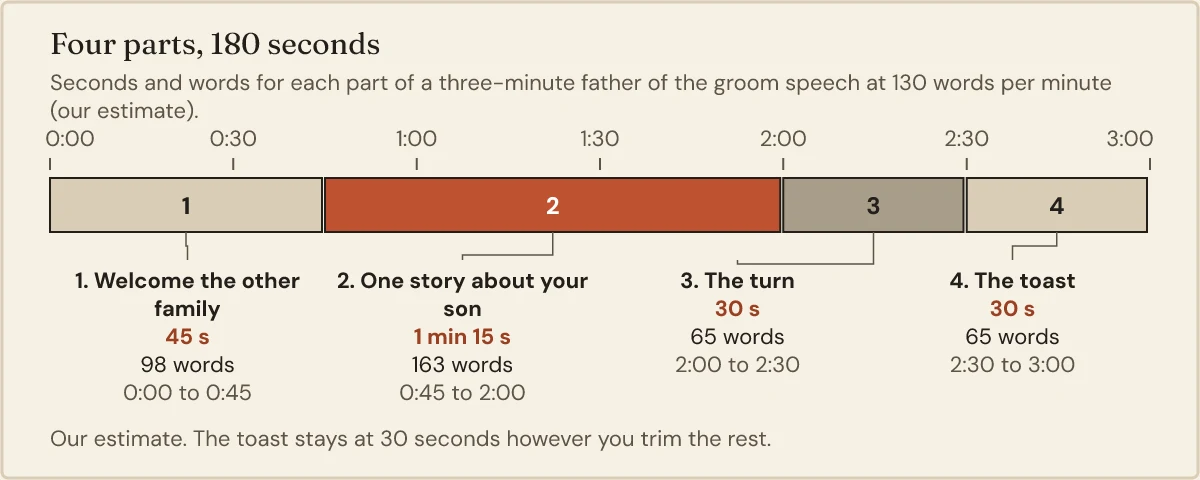
If you run long, trim the story before the welcome. Never cut the toast.

Eight ways to welcome the bride’s family
Each line is a starting point with brackets to fill. Tap Copy under any card to move it to your clipboard. Word counts come from our own count and include the bracketed placeholders as written.
1. Plain thanks (33 words)
[Partner’s parents], before I say anything about my son, thank you. You raised someone who makes him laugh, and you welcomed our family as though we had always been on your guest list.
2. One long table (31 words)
Tonight two families share one long table. I am [Your name], [Son]‘s father, and on behalf of my side, I want to say how glad we are that yours made room.
3. A little humor about meeting (31 words)
[Partner’s parents], when we first met at [place], I rehearsed three topics in the car. We used none of them. You made it easy, and I have been grateful ever since.
4. For parents who traveled (36 words)
Some of you flew [number] hours to be here, and I know how long that is. [Partner’s parents], thank you for trusting us with the rest of the weekend. We will take good care of you.
5. For a blended family (33 words)
To every parent in this room, however you came to that title, thank you. [Partner] has been loved by more people than most, and it shows in how kindly they treat my son.
6. When you have only met once (29 words)
We have only had one dinner, [Partner’s parents], and that was enough. I could tell within ten minutes how [Partner] became the person we are all here to celebrate.
7. Short and direct (21 words)
[Partner’s parents], welcome to the family. I will say more later, but I wanted you to hear it from me first.
8. Naming everyone (32 words)
To [Partner]‘s parents, grandparents, brothers, sisters and friends, I am [Your name], [Son]‘s dad. Thank you for coming, and thank you for letting my son into a family that was already complete.
More wording for a general welcome is in the fill-in speech template.
Example one: a reception speech (269 words)
This one follows the table. The story is invented, so replace it with something that happened in your house. About 2.1 minutes at 130 words per minute (our assumption).
Good evening, everyone. I’m [Your name], [Son]‘s dad. [Partner’s parents], I would like to start with you. Thank you for raising [Partner], for the welcome you gave our family, and for the dinner last spring that ran two hours longer than planned. We are glad to be on the same side of the table.
I have been thinking about which story to tell about [Son]. There are plenty. I picked this one. When he was nine, his team lost a game by one run, and he cried in the car. The next morning he was in the yard before me, throwing a ball against the garage door. I asked how long he had been out there. He said, “Since it got light.” Nobody told him to.
That is how [Son] works. He decides something matters, and he puts in the quiet hours. I saw it again after he met [Partner]. He called me, a little out of breath, and said, “Dad, I think I have to get this right.” I told him he did not have to get anything right, he only had to show up. He showed up.
[Partner], I have watched you laugh at his jokes, even the ones I taught him. I have watched you be patient with the garage door. Thank you for choosing him.
[Son], your mother and I are proud of you in ways you do not know about. Marry well, argue briefly, and call your parents on Sundays. Or on some Sundays.
Everyone, please stand and raise a glass. To [Son] and [Partner], and to [Partner’s parents]. Welcome to the family. Cheers.
Notice the proportions. The welcome opens, the story is the longest block, and the toast is a single request.
Example two: a rehearsal dinner host toast (343 words)
The dinner is a smaller room and the host speaks first, so a few logistics and a looser tone are fine. You have room to run longer. This runs about 2.6 minutes at 130 words per minute (our assumption), well under the 10 minutes one source gives as the host’s ceiling.
Hello, everyone, and welcome. For those who do not know me, I’m [Your name], [Son]‘s father. Tonight I get to be the host, which mostly means I paid and I speak first.
A few thank-yous. [Partner’s parents], thank you for driving here from [place]. To the staff at [Venue], thank you for putting up with a table of [number] people who all want their food at once. And thank you to everyone who traveled. Some of you crossed an ocean. Some of you crossed a state line and complained about it more.
Tomorrow belongs to the two of them, and the toasts will be short. Tonight we have more time, so I am going to tell a longer story.
When [Son] was fourteen, he decided to build a deck behind our house. Nobody asked him. He drew the plans on the back of a pizza box, bought the wrong screws twice, and borrowed my truck without the usual conversation. It took the whole summer. It leaned a little. It still stands, and I have never had the heart to level it.
Here is what I learned from that deck. [Son] does not build things to be admired. He builds them so other people have somewhere to sit. When he first described [Partner] to me on the phone, he used the same tone. He did not list qualities. He said, “You will understand when you are at the table with us.”
Last spring, I understood. [Partner], I watched you listen to my brother tell the same story for the fourth time and laugh as if it were new. I watched my wife ask you a question and wait for the whole answer. In one evening you had a seat with us, and nobody had to make room.
[Partner’s parents], thank you for the person you sent us. [Son], thank you for the deck and for everything it taught me.
Please raise a glass. To [Son] and [Partner], to the two families at this table, and to a wedding tomorrow with no leaning decks. Cheers.
What to leave out, and why
- Exes and past relationships. The partner’s grandparents are listening. No laugh is worth that silence.
- Money. A joke about paying for the wedding lands on the other family’s budget too, and they cannot answer back.
- Comparisons between the two families. “We are the fun side” sounds like a ranking, even when you mean it kindly.
- Advice about marriage drawn from your own. A line about your spouse that gets a laugh may land badly if your marriage ended or you are remarried in the room.
- Baby photos and bathroom stories. Your son has a lifetime of reasons to forgive you, and he has one wedding day to remember. Do not spend the goodwill.
- A long list of achievements. Awards read like a résumé. One scene of effort shows more than ten titles.
- Reading from a phone with notifications on. Use paper or cards. A buzz in the middle of the toast cannot be taken back.
For a gentler way to handle humor, see how to give a toast.
Words to minutes for your draft
Table: speaking time for common word counts at 130 words per minute (our estimate, assumptions below)
| Words in your draft | Minutes aloud | Fits |
|---|---|---|
| 200 | 1.5 | A short welcome and toast after a long dinner |
| 300 | 2.3 | A reception speech that shares the evening with several others |
| 400 | 3.1 | Our suggested reception length |
| 500 | 3.8 | A rehearsal dinner toast with a short story |
| 650 | 5.0 | The top of the general guideline below |
| 900 | 6.9 | A host toast at a small rehearsal dinner |
Assumptions: 130 words per minute, minutes rounded to one decimal, no pauses. One vendor sample of practice presentations found a median of 111 words per minute, so nervous speakers can run slower than this table. Read your draft aloud once, standing, with a timer.
Type your word count into the box above the page text to see minutes for your own draft.
Length: what published advice says
No guide publishes a number for the father of the groom alone. The nearest figures are 3 to 5 minutes for the mother of the groom and 5 to 7 minutes as a general guideline, both from a UK source, where speeches run longer than in the US. For the father of the bride the same source says 7 to 9 minutes. A US source says to keep any wedding speech under five minutes.
Our rule: three minutes at the reception, up to about five at the rehearsal dinner. If you speak at both, give the long story at the dinner. Your reception speech is then the short welcome and toast, and the guests who heard the story laugh when you nod to it.
The full range for every role is in how long a wedding speech should be.
Reception or rehearsal dinner
Table: where a father of the groom speaks and what to put in each slot (our estimate, assumptions below)
| Slot | Who sets it | What to say | Aim for |
|---|---|---|---|
| Rehearsal dinner, as host | You, as the person hosting | Welcome, thanks, the longer story, a toast | 3 to 5 minutes (our suggestion) |
| Rehearsal dinner, as guest | The hosts | A short toast, only if invited | 1 to 2 minutes (our suggestion) |
| Reception, in the schedule | The couple | The four parts in the table above | 3 minutes (our suggestion) |
| Reception, not in the schedule | You, by asking | A single toast of four or five sentences | Under 1 minute (our suggestion) |
Assumptions: the aims are our suggestions for a typical evening, not published rules. Published sources say the dinner host is traditionally the groom’s father, who gives the first toast, and that hosts should stay under 10 minutes.
Sources agree on one point. Fathers often speak, particularly when they host, but speakers should confirm the list and the order in advance. If the schedule does not include you, ask the couple before the day, not at the microphone. In the traditional US order the hosting parents follow the best man and maid of honor. Details on the whole block are in who speaks in which order.
Make it yours in four questions
- Which single scene shows who your son is? Choose one age, one place and one small detail. A list of traits is weaker than a minute in the yard.
- What did you notice when his partner arrived? Describe a habit, a phone call or a laugh, not a compliment.
- What can you say about the other family that you know is true? A fact from a dinner or a drive works better than praise.
- Who reads it first? Ask your son, and ask one person who knows both families to check that nothing needs explaining.
If the bride’s father is also speaking, ask him which story he plans to tell. The overlap between two fathers’ stories is the most common clash, and the speech for the other side is covered in the father of the bride speech. Your wife may also speak, so the mother of the groom speech is worth a read before you both choose a story.
Send the outline to your son
Copy this note and send it before you finalize. It lets him say yes, or ask you to swap the story, in one reply.
My speech for the wedding, about three minutes and 390 words. 1. Welcome to [Partner]‘s family, 45 seconds. 2. One story about you, 75 seconds. 3. What I see in the two of you, 30 seconds. 4. The toast, 30 seconds. The story I plan to tell is about [topic]. Are you comfortable with it, and is there anything you would like me to leave out?

Save for later
Pin it now and find it when you are ready to plan.
Questions people ask
What does the father of the groom say at a wedding?
Most fathers of the groom do three things. They thank the guests and welcome the partner's family, tell one short story that shows who their son is, and close with a toast. Starting with the welcome matters most, because the new family is the audience that has never heard you speak.
How long should a father of the groom speech be?
No guide publishes a figure for this role alone. The closest published ranges are 3 to 5 minutes for the mother of the groom and 5 to 7 as a general guideline, from a UK source. We suggest three minutes at the reception, about 390 words at 130 words per minute, which is our assumption.
Do I speak at the rehearsal dinner or the reception?
Either, and sometimes both. Traditionally the groom's father hosts the rehearsal dinner and gives its first toast, while the reception order is set by the couple. Ask your son which slots exist. If you speak at both, give the long story at the dinner and keep the reception to a short welcome and toast.
Should I mention the bride's family in my speech?
Yes, and early. A thank you to your son's partner's parents, by name, tells their side of the room that they are welcome. Keep it specific, one real memory of meeting them or one thing you noticed about how they raised their child. Avoid jokes about their cost or their relatives.
How do I tell a story about my son without embarrassing him?
Pick a story where he comes out well, even if it started badly. A failed attempt that ended in effort is safer than a prank. Then ask him to read it. The send note below takes ten seconds to copy, and a yes from him is worth more than any edit you could make alone.
Can I read my speech from paper?
Yes. Guests expect it, and a printed page is calmer than memory when the room is warm and your voice is shaky. Print it in a large font with short lines, hold it low, and look up at each break between paragraphs. Do not read from a phone, because a notification can interrupt a toast.
Sources
- bridebook.com/uk/article/how-long-should-a-wedding-speech-be (opens in a new tab) : UK-oriented length guidance of 3 to 5 minutes for the mother of the groom, 7 to 9 for the father of the bride and 5 to 7 as a general guideline. No figure is published for the father of the groom specifically.
- zola.com/expert-advice/how-to-write-a-rehearsal-dinner-speech (opens in a new tab) : The rehearsal dinner host, traditionally the groom's father, gives the first toast, and the host's speech should stay under 10 minutes.
- www.insideweddings.com/news/expert-advice/the-must-know-rules-for-making-a-wedding-toast/1622 (opens in a new tab) : Fathers of the bride and groom often speak, especially when hosting; speakers should confirm the list and order in advance, and unscheduled speakers should ask the couple first.
- weddingwire.com/wedding-ideas/who-gives-a-speech-at-a-wedding (opens in a new tab) : Traditional US reception order has the hosting parents after the best man and maid of honor, and advice to keep any wedding speech under five minutes.
- virtualspeech.com/blog/average-speaking-rate-words-per-minute (opens in a new tab) : Median pace of 111 words per minute across a vendor sample of practice presentations (vendor data, not toasts).
Updated by bigdaydesk editorial
Keep planning
-
Write speech mother of the groom
Gives a short welcome-to-the-family frame and two examples, one for a short toast and one for a full speech.
-
Covers the groom welcome and the toast
Covers the groom welcome and the toast, which this role must handle and others skip, with eight timed openings.
-
Wedding speech mother of the bride: toast and outline
Writes for a speaker who is not expected to speak, so it leads with a three-sentence toast before a full speech.
-
Write your vows for him
Written to be said to a husband or groom, with a prompt list for the one specific memory that makes it his.


