51 to 120 guests. Step lengths are our pacing estimates, not measured data.
Paused: fix the time
Wedding day timelinebigdaydesk.com
Ceremony 4:30 PM, First look plan, Medium guest count
Your timeline
Share this result
Send this exact result. The link opens it the same way for them.
Save this result to Pinterest
Pin it now and find it when you are ready to plan.
Type your ceremony time into the planner on this page and you get every step of the day in order. At the default 4:30 PM ceremony with a medium guest count, hair and makeup start at 11:55 AM and the send-off song starts at 10:05 PM. Change the time, the size or the style and every other time moves with it.
Here is why that works. Everything on a wedding day hangs off one fixed moment, the ceremony. The tool counts backward from it for getting ready and portraits, then forward for dinner and dancing.
Timeline table for the default 4:30 PM ceremony
This is the sheet the tool prints for a medium wedding (51 to 120 guests) with a first look. It is our estimate, so adjust it to your venue and vendors.
Table: Default wedding day for a 4:30 PM ceremony, medium guest count, first look (our estimate, assumptions below)
| Time | Step | Length and buffer |
|---|---|---|
| 11:55 AM | Hair and makeup | 105 min, then 15 min buffer |
| 1:55 PM | Get dressed, detail photos | 30 min, then 10 min buffer |
| 2:35 PM | First look and couple portraits | 30 min, then 15 min buffer |
| 3:20 PM | Wedding party portraits | 30 min, then 10 min buffer |
| 4:00 PM | Guests arrive and find seats | 30 min |
| 4:30 PM | Ceremony | 30 min |
| 5:00 PM | Family portraits | 30 min, then 5 min buffer |
| 5:35 PM | Cocktail hour | 60 min |
| 6:35 PM | Dinner | 70 min |
| 7:45 PM | Toasts and cake | 30 min, then 10 min buffer |
| 8:25 PM | First dance | 10 min |
| 8:35 PM | Open dancing | 90 min |
| 10:05 PM | Last song and send-off | 15 min |
Assumptions behind the table:
- The ceremony start time is the only fixed point.
- Steps before the ceremony add up to 4 h 35 min including 50 min of buffer, so the first step starts 4 h 35 min ahead.
- Steps after the ceremony run forward with 15 min of buffer in total.
- The day runs 625 min, or 10 h 25 min, from the first step to the end of the last song.
- Every duration is our own pacing estimate, not a measured average.
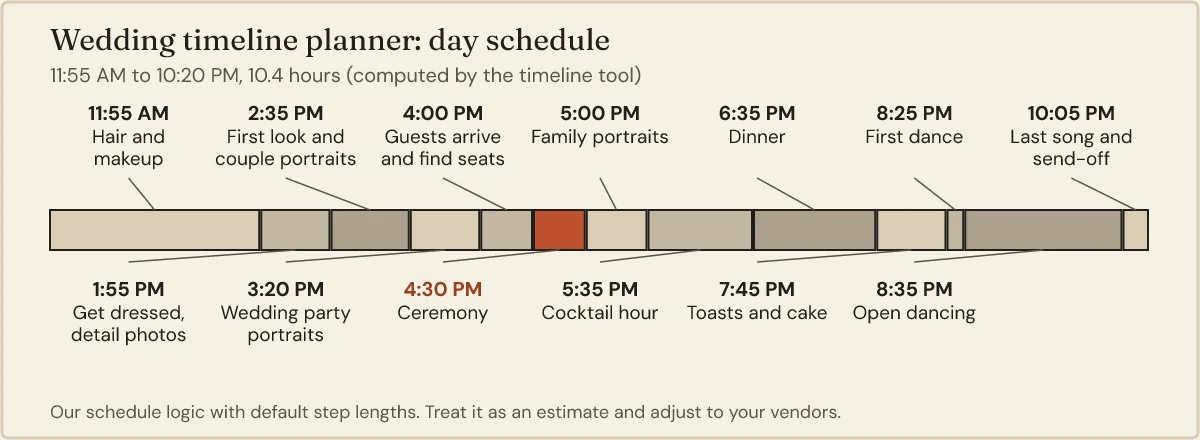
How the times are built
Each step has a length for small, medium and large guest counts. The tool adds a short buffer after steps where things tend to slip, such as hair and the first look. Buffers are part of the schedule, not extra.
A photographer’s sample day gives a useful check. For a 4:30 PM ceremony, that sample has the photographer arriving at 11:45 AM. Our first step starts at 11:55 AM, ten minutes later, because we count hair and makeup, not photographer arrival.
Published ranges agree with the pacing in the table. Planners give 45 to 60 minutes for a cocktail hour and 60 to 90 for open dancing. Our medium day uses 60 and 90. Most sources put buffers between major events at 10 to 15 minutes. We use 5 to 15 minutes, with the larger ones before the ceremony where a slip hurts most.
Same ceremony time, three guest counts
Guest count changes the day more than people expect. More people means longer seating, longer portraits, slower dinner service and a longer party. One planner suggests adding 15 to 30 minutes to each portion for lists over 150 guests.
Table: One 4:30 PM ceremony at three guest count bands, first look (our estimate)
| Guest count | First step | Ceremony ends | Last song ends | Whole day |
|---|---|---|---|---|
| Small, up to 50 | 12:30 PM | 4:50 PM | 8:45 PM | 8 h 15 min |
| Medium, 51 to 120 | 11:55 AM | 5:00 PM | 10:20 PM | 10 h 25 min |
| Large, 121 or more | 11:05 AM | 5:05 PM | 11:40 PM | 12 h 35 min |
The large day starts 50 min earlier than the medium one and ends 80 min later. Dinner alone grows from 70 to 90 minutes.
A small wedding does not need a shorter ceremony as much as shorter waits. If you are under 50 guests, look at the micro wedding schedule for a day built around a single room and a single table.
Pick the style that fits the day
The style switch swaps whole blocks of the schedule, not just the labels. Church days add two drives. Outdoor days add a weather call. Evening days drop the first look.
Table: Four styles, each with its own start and end (our estimate)
| Style and ceremony | First step | Last step ends | Whole day | What changes |
|---|---|---|---|---|
| Outdoor, 4:30 PM, medium | 12:20 PM | 10:35 PM | 10 h 15 min | Rain plan call at 2:20 PM, late-light portraits at 8:25 PM |
| Church, 2:00 PM, medium | 9:40 AM | 8:55 PM | 11 h 15 min | 25 min to the church, 25 min to the reception, a 20 min receiving line |
| Evening, 6:00 PM, medium | 2:35 PM | 10:35 PM | 8 h | No first look, 45 min of drinks instead of a full cocktail hour |
| Elopement, 11:00 AM, small | 8:30 AM | 2:10 PM | 5 h 40 min | 15 min ceremony, then portraits, a toast and a 90 min dinner |
For an afternoon start without a first look, see how skipping the first look moves the portraits. For a two-person day, the elopement timeline is a better starting point than any big-day sheet.
If you want golden-hour light, work from sunset, not from the clock. One planner suggests starting the ceremony two to three hours before sunset. Look up sunset for your date and place, then type that ceremony time into the planner.
Running late: what to cut, in order
Every day slips. The question is where to take the minutes back. The list below is for the default day, ordered from the cut guests notice least to the one they notice most.
Steps to win time back on the default day (our estimate):
- Trim family portraits from 30 to 20 minutes with a written shot list. Saves 10 min, 10 min total.
- Shorten cocktail hour from 60 to 45 minutes. Saves 15 min, 25 min total.
- Fold toasts and cake from 30 to 20 minutes. Saves 10 min, 35 min total.
- Cut the first dance from 10 to 5 minutes. Saves 5 min, 40 min total.
- Drop the two buffers after family portraits and after toasts. Saves 15 min, 55 min total.
Before the ceremony the buffers do the work. The day holds 50 minutes of buffer before 4:30 PM. If hair runs 30 minutes long, you spend 30 of the 50 and the ceremony still starts on time.
Never cut hair and makeup short on the day. Spend the buffers first, then cut from the end of the list, not the start.
Three mistakes that break a timeline
- Timing hair by the clock, not by the head count. One source puts a hair or makeup service at about 30 minutes per person. A party of four with two stylists lands at two to three hours. Fix: ask your stylist for a start time per person, then give the first person to finish a firm end time.
- Forgetting travel. A church day with a separate reception needs two drives. In the table above that is 50 minutes you would not see on a one-venue sheet. Fix: pick the style that matches your venues, then change the minutes to your real drive time.
- Stacking portraits on top of cocktail hour. Without a first look, a sample day pushes couple portraits into the cocktail hour, so you miss the first drinks with guests. Fix: either use a first look, or tell guests the drinks start without you and keep that block to about an hour.
Decisions to make before you print
Settle these four before you send the sheet to anyone. Each one moves several rows.
- First look or not. A first look puts about 30 minutes of portraits before the ceremony and gives you more time at cocktail hour.
- Ceremony length. Our default is 30 minutes. Religious ceremonies often run longer, so move the ceremony into the church style and check the end time.
- Plated or buffet. Dinner is the biggest swing in the reception. Our estimate runs 50 to 90 minutes depending on size.
- Who needs a different sheet. Your photographer wants the full day. Guests only need a few anchor times, which is what the guest schedule sign is for.
When the afternoon is settled, plan the evening in more detail with the reception order of events. A common planning figure is about four hours for a reception. In our estimate the default reception runs 4 h 45 min, from cocktail hour to the last song.
Send it to the people who need it
The link on this page reopens your exact schedule, so everyone sees the same times. Print it for the day, share the link for edits. Pick who you are sending to and paste the link after the line.
Ready-made wording, copy any one:
- To your partner: Here is a 4:30 PM wedding timeline I made for us. Take a look and tell me what you would change.
- To your maid of honor: I made a 4:30 PM wedding timeline. Can you check it before I lock it in?
- To your planner or photographer: Here is the current version of our 4:30 PM wedding timeline. Sending it so we work from the same times.
Change the time before you send it if yours is not 4:30 PM. If you also need the earlier months of planning, the planning checklist covers what happens before this sheet. If your ceremony is later, shift it to a 5 PM ceremony and compare the evening.
Questions people ask
What is a good wedding timeline?
A good timeline starts from the ceremony and works outward. Leave 5 to 15 minutes between big moments, give portraits their own block, and put dancing last so any cut costs the least. For a 4:30 PM ceremony and a medium guest count, our estimate runs from 11:55 AM to 10:20 PM.
What does a wedding day schedule look like?
It runs in four blocks. First comes getting ready, then portraits and guest arrival, then the ceremony and cocktail hour, then dinner, toasts and dancing. Our default day has 13 steps, from hair and makeup at 11:55 AM to a send-off song at 10:05 PM, with 65 minutes of buffer spread through it.
How to plan a wedding schedule
Fix the ceremony time first, because the venue, the light and your vendors all hang on it. Then pick a guest count band and a style, read the timed list, and send it to your photographer and DJ for corrections. Change one input at a time so you can see what moves, and print again after each confirmation.
What time should a Saturday wedding start?
Pick the start by light and by how long you want the party. In our estimate a 4:30 PM ceremony makes a day of about ten and a half hours, and a 6 PM evening ceremony makes a day of eight. One planner suggests starting two to three hours before sunset for golden-hour portraits, so check sunset for your date.
How early should hair and makeup start?
Count services, not people. One source puts a single hair or makeup service at about 30 minutes per person, and a party of four with two stylists at two to three hours. Our default gives a medium party 105 minutes, which puts the first service at 11:55 AM for a 4:30 PM ceremony. Add travel time if you get ready off site.
Sources
- www.zola.com/expert-advice/how-long-do-wedding-photos-take (opens in a new tab) : Sample day for a 4:30 PM ceremony with the photographer arriving at 11:45 AM, small buffers between steps, and portraits that overlap cocktail hour when there is no first look.
- www.littlechapel.com/wedding-blog/?p=13136 (opens in a new tab) : Buffers of 10 to 15 minutes between major events, 15 to 30 extra minutes per portion for guest lists over 150, and starting the ceremony two to three hours before sunset for golden-hour portraits.
- www.easyweddings.com.au/articles/how-to-plan-the-perfect-wedding-day-timeline (opens in a new tab) : Hair and makeup at about 30 minutes per person per service, a party of four with two stylists at two to three hours, and a first look of about 30 minutes.
- paperlust.co/blog/?p=21248 (opens in a new tab) : Typical cocktail hour of 45 to 60 minutes and open dancing of 60 to 90 minutes, which the default pacing stays inside.
- zola.com/expert-advice/wedding-reception-timeline (opens in a new tab) : Reception length of about four hours as a common planning figure, used to compare our reception block.
Updated by bigdaydesk editorial
Timelines by ceremony time
-
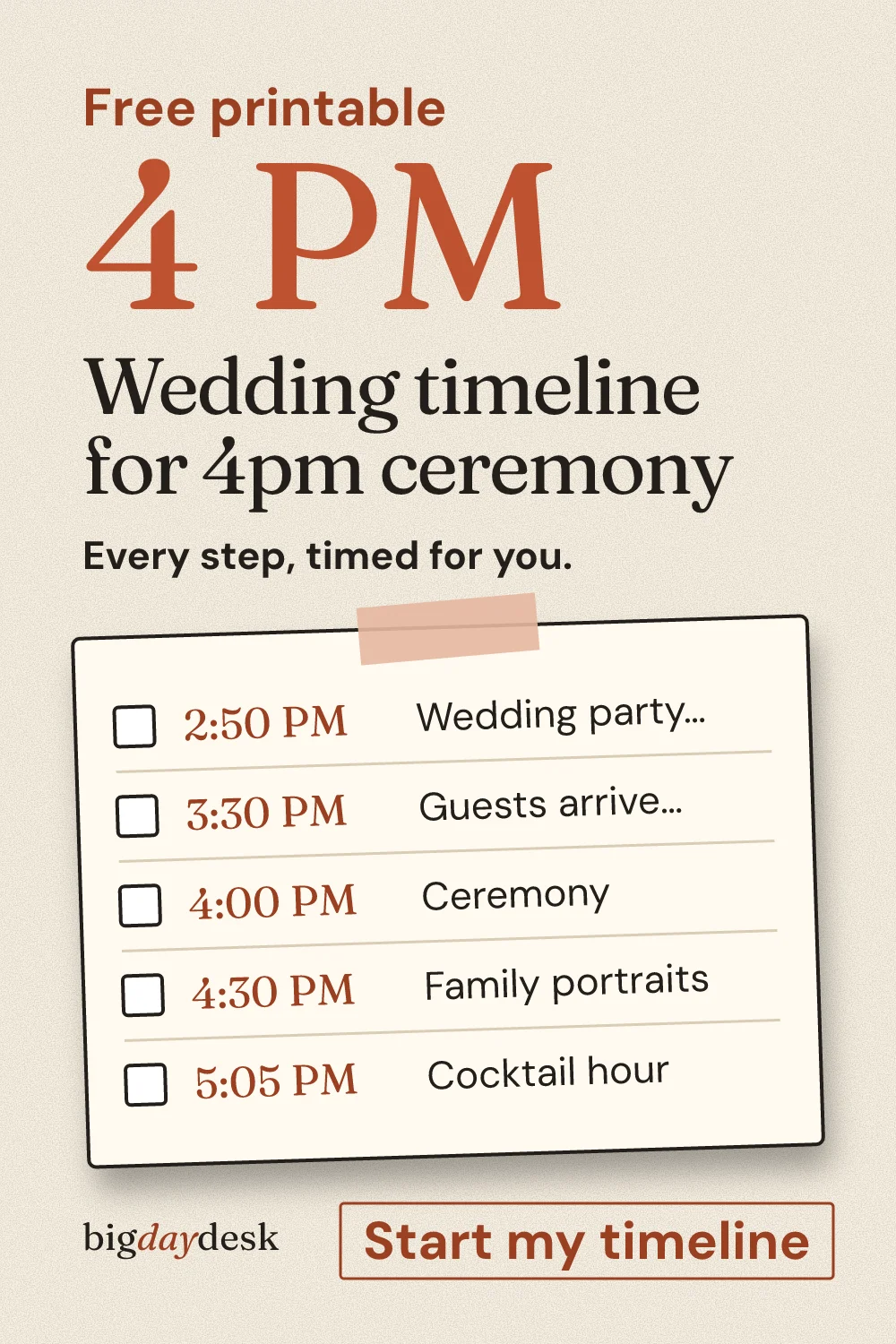
Wedding timeline for 4pm ceremony, hour by hour
The most searched ceremony time: a classic late-afternoon day with an indoor and an outdoor variant and what to cut when running late.
-
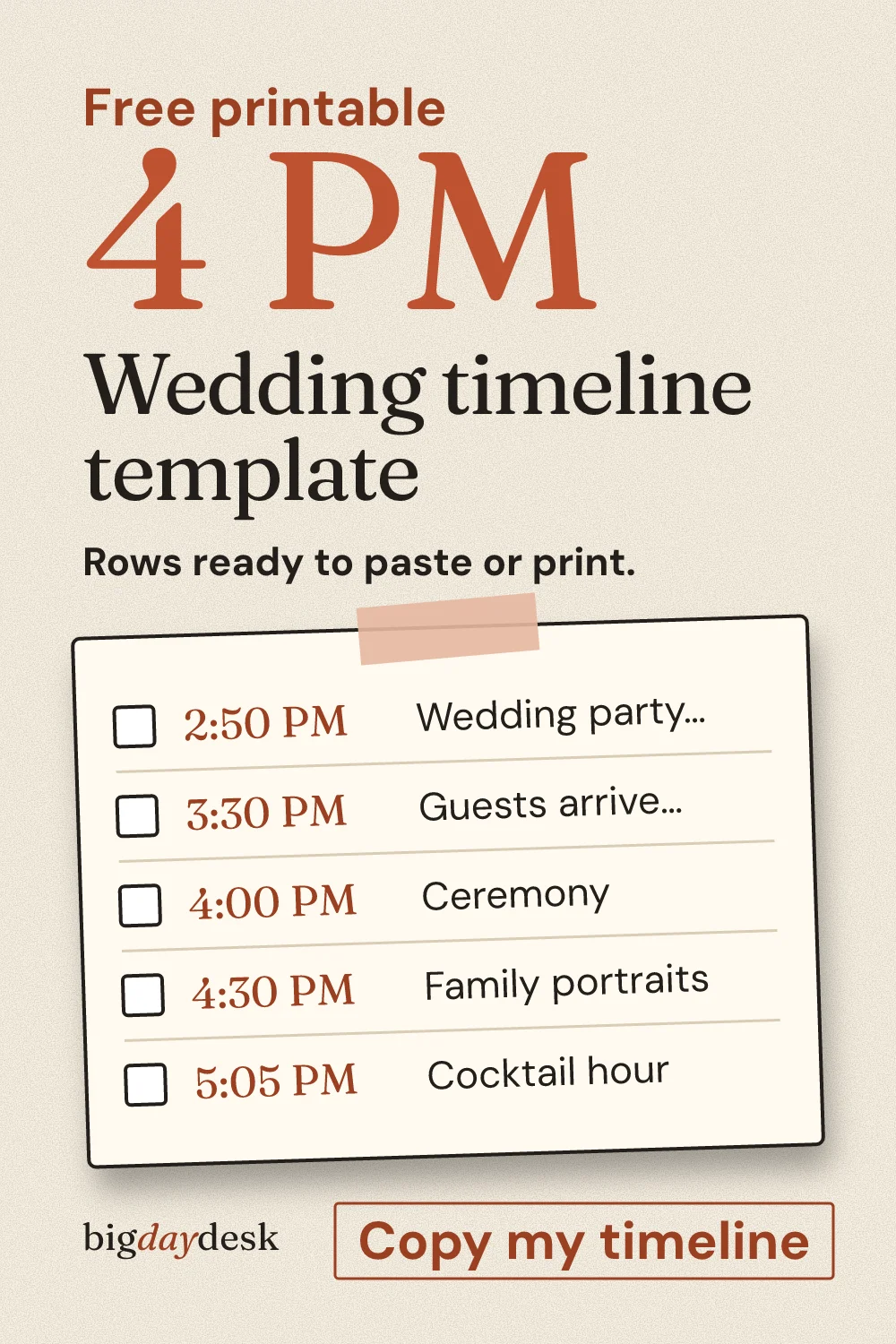
Wedding timeline template you can fill in or paste into a sheet
The only timeline page built for editing offline: a blank print sheet and tab-separated rows you paste into a spreadsheet.
-
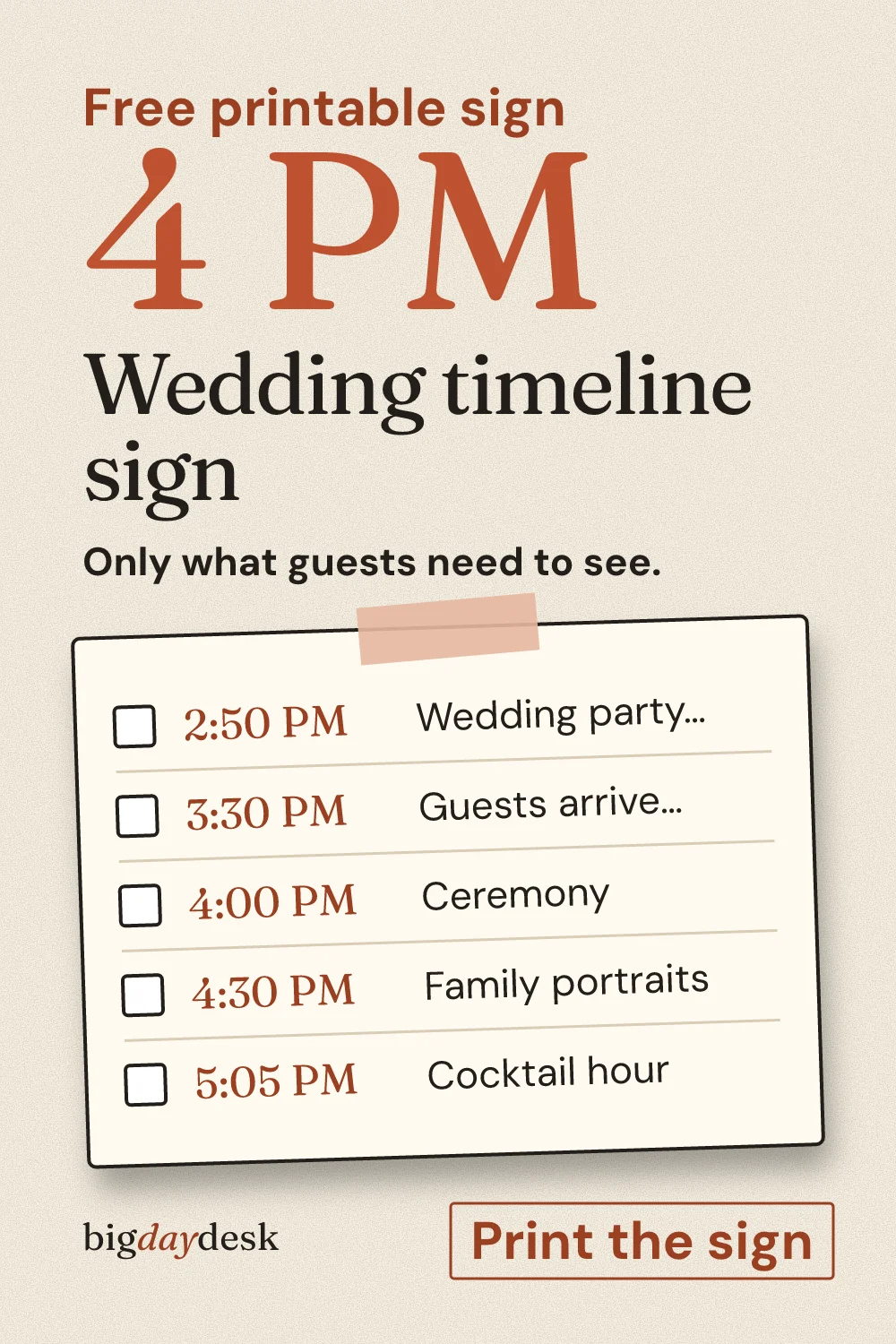
Wedding timeline sign for your guests
Guest-facing view of the timeline: private steps like hair and makeup are removed and the sign is laid out for print.
-
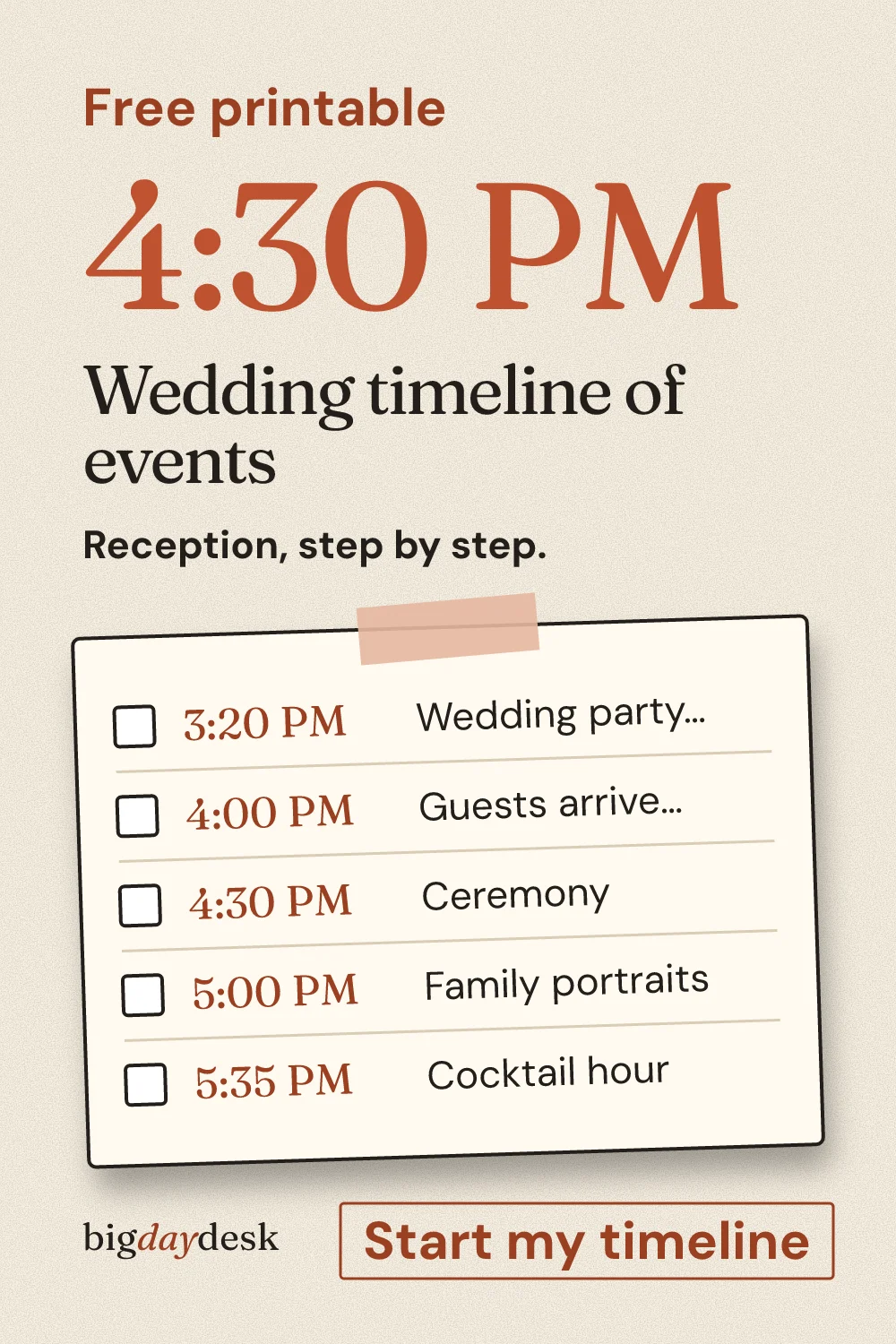
Wedding timeline of events: the reception in order
Reception only: the order of events with a clock time for each, so the DJ and caterer share one sheet.
Keep planning
-
Timeline for 4pm ceremony
The most searched ceremony time: a classic late-afternoon day with an indoor and an outdoor variant and what to cut when running late.
-
Curious about timeline sign?
Guest-facing view of the timeline: private steps like hair and makeup are removed and the sign is laid out for print.
-
Wedding timeline template you can fill in or paste into a sheet
The only timeline page built for editing offline: a blank print sheet and tab-separated rows you paste into a spreadsheet.
-
wedding planning checklist
The master checklist: steps ordered by months out, each with a why and a time estimate, plus a compressed path if you have fewer months.
