Typical-area setting: $20,000 is used as is (our 1.00 assumption).
Edit the split (percent)
Total 100%
How we estimate
- The split is our own planning rule of thumb, not an industry survey. Edit any percentage.
- Guest count picks the starting split: up to 50 guests, 51 to 120, and 121 or more.
- The cushion line is 5% for tips, alterations and late changes.
- Region multipliers are our assumption: lower-cost 0.85, typical 1.00, higher-cost metro 1.20. They are not measured prices.
- The region figure only restates your total in typical-area terms. It does not change the split.
Paused: fix the amount
Wedding budget (estimate)bigdaydesk.com
$20,000 total, 100 guests, typical area (estimate)
Your budget split
About $200 per guest. Food and drink about $68 per guest (our estimate).
Share this result
Send this exact result. The link opens it the same way for them.
Save this result to Pinterest
Pin it now and find it when you are ready to plan.
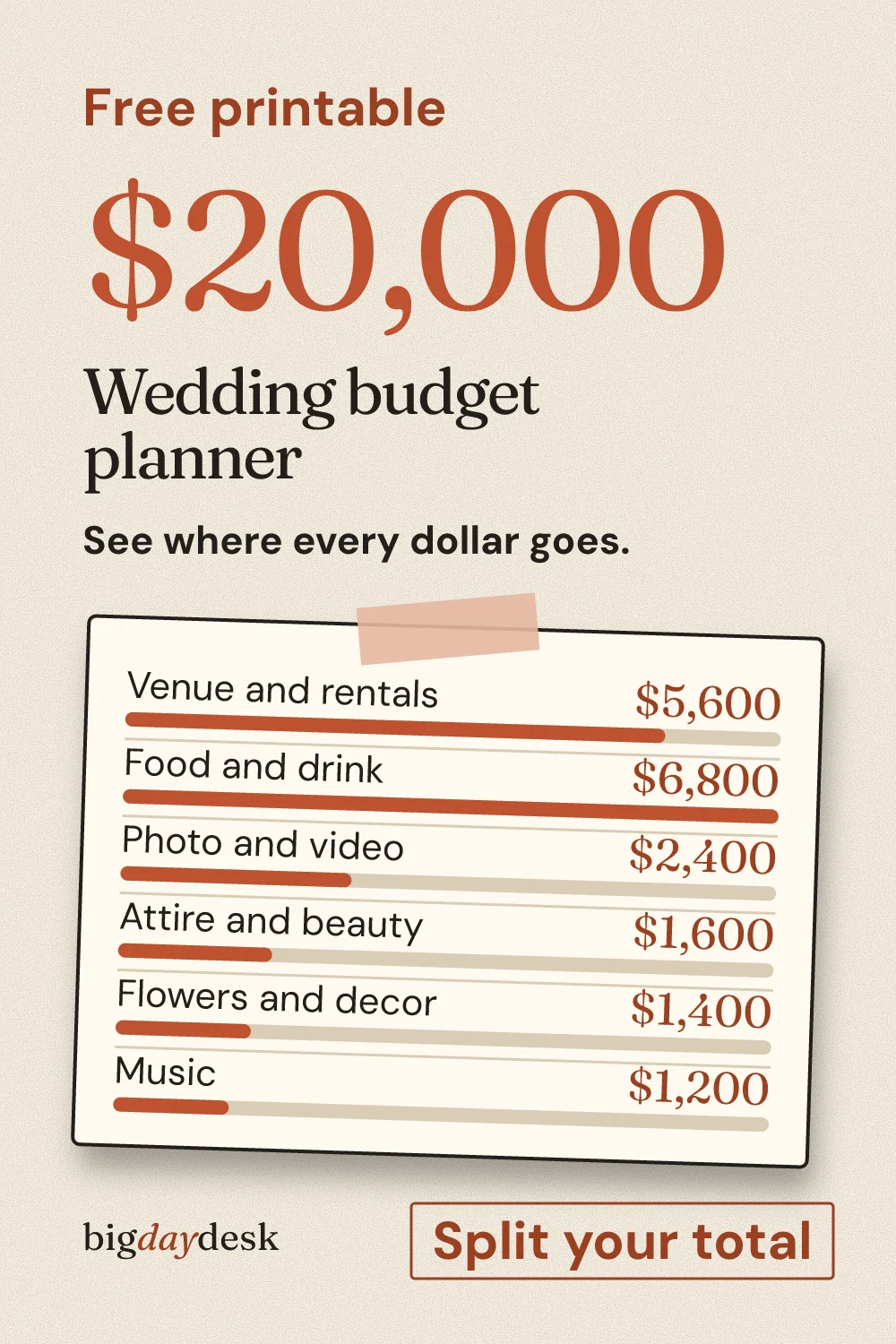
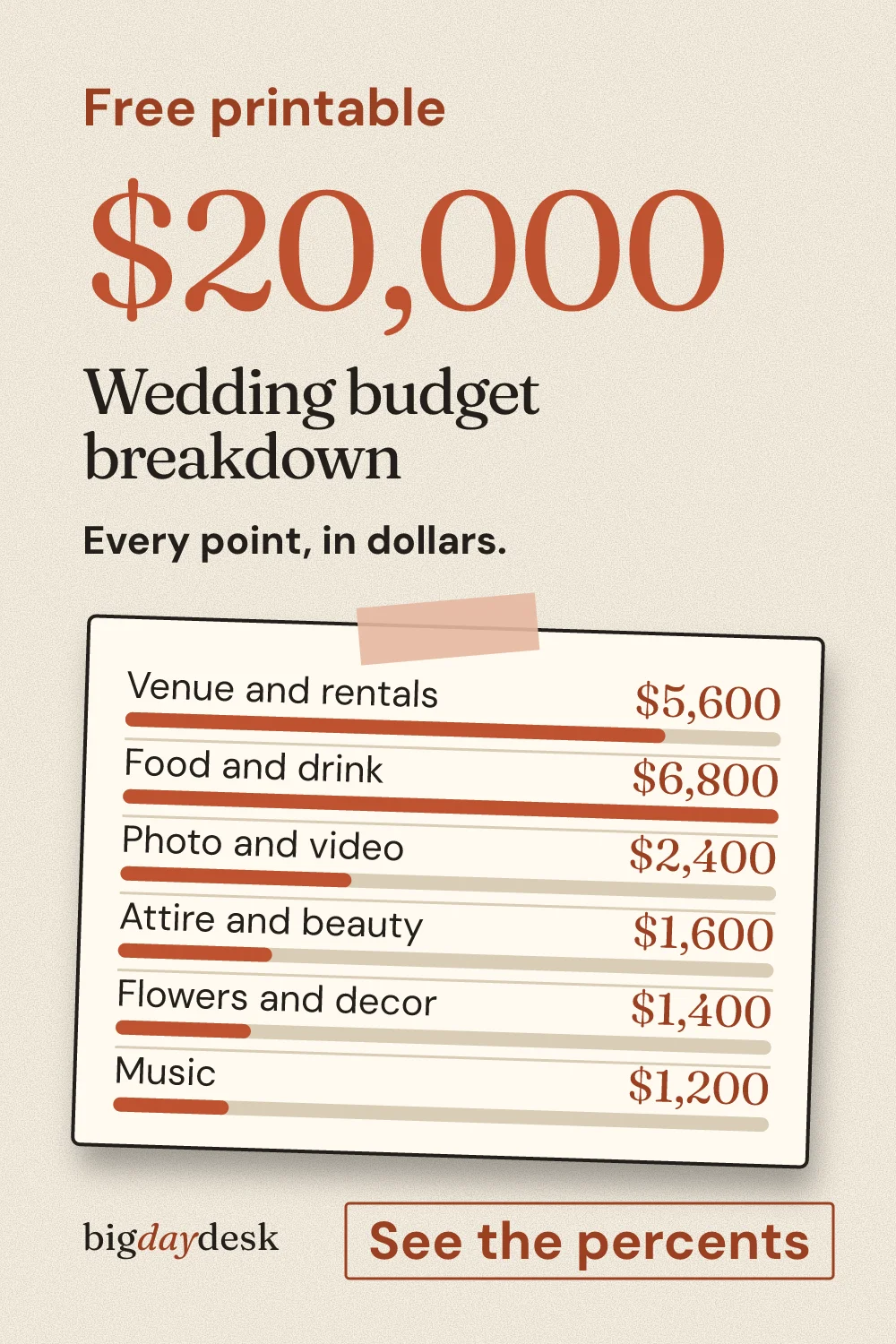
For a $20,000 budget and 100 guests, our estimate puts $5,600 on the venue, $6,800 on food and drink, and $1,000 in a cushion. That is $200 per guest. The sheet above does the same math for your total. Change the total, the guest count or any category, and the amounts follow.
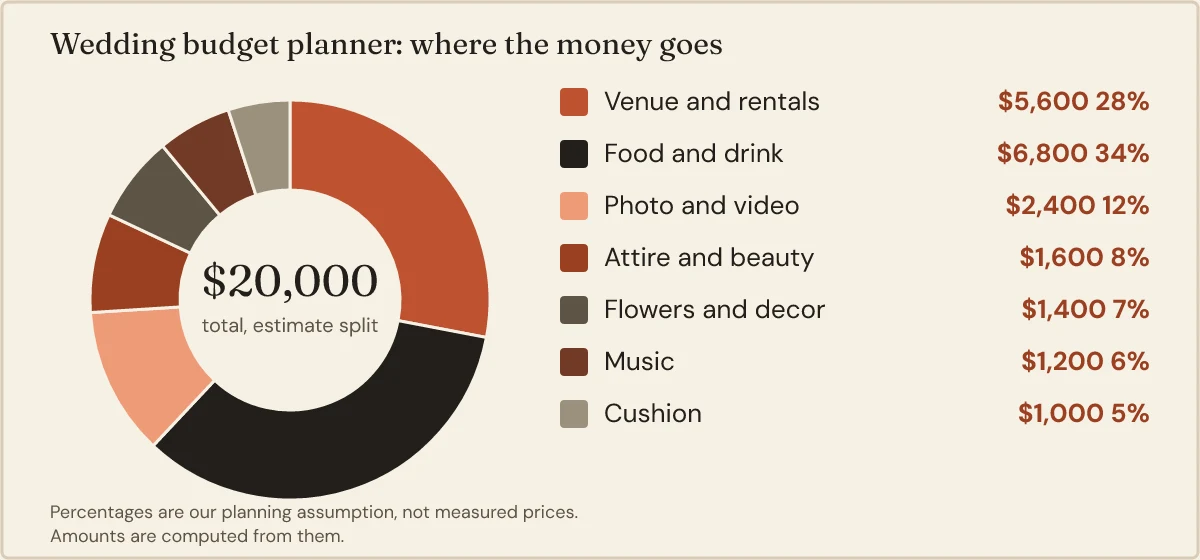
Category table for $20,000 and 100 guests
This is the default result of the tool, written out so you can see every number.
Table: Default split for a $20,000 total and 100 guests, typical-cost area (our estimate, assumptions below)
| Category | Share | Amount |
|---|---|---|
| Venue and rentals | 28% | $5,600 |
| Food and drink | 34% | $6,800 |
| Photo and video | 12% | $2,400 |
| Attire and beauty | 8% | $1,600 |
| Flowers and decor | 7% | $1,400 |
| Music | 6% | $1,200 |
| Cushion | 5% | $1,000 |
Per guest: $200 across everything, and $68 on food and drink alone.
Assumptions: the percentages are our own planning rule of thumb, not a survey. For 51 to 120 guests we move share toward food and drink. Dollar amounts are rounded so the lines add up to your exact total.
The shares are a starting point. You will change them within a week of your first real quote, and that is the point of editing them here.
Steps to build your own split
- Enter the total you can actually spend, including money from family if it is firm.
- Enter your guest count. It picks the starting split.
- Read the venue and food lines first. They are the two that decide the rest.
- Edit any percentage as quotes arrive. Use the fix button to push leftover points into the cushion.
- Print the sheet, or copy the link and send it to your partner.
Same $20,000, three guest counts
Guest count changes the split more than the total does. The tool has three starting splits: up to 50 guests, 51 to 120, and 121 or more.
Table: One $20,000 total at three guest counts (our estimate)
| Guests | Venue and rentals | Food and drink | Food per guest | Cost per guest |
|---|---|---|---|---|
| 40 | $6,000 | $6,000 | $150 | $500 |
| 100 | $5,600 | $6,800 | $68 | $200 |
| 160 | $4,800 | $8,000 | $50 | $125 |
At 40 guests you can afford $150 per guest on food and drink. At 160, the same total gets you $50.
Read the last column before you finalize the list. Adding 60 people to a fixed total does not feel like much until the food line is split 160 ways.
What guest-dependent costs look like against Zola’s range
Zola puts guest-dependent costs, meaning food, drinks, rentals and similar items, at $150 to $300 per guest. Photography and music are not in that figure. It does not explain how the range was built, so treat it as a rough check.
In our default, venue plus food comes to $12,400 for 100 guests. That is $124 per guest, below Zola’s range. Our reading: at $20,000 you either trim the list, pick a lower-cost venue or accept a simpler menu.
At 40 guests the same two lines come to $12,000, or $300 per guest. At 160 guests they come to $12,800, or $80 per guest. Only the 40-guest version sits inside Zola’s range.
How much cushion is enough
Our default cushion is 5%. Published numbers say that may be light.
Zola measured unplanned costs averaging $3,314, about 9% of total spend. It also found that 69% of couples exceeded their initial budget. One planner, writing for Northwestern Mutual, recommends reserving at least 10%.
The cushion pays for the items nobody quotes: tips, alterations, postage, vendor meals and a service charge added to an invoice. Zola lists service charges at 18 to 22% of some vendor costs, so read each contract for them.
Example: moving the cushion from 5% to 10% at $20,000 and 100 guests, taking the 5 points from food and drink.
| Category | Default | With 10% cushion |
|---|---|---|
| Food and drink | 34%, $6,800 | 29%, $5,800 |
| Cushion | 5%, $1,000 | 10%, $2,000 |
Food per guest drops from $68 to $58 in our estimate. Unspent cushion can go to the honeymoon.
If you would rather not touch the menu, take the points from flowers and decor. It is the easiest line to simplify late.
Where a $20,000 total sits against published averages
Averages are context. They are not a target, and they disagree with each other.
Zola reports an average of $36,000 for 2026 weddings. The Knot reports $33,000 for 2024 weddings, from 16,956 US couples. The samples and methods differ, so do not blend them. The Knot also reports an average of 116 guests, close to our 100-guest default.
The Knot puts the venue alone at about $8,000, and about $22,000 when the venue bundle includes catering, alcohol and rentals. Zola says venue, catering and bar often make up 40 to 45% of a budget. In our default those lines add to 62%, because our venue line includes rentals and our food line includes drink. Compare the groups, not single lines.
A $20,000 total is below both averages. It works for plenty of couples, especially with a smaller list or an off-peak date.
Three moves when the numbers do not fit
Each move below is recomputed by the tool so you can see what it buys.
- Cut the list from 100 to 80 guests at the same $20,000: cost per guest rises from $200 to $250, and food and drink rises from $68 to $85 per guest.
- Lift photo and video from 12% to 15%, taking 3 points from food and drink: photo goes from $2,400 to $3,000, food from $6,800 to $6,200.
- Switch to a higher-cost metro setting: our 1.20 assumption says $20,000 stretches about as far as $16,667 would in a typical area.
All three are our estimates. The region setting restates your total. It does not change the split.
Moves one and two are decisions. Move three is a reality check, so run it before you fall in love with a venue.
Mistakes that break a budget
Starting from the average instead of your cash. The Knot found that nearly half of couples said their starting budget fell short of real costs. Start from what you can pay and build the split from there.
Spending the cushion on day one. The cushion is a line, so it is easy to rename and spend. Keep it as a visible 5 to 10% on the printed sheet. Someone will need it by the last month.
Leaving the guest count loose. A budget with a range of guests is two budgets. Choose a number, plan on it, and change it only on purpose. Your guest list template helps you pin it down.
Ignoring quote add-ons. A quote is not a final price. Ask each vendor about service charges, tax, travel and overtime, and write the answer next to the line it affects.
Print it, share it, send it to whoever is paying
Print the sheet and tape it above your desk, or save it as a PDF. Fill the amounts you have paid by hand as the months go by.
The share link carries your total, guest count, region and any edited split. Your partner opens the same numbers, changes one line and sends it back. Nothing is stored on a server. The link holds what you typed and nothing else.
Pick the share wording that fits who receives it: your partner, your maid of honor or a planner. The text is ready to edit.
Where to go next
Starting from a round number? See the split for a $10,000 wedding or a $25,000 version. If your list is the variable, compare the 50 guest budget with the 200 guest budget.
Want every category as a percentage with the reasoning? Read the full category breakdown. For ways to cut without losing the day, try where savings really are.
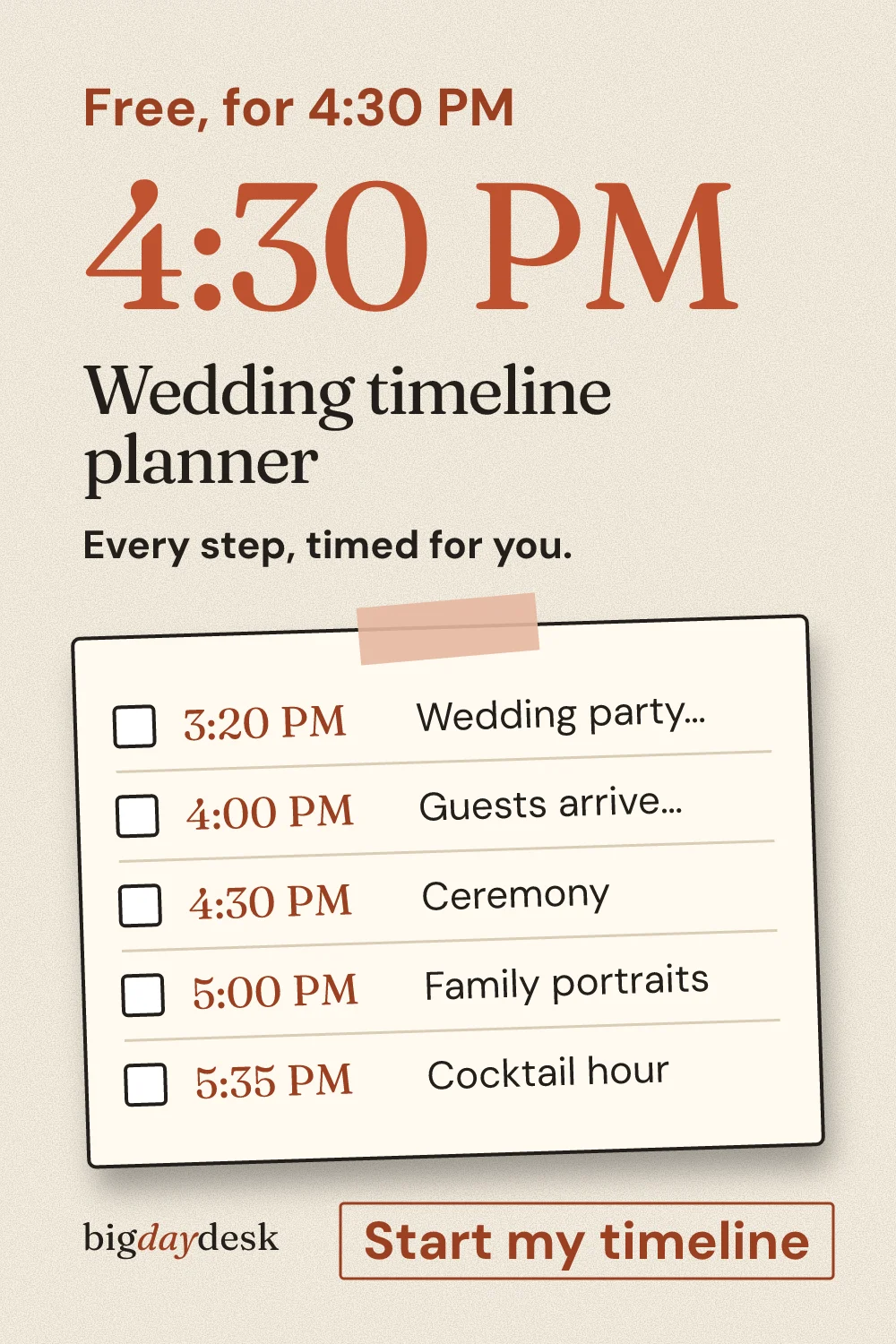
Once the money is set, schedule the day with the wedding timeline planner.
Questions people ask
What should be included in a wedding budget?
Start with the big blocks: venue and rentals, food and drink, photo and video, attire and beauty, flowers and decor, and music. Then add a cushion line for tips, alterations, postage and fees nobody quoted. This planner uses exactly those seven lines. Add stationery, a planner or a rehearsal dinner by moving percentage points into the closest category.
How to budget wedding expenses
Fix two numbers first: the total you can spend and the guest count. Split the total by percentage, then check each line against real quotes. When a quote lands higher, take points from a flexible line like flowers, not from the cushion. Keep one sheet, and send the same link to everyone paying or helping.
How much should I set aside as a cushion?
Our default is 5%, which is a starting point, not a rule. Zola measured unplanned costs near 9% of total spend, and one planner recommends at least 10%. If you want to be safe, move your cushion to 10% and take the points from food or decor. Unused cushion can go to the honeymoon.
What is a realistic wedding budget?
It is the number you can pay without debt, matched to your guest count. Published averages differ: Zola reports $36,000 and The Knot reports $33,000, using different samples. Many couples spend far less. Use averages as context only. Your guest count, date and area move the real cost more than any national figure.
Can I change the percentages in the planner?
Yes. Edit any category and the dollar amounts update. The percentages must add up to 100, and the sheet tells you when they do not. One tap moves the difference into the cushion. The edited split is saved in the link you share, so your partner opens your version, not the default.
Sources
- www.zola.com/expert-advice/what-weddings-really-cost (opens in a new tab) : Zola average cost $36,000 (2026 report); hidden costs averaging $3,314, about 9% of spend; 69% of couples exceeded their initial budget; venue, catering and bar often 40-45% of budget; $150-$300 per guest for guest-dependent costs; service charges 18-22% of vendor costs.
- www.theknotww.com/press-releases/weddings-shine-bright-in-2025-the-knot-study-reveals-couples-prioritize-celebration-joy-and-connection-amid-socioeconomic-instability (opens in a new tab) : The Knot 2025 Real Weddings Study: $33,000 average for 2024 weddings, 16,956 US couples; average 116 guests; venue about $8,000 alone, about $22,000 bundled with catering, alcohol and rentals; nearly half found their starting budget fell short.
- northwesternmutual.com/life-and-money/how-to-create-a-wedding-budget-for-every-important-cost (opens in a new tab) : One planner recommends reserving at least 10% of the budget for forgotten costs and emergencies.
Updated by bigdaydesk editorial
Budgets by total
-
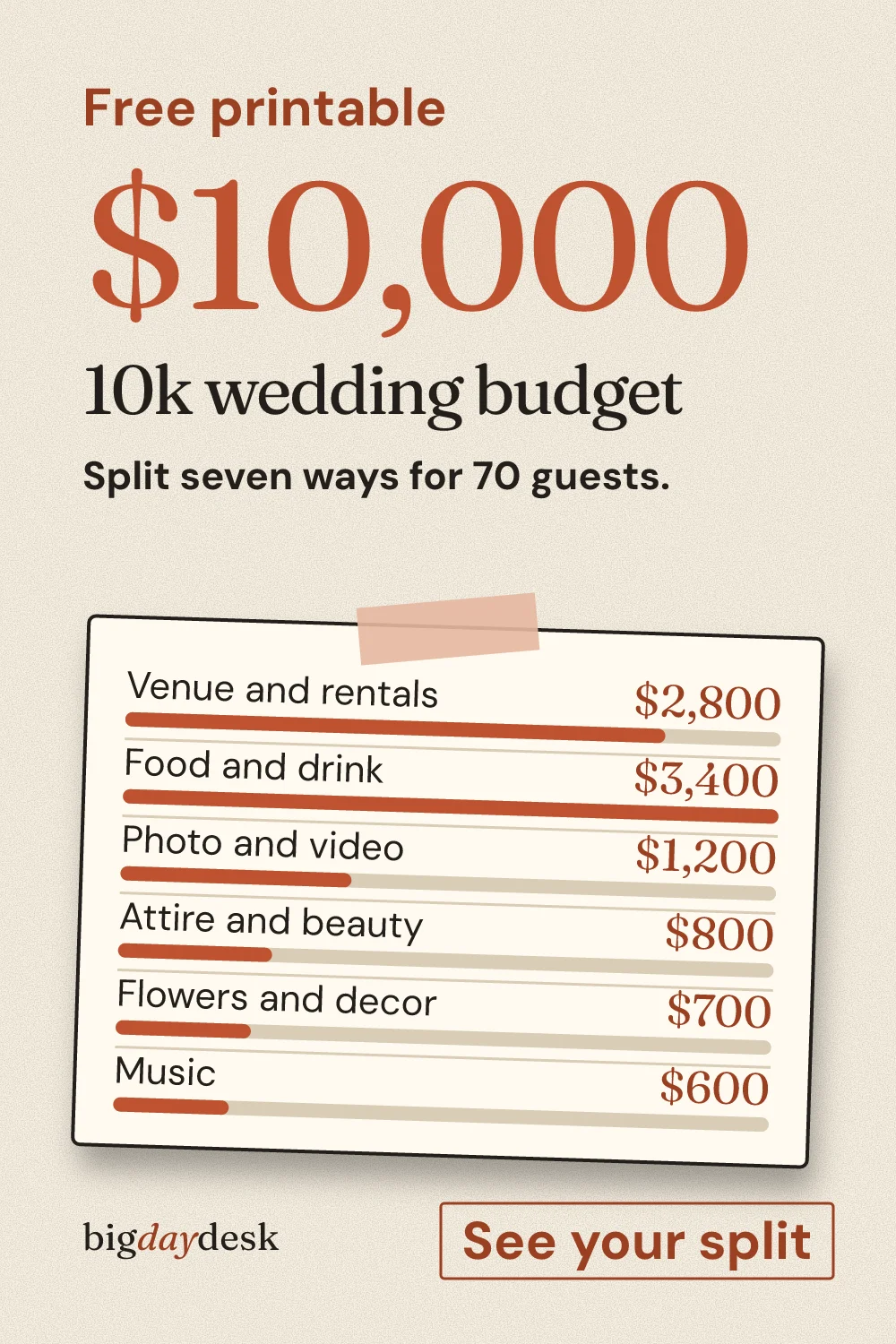
10k wedding budget, split by category
Mid-small total: how a $10,000 budget moves when guests go from 70 to 50, and where the cushion sits.
-
Wedding budget breakdown: every category as a percentage
Percent-first view of the same split: drag points between categories and the dollar amounts and per-guest cost follow.
-
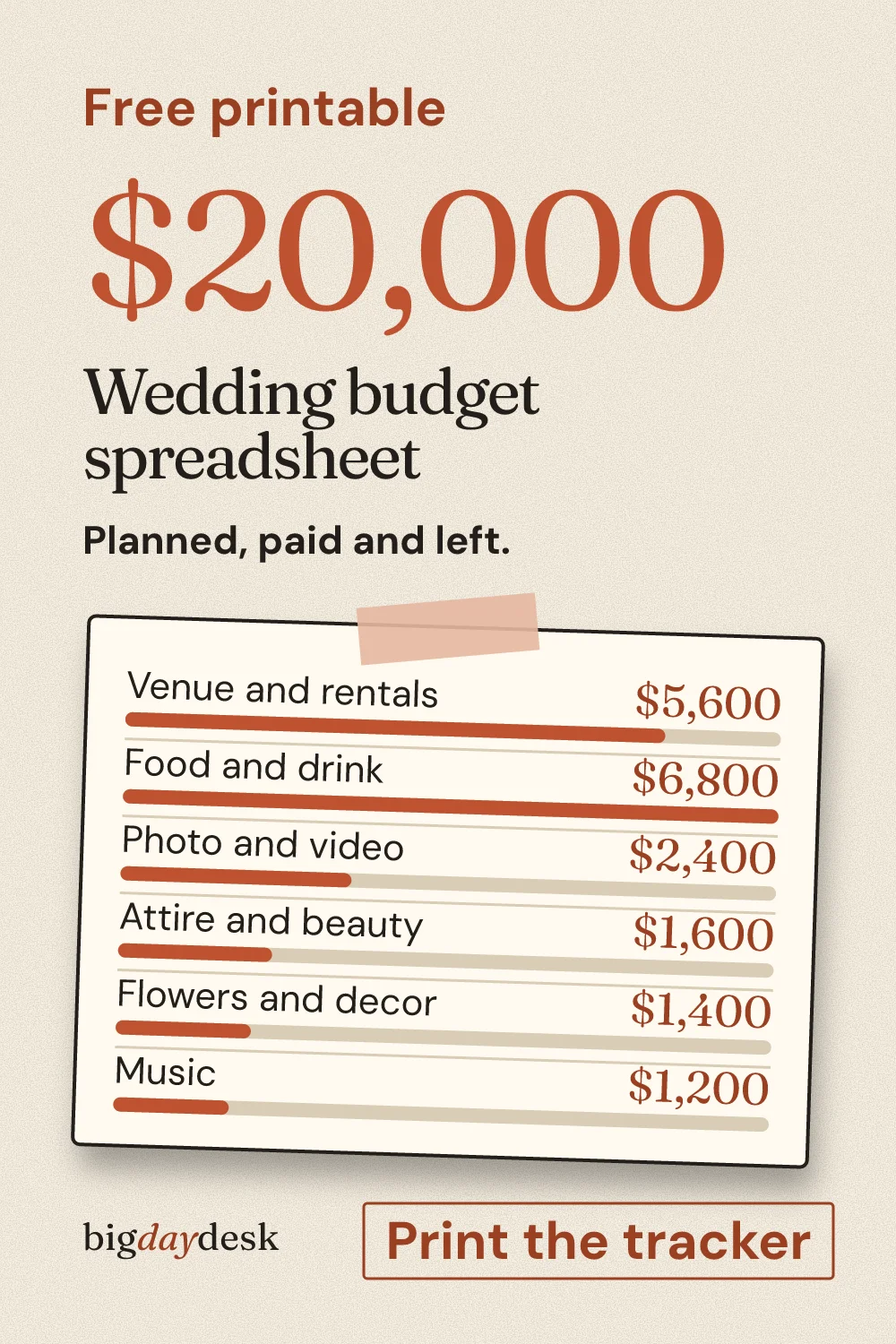
Wedding budget spreadsheet: planned, paid and left
Adds planned, actual and paid columns to the split and exports as tab-separated rows for Sheets or Excel.
-
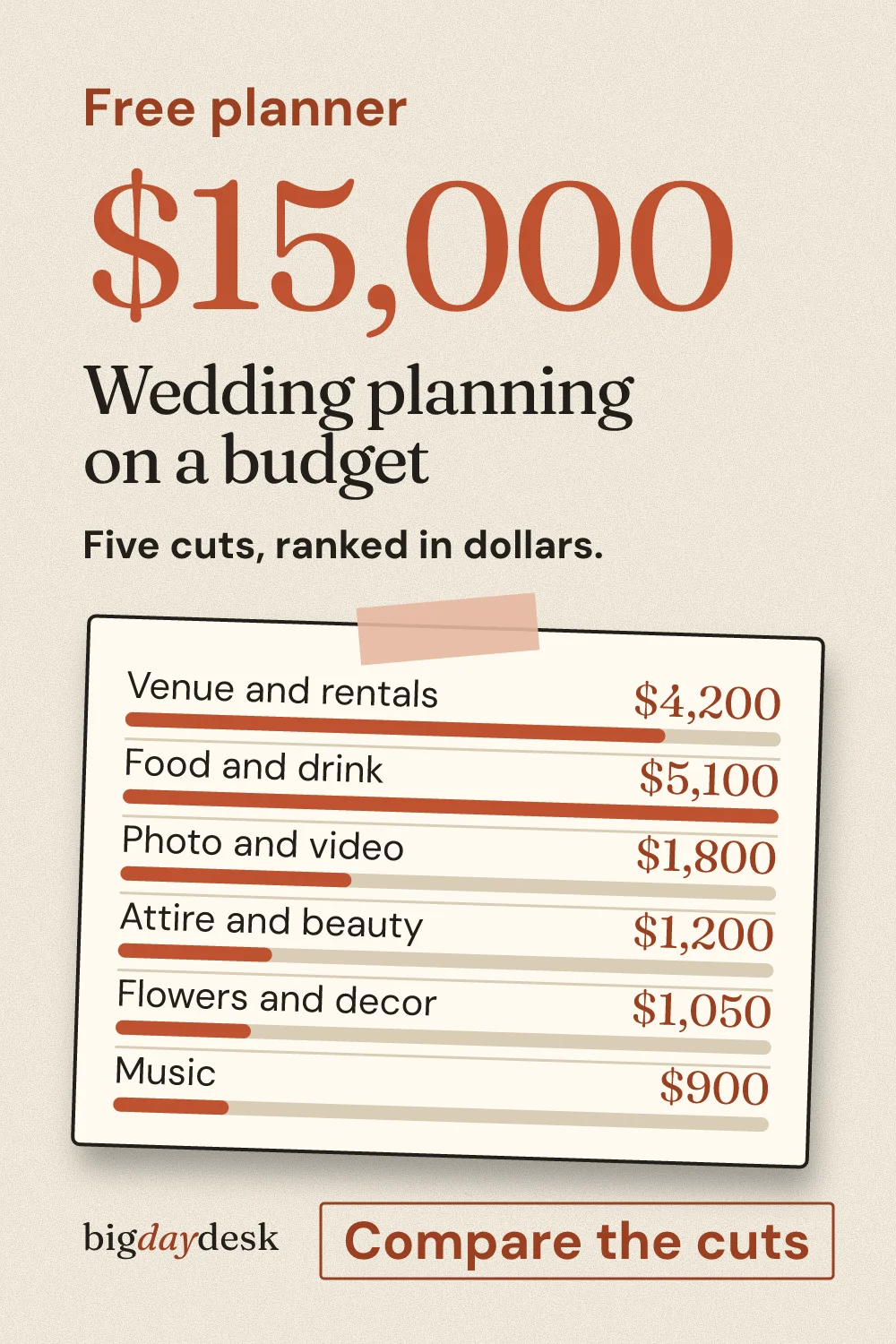
Wedding planning on a budget: where the savings really are
Ranks five common cuts (guests, hours, season, day, venue type) by dollars saved at the same total, using our own percentages.
-
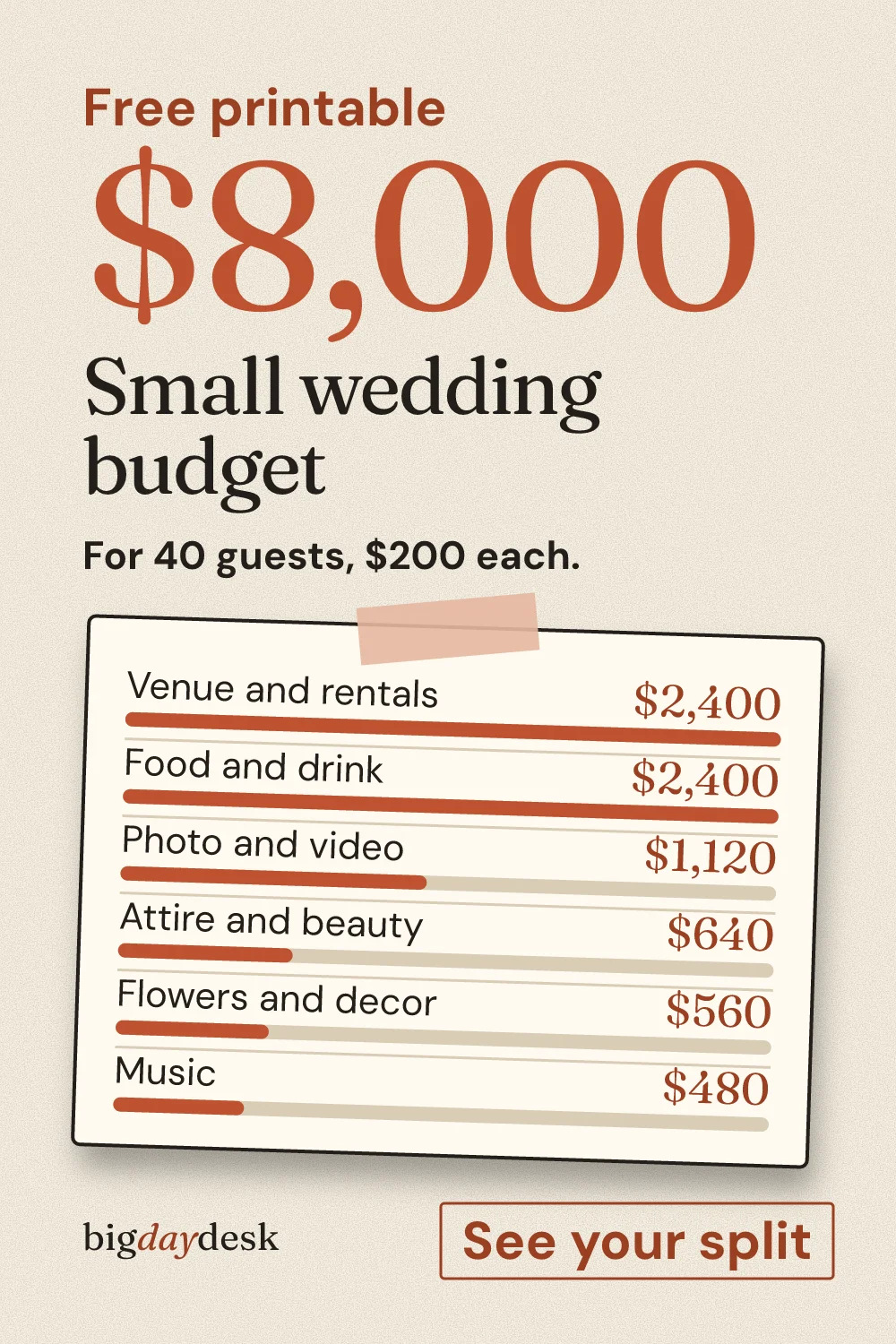
Small wedding budget: split for 40 guests
Uses the small-guest-list split of the tool and marks the fixed costs that do not shrink with 40 guests.
Keep planning
-
10k wedding budget
Mid-small total: how a $10,000 budget moves when guests go from 70 to 50, and where the cushion sits.
-
Percent-first view of the same split
Percent-first view of the same split: drag points between categories and the dollar amounts and per-guest cost follow.
-
Wedding on a budget
Ranks five common cuts (guests, hours, season, day, venue type) by dollars saved at the same total, using our own percentages.
-
Wedding timeline
One ceremony time drives every step, timed backward and forward, with guest count and scenario switches and a one-page printout.