Typical-area setting: $10,000 is used as is (our 1.00 assumption).
Edit the split (percent)
Total 100%
How we estimate
- The split is our own planning rule of thumb, not an industry survey. Edit any percentage.
- Guest count picks the starting split: up to 50 guests, 51 to 120, and 121 or more.
- The cushion line is 5% for tips, alterations and late changes.
- Region multipliers are our assumption: lower-cost 0.85, typical 1.00, higher-cost metro 1.20. They are not measured prices.
- The region figure only restates your total in typical-area terms. It does not change the split.
Paused: fix the amount
Wedding budget (estimate)bigdaydesk.com
$10,000 total, 70 guests, typical area (estimate)
Your budget split
About $143 per guest. Food and drink about $49 per guest (our estimate).
Share this result
Send this exact result. The link opens it the same way for them.
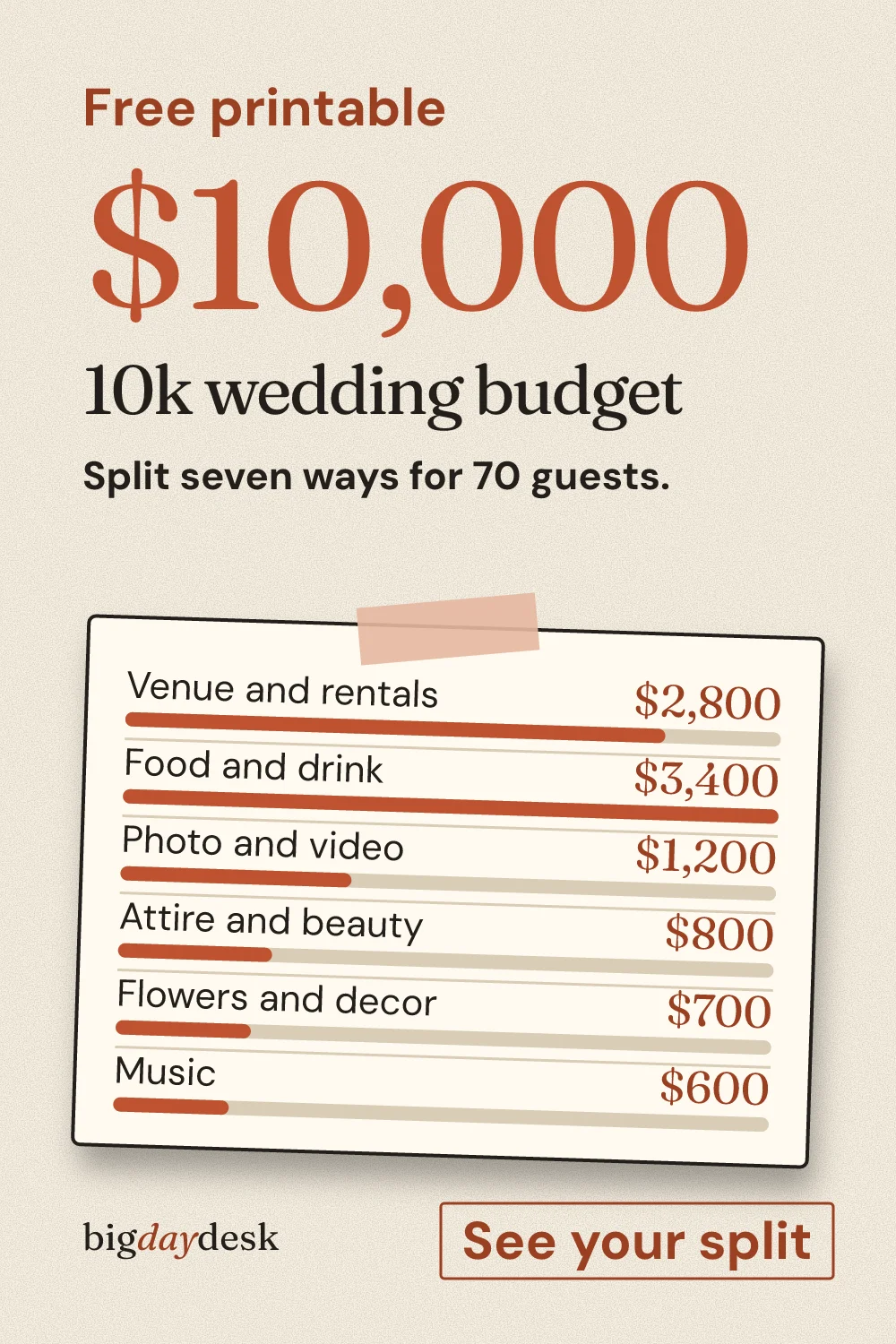
Save this result to Pinterest
Pin it now and find it when you are ready to plan.
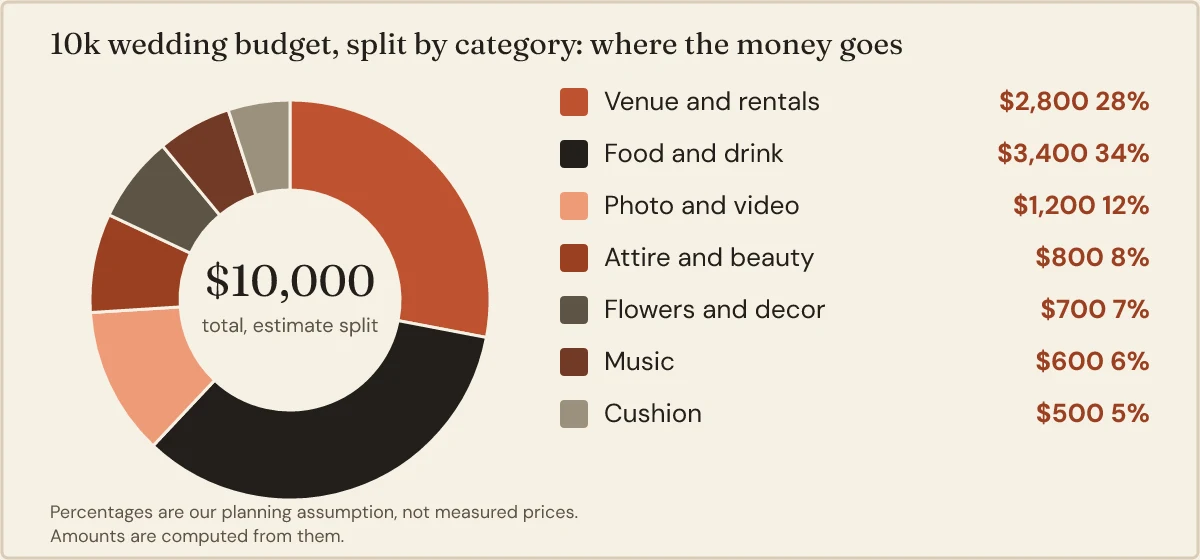
A $10,000 wedding works best with about 50 to 70 guests, one low-cost venue and a protected cushion. This page splits the full $10,000 across seven categories for 70 guests. It then shows what changes at 50 and at 100 guests. All splits are our estimates, not quotes from vendors.
Change the guest count in the planner above and every line recomputes. Print it, or send the link to whoever is chipping in.
Budget table for 70 guests, with a guest-count comparison
Table: $10,000 wedding budget split for 70 guests (our estimate, assumptions below)
| Category | Share | Amount |
|---|---|---|
| Venue and rentals | 28% | $2,800 |
| Food and drink | 34% | $3,400 |
| Photo and video | 12% | $1,200 |
| Attire and beauty | 8% | $800 |
| Flowers and decor | 7% | $700 |
| Music | 6% | $600 |
| Cushion | 5% | $500 |
| Total | 100% | $10,000 |
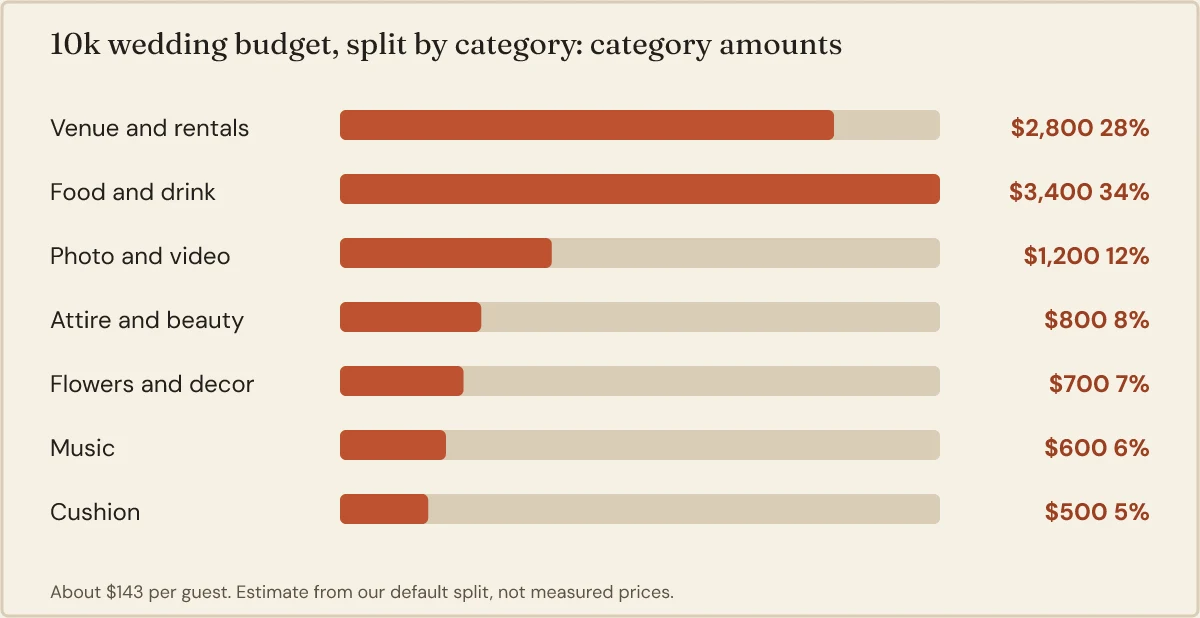
That is about $143 per guest overall and about $49 per guest for food and drink.
The percentages are our own rule of thumb. They are an example split, not a survey result. We assume a guest count of 51 to 120 gets the same share for each line, and a list of 50 or fewer shifts a little from food to venue and photo.
Edit any share in the tool if your priorities differ. Photo might matter more to you than flowers.
What $10,000 buys at 50, 70 and 100 guests
Guest count is the lever you control first. It changes the food line, the rentals and often the venue size.
Table: the same $10,000 at different guest counts (our estimate, assumptions below)
| Guests | Per guest, all-in | Food and drink total | Food and drink per guest | Venue and rentals |
|---|---|---|---|---|
| 50 | $200 | $3,000 | $60 | $3,000 |
| 60 | $167 | $3,400 | $57 | $2,800 |
| 70 | $143 | $3,400 | $49 | $2,800 |
| 80 | $125 | $3,400 | $43 | $2,800 |
| 100 | $100 | $3,400 | $34 | $2,800 |
| 120 | $83 | $3,400 | $28 | $2,800 |
Read the food column across. At 50 guests you have $60 each. At 100 you have $34 each. The second figure covers a simple buffet or a casual spread, not a plated dinner.
The 50-guest row uses a different split: 30% venue, 30% food, 14% photo. That is our assumption for small lists, where fixed costs like photography take a bigger share.
Why $10,000 is tight, and where it breaks
Real averages are far higher than your total. Zola reports an average of $36,000 for 2026, and The Knot reports $33,000 for weddings held in 2024. Zola also says some couples spend $10,000 or less. You are in a smaller group, so your choices matter more.
Two sourced numbers explain the pressure. The Knot reports about $8,000 for a venue alone. Your venue and rentals line is $2,800. You need a park, a home, a community hall or a venue that includes rentals at a low rate.
Zola also puts guest-dependent costs at $150 to $300 per guest. On our split, venue and food together get $6,200. At $150 per guest that covers about 41 guests, by our math. That is the honest ceiling for a conventional setup at this budget.
If your list is larger, plan on a shorter menu, a daytime event or a buffet. The 70-guest table above still works, but it asks for those choices.
Three trims, recomputed
Each scenario below changes one thing and recomputes the amounts. We assume savings go to the cushion unless you spend them somewhere else.
Table: savings scenarios on the $10,000, 70-guest budget (our estimate, assumptions below)
| Scenario | What changes | Saved | Food per guest | Cushion |
|---|---|---|---|---|
| Base | Nothing | $0 | $49 | $500 |
| Smaller list | 50 guests, same $10,000 | $0 | $60 | $500 |
| Trim fixed costs | Venue 10% lower, flowers 40% lower, music 50% lower | $860 | $49 | $1,360 |
| Trim the menu | Food and drink 15% lower | $510 | $41 | $1,010 |
| Both trims | Fixed costs and menu together | $1,370 | $41 | $1,870 |
The venue trim is $280 off $2,800. The flower trim is $280 off $700, which means a simple bouquet and a few table pieces. The music trim is $300 off $600, which means a playlist and a hired speaker rather than a full DJ.
The menu trim takes $510 off $3,400. It leaves about $41 per guest. That works for a buffet or for appetizers and cake instead of a full dinner.
Where the cushion goes
The default cushion is $500, or 5%. That is thin. Zola found hidden costs averaged $3,314, about 9% of spend, and 69% of couples went over their budget. One planner recommends at least 10%.
At $10,000, 9% is $900 and 10% is $1,000. The trims above are the easiest way to get there. Both trims together lift the cushion to $1,870.
Service charges are a common surprise. Zola says they often run 18% to 22% of vendor costs. On a $3,400 catering bill that is $612 to $748, our math on their range. Ask every vendor whether the quote includes it. Put the answer in writing before you pay a deposit.
Three mistakes at this budget
Booking the venue first and the food second. Your venue line is small. Check what the site charges for rentals and whether you can bring your own food. A venue that looks cheap and requires its own caterer can eat both lines.
Treating the cushion as spare money. It is for alterations, tips, postage and a late rental. If you spend it early, the first surprise lands on a credit card. Move it to the end of your plan and protect it.
Adding guests without adding dollars. One extra table of eight at $49 each is about $390 in food alone, before rentals and a bigger room. Add guests only when you have also named the line you will trim.
Next steps
- Set your real guest count in the planner and check the per-guest food figure.
- Pick one trim from the table and decide which line it comes from.
- Call two venues and ask for the all-in price with rentals and service charges.
- Move the saved amount into the cushion line and print the sheet.
- Send the link to the person who is helping pay, so you both start from the same numbers.
If your total is lower, the $5,000 version shows what a smaller budget leaves you. If you want to fix the headcount first, try the 50-guest split. Open the full budget planner for any other amount.
Outdoor sites cut the venue line fastest, and a backyard setup shows what that does to the rest. For a guest list under 30, see the micro wedding numbers. More ideas for lowering every line are in planning on a tight budget.
Once the money is set, the day needs a schedule. A 5 PM ceremony timeline is a good next sheet to print.
Questions people ask
How many guests can you invite on a $10k budget?
On our split, venue and food together get $6,200. Zola puts guest-dependent costs at $150 to $300 per guest, so the low end covers about 40 guests. Past that, you need a free or cheap site, a buffet or a short menu. The table above shows the per-guest math at 50 to 120.
What is the biggest cost on a $10,000 wedding?
Food and drink, at 34% or $3,400 in our default split for 70 guests. It is also the line that moves most when the guest list changes, because it is paid per head. Venue is second at $2,800. Together they take 62% of the budget.
What is a realistic wedding budget?
It depends on guests and place. Zola reports a $36,000 average for 2026 and The Knot reports $33,000 for 2024 weddings, so $10,000 is well under both. It is realistic for about 50 guests with a low-cost venue, careful choices and a cushion you actually protect.
How much cushion should I keep?
Our default is 5%, $500. Zola found hidden costs averaged $3,314, about 9% of spend, and one planner suggests at least 10%. On $10,000 that means $900 to $1,000. If you can, trim a line or two and move the savings into the cushion.
Does a smaller guest list always save money on a $10k wedding?
It lowers food and rental costs, but our estimate keeps the total at $10,000 and gives each guest more. At 50 guests food and drink is about $60 per guest instead of $49 at 70. You can spend that on a better menu or save it.
Sources
- www.zola.com/expert-advice/what-weddings-really-cost (opens in a new tab) : Zola 2026 average wedding cost of $36,000 with some couples at $10,000 or less; average hidden costs of $3,314, about 9% of spend; service charges often 18 to 22% of vendor costs; $150 to $300 per guest for guest-dependent costs; 69% of couples exceeded their budget.
- www.theknotww.com/press-releases/weddings-shine-bright-in-2025-the-knot-study-reveals-couples-prioritize-celebration-joy-and-connection-amid-socioeconomic-instability (opens in a new tab) : The Knot 2025 Real Weddings Study: $33,000 average cost for 2024 weddings (16,956 US couples), about $8,000 for the venue alone, 116 average guests.
- northwesternmutual.com/life-and-money/how-to-create-a-wedding-budget-for-every-important-cost (opens in a new tab) : One wedding planner recommends reserving at least 10% of the budget for forgotten costs and emergencies.
Updated by bigdaydesk editorial
Keep planning
-
Curious about small wedding budget?
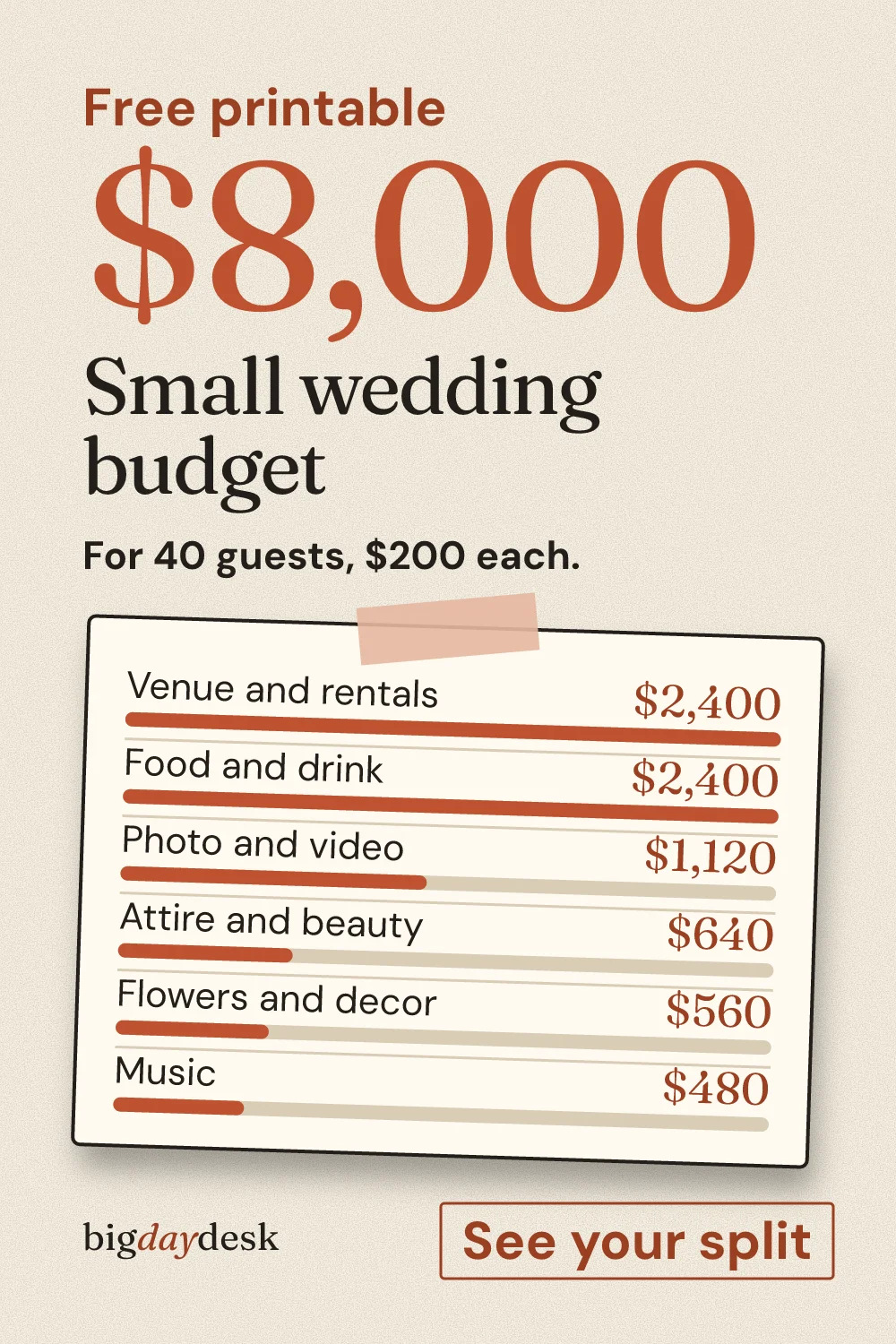
Uses the small-guest-list split of the tool and marks the fixed costs that do not shrink with 40 guests.
-
wedding planning on a budget
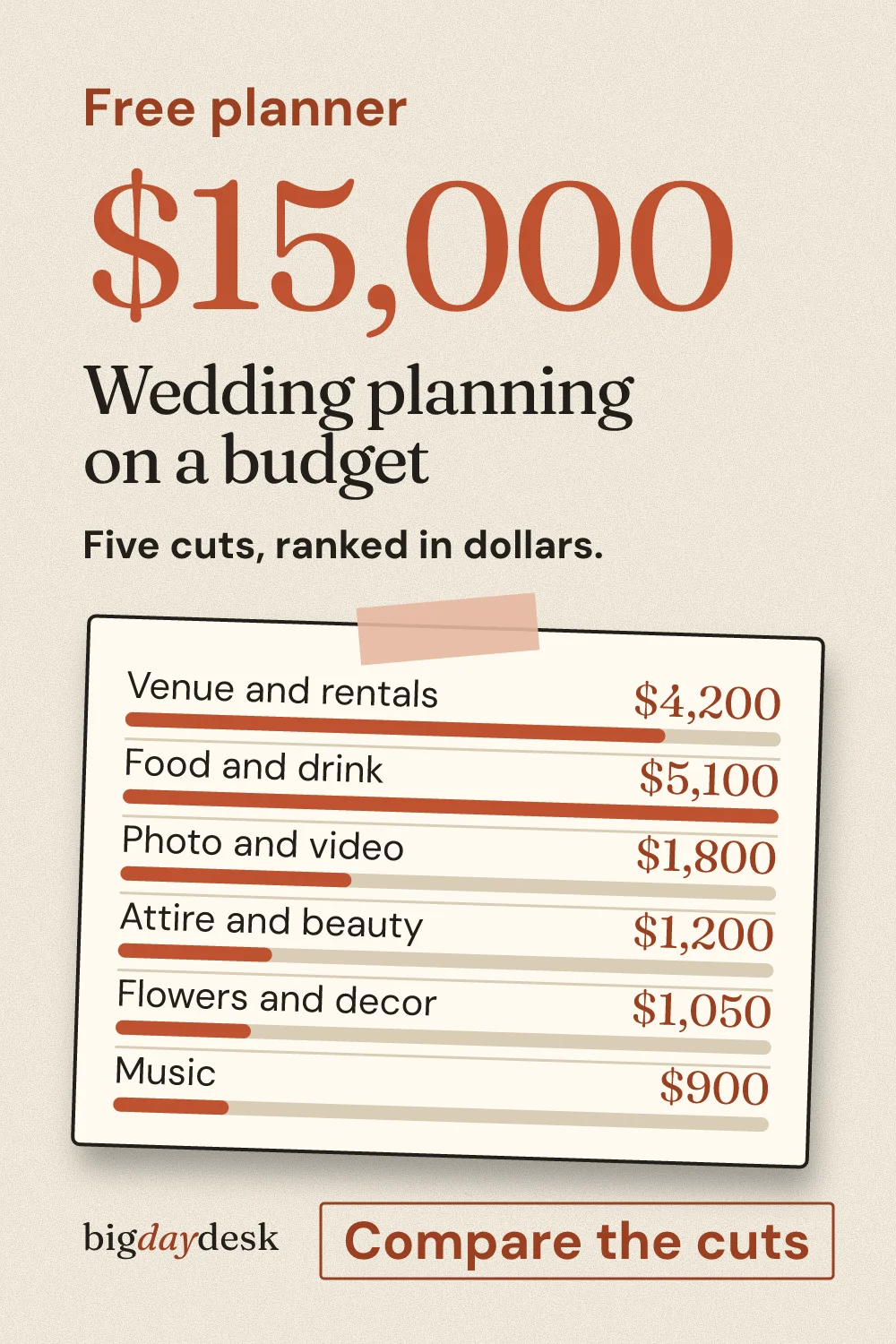
Ranks five common cuts (guests, hours, season, day, venue type) by dollars saved at the same total, using our own percentages.
-
Percent-first view of the same split
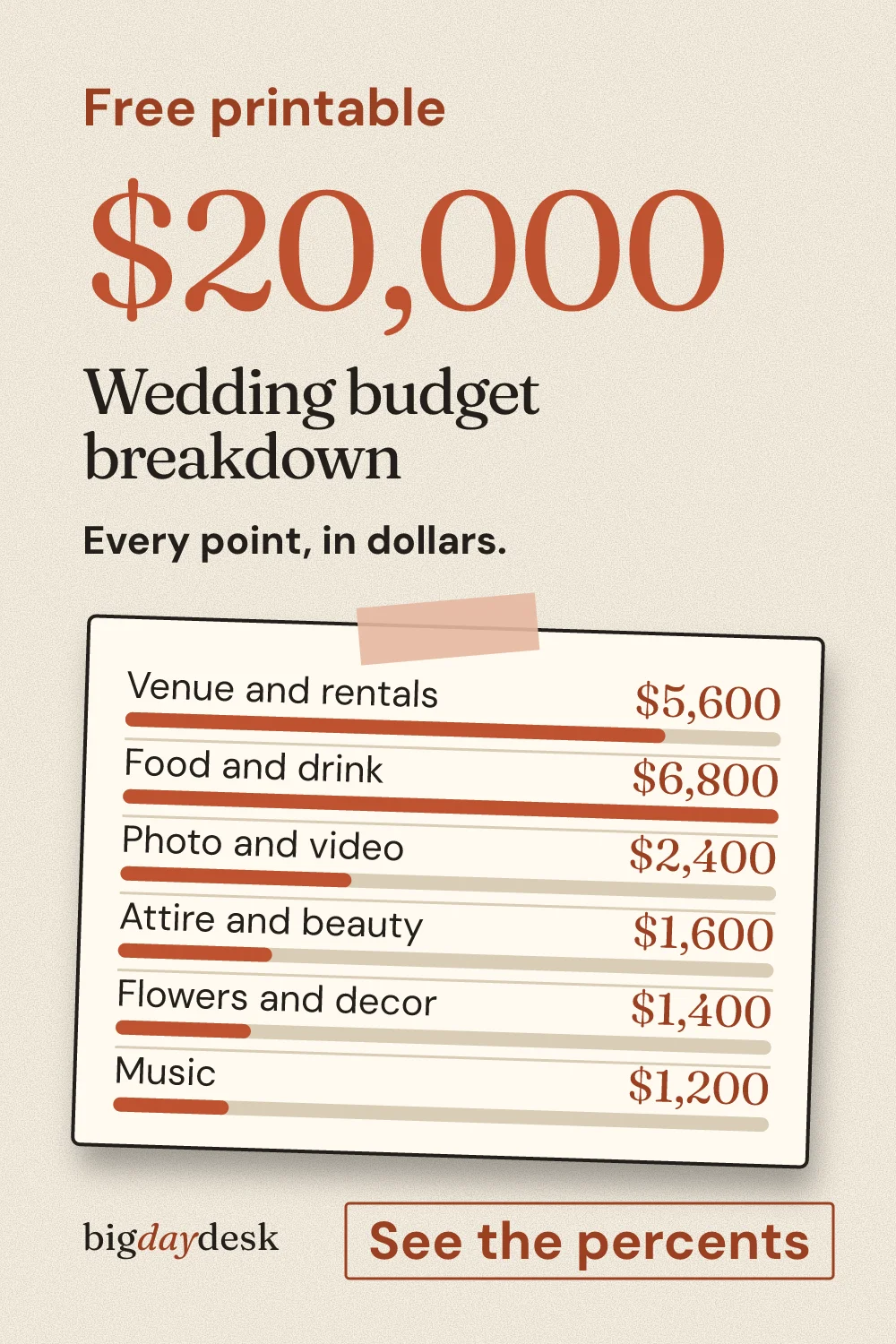
Percent-first view of the same split: drag points between categories and the dollar amounts and per-guest cost follow.
-
Plan the day around timeline for 4pm ceremony
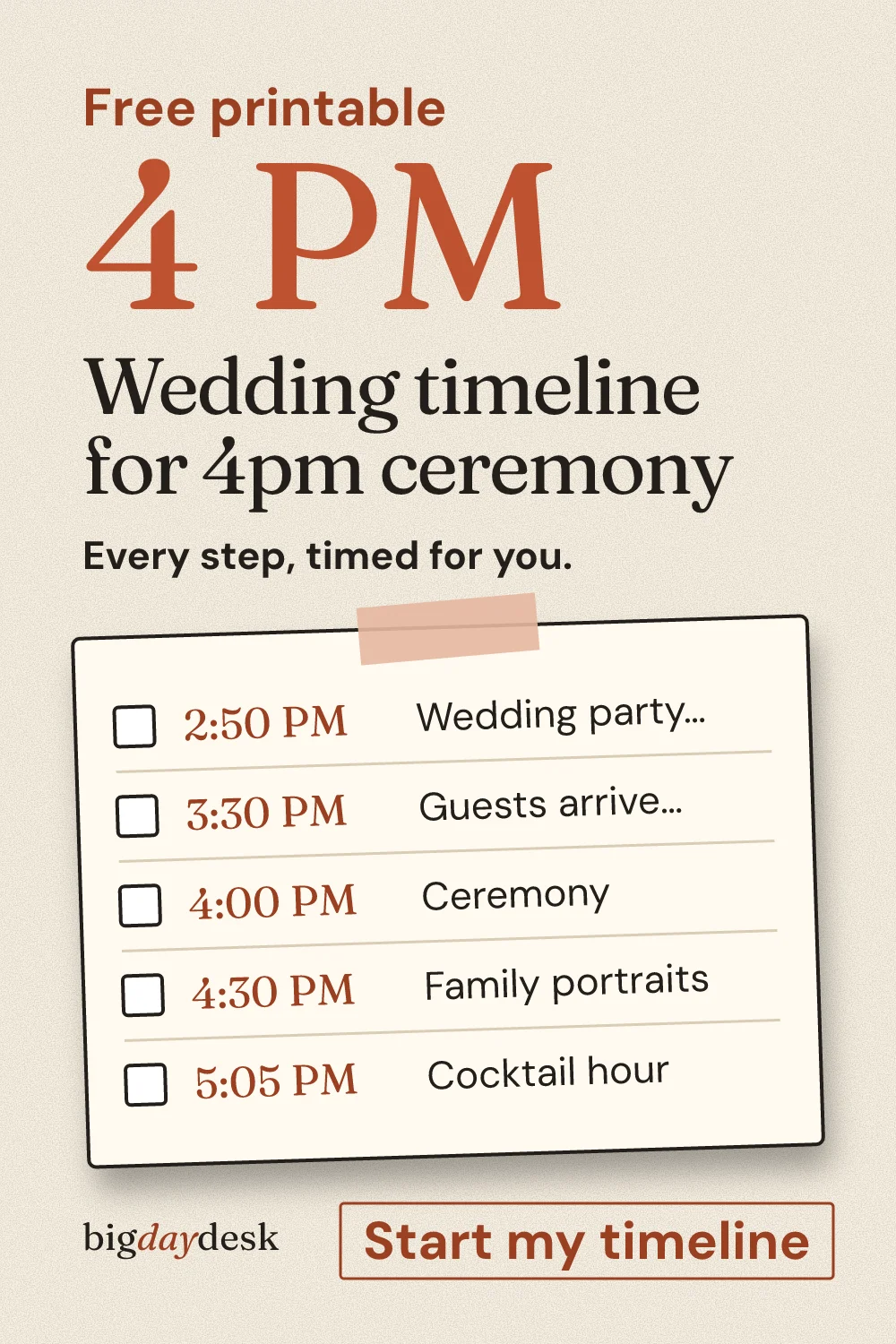
The most searched ceremony time: a classic late-afternoon day with an indoor and an outdoor variant and what to cut when running late.