Typical-area setting: $20,000 is used as is (our 1.00 assumption).
Edit the split (percent)
Total 100%
How we estimate
- The split is our own planning rule of thumb, not an industry survey. Edit any percentage.
- Guest count picks the starting split: up to 50 guests, 51 to 120, and 121 or more.
- The cushion line is 5% for tips, alterations and late changes.
- Region multipliers are our assumption: lower-cost 0.85, typical 1.00, higher-cost metro 1.20. They are not measured prices.
- The region figure only restates your total in typical-area terms. It does not change the split.
Paused: fix the amount
Wedding budget (estimate)bigdaydesk.com
$20,000 total, 100 guests, typical area (estimate)
Your budget split
About $200 per guest. Food and drink about $68 per guest (our estimate).
Share this result
Send this exact result. The link opens it the same way for them.
Save this result to Pinterest
Pin it now and find it when you are ready to plan.
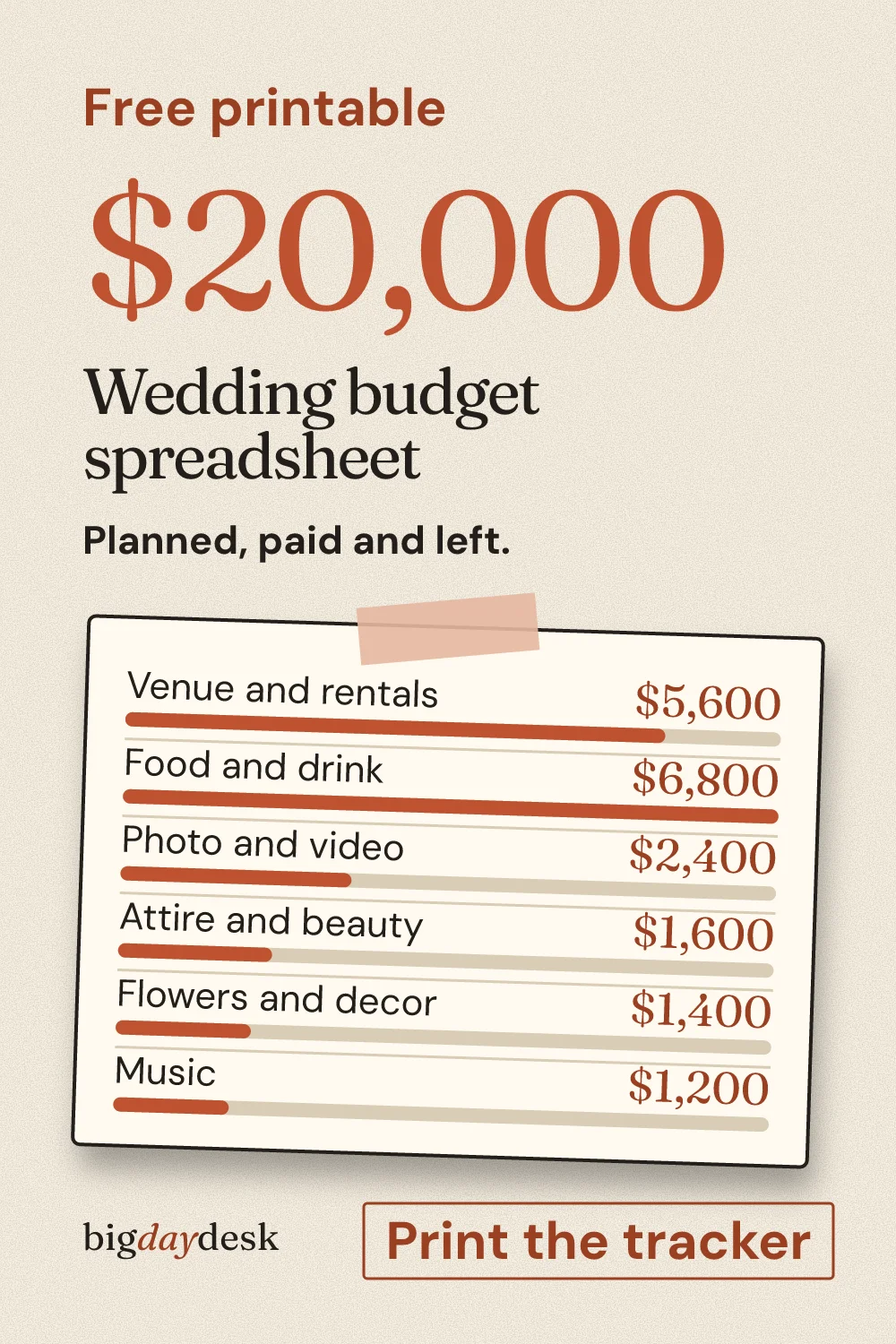
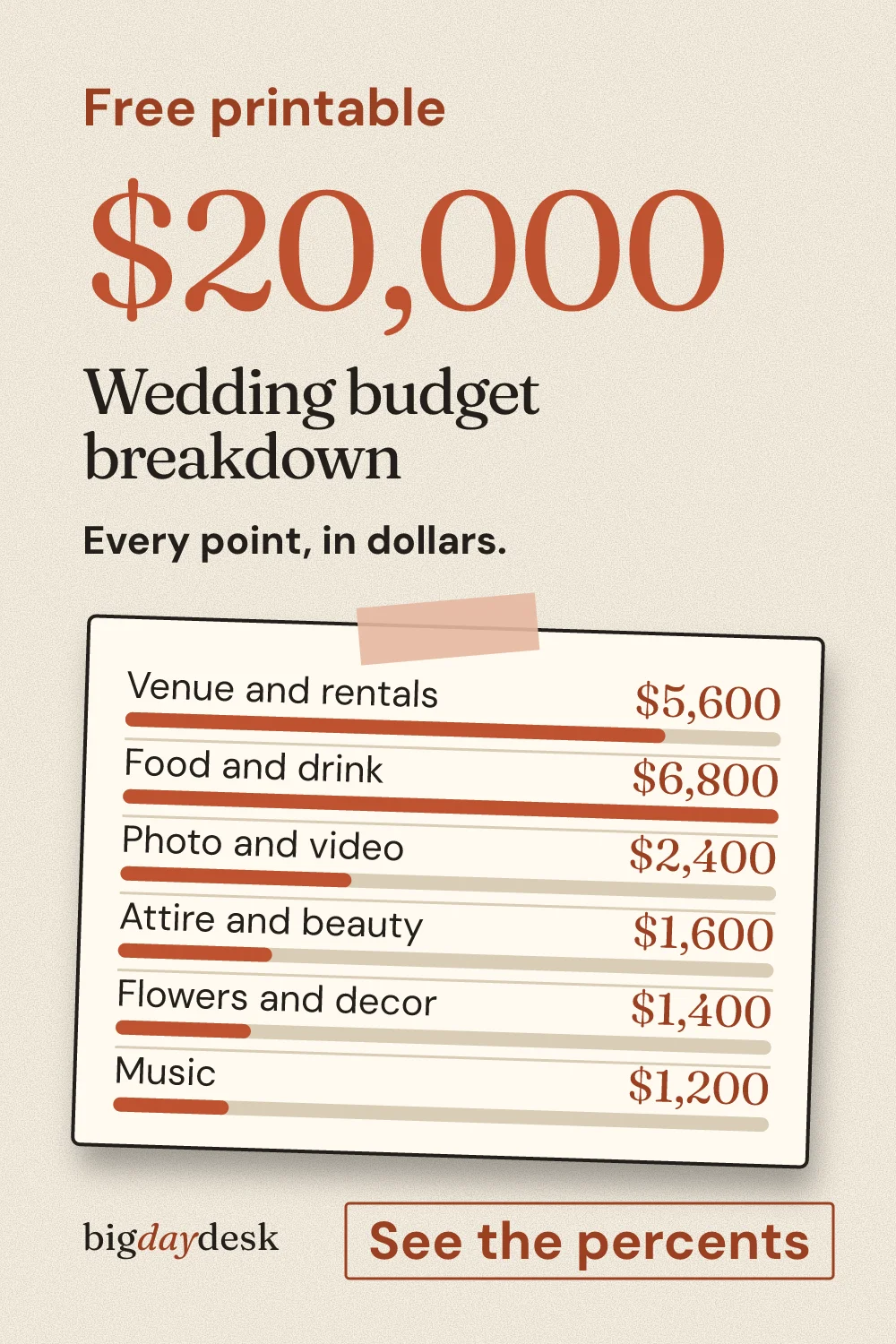
For $20,000 and 100 guests, our estimate gives 34% to food and drink, 28% to venue and rentals, 12% to photo and video, and 5% to a cushion. The sheet above shows the same split in dollars. Move points between lines and every amount and the cost per guest update.
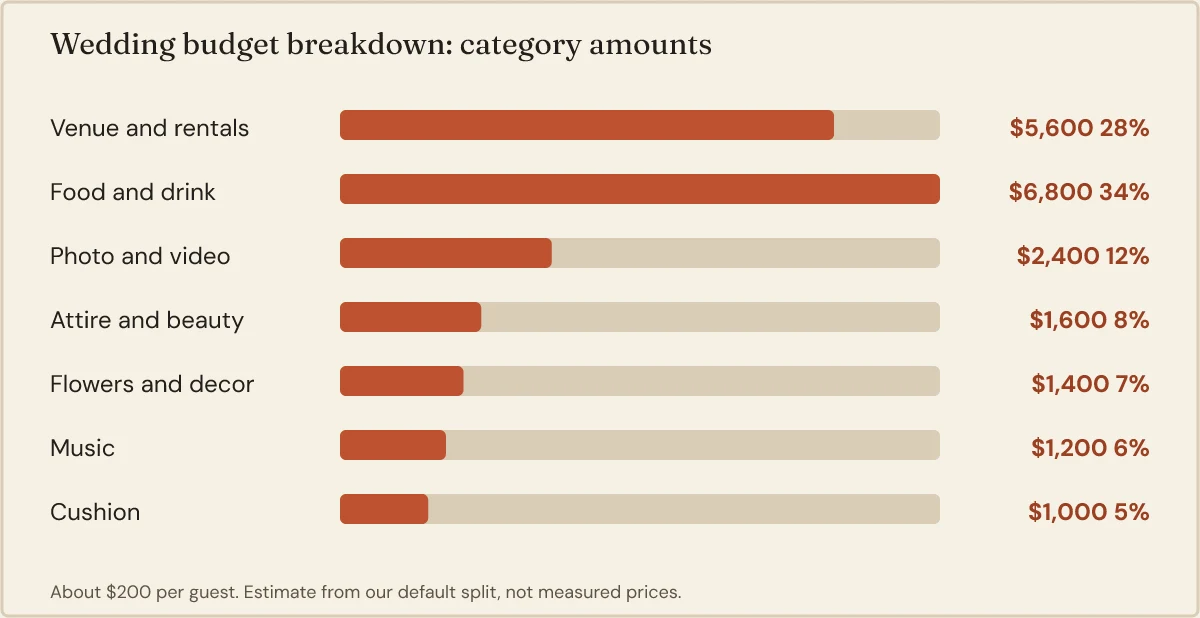
Percent table for the default split, and after shifting five points
Start with the default. Then take five points from flowers and decor and give them to food and drink. Decor drops from 7% to 2%, which is a hard cut, so it shows what a five point move really does.
Table: Default split and the version after moving five points from decor to food, $20,000 and 100 guests (our estimate, assumptions below)
| Category | Default share | Default amount | After shift share | After shift amount |
|---|---|---|---|---|
| Venue and rentals | 28% | $5,600 | 28% | $5,600 |
| Food and drink | 34% | $6,800 | 39% | $7,800 |
| Photo and video | 12% | $2,400 | 12% | $2,400 |
| Attire and beauty | 8% | $1,600 | 8% | $1,600 |
| Flowers and decor | 7% | $1,400 | 2% | $400 |
| Music | 6% | $1,200 | 6% | $1,200 |
| Cushion | 5% | $1,000 | 5% | $1,000 |
| Total | 100% | $20,000 | 100% | $20,000 |
Cost per guest is $200 in both versions. Food and drink go from $68 to $78 per guest.
Assumptions: the starting percentages are our own rule of thumb for 51 to 120 guests, not a survey. Amounts are whole dollars that add up to the total.
Five points moved $1,000 and left the total alone. That is the whole idea of a percent-first view. Trades stay inside the total, so you can see what each one costs.
What one point is worth
A percentage point means different money at different totals. Know the number before you trade.
Table: Value of one percentage point at three totals and three guest counts (our estimate)
| Total | One point in dollars | Per guest at 50 | Per guest at 100 | Per guest at 150 |
|---|---|---|---|---|
| $15,000 | $150 | $3.00 | $1.50 | $1.00 |
| $20,000 | $200 | $4.00 | $2.00 | $1.33 |
| $30,000 | $300 | $6.00 | $3.00 | $2.00 |
Read the $20,000 row at 100 guests. Moving one point from decor to food adds two dollars to every guest’s meal. Moving five adds ten. Decide whether guests would taste that difference before you give up the flowers.
At 50 guests the same five points add $20 per guest. Smaller lists feel each shift more.
Three trades to try on the default
Each trade below is recomputed from the default $20,000 split. The total never moves.
Table: Three trades from the default split, $20,000 and 100 guests (our estimate)
| Trade | Venue | Food and drink | Flowers and decor | Cushion | Food per guest |
|---|---|---|---|---|---|
| Default | 28%, $5,600 | 34%, $6,800 | 7%, $1,400 | 5%, $1,000 | $68 |
| Venue quote runs high: take 5 from food | 33%, $6,600 | 29%, $5,800 | 7%, $1,400 | 5%, $1,000 | $58 |
| Build a bigger cushion: take 4 from food | 28%, $5,600 | 30%, $6,000 | 7%, $1,400 | 9%, $1,800 | $60 |
| Feed guests better: take 5 from decor | 28%, $5,600 | 39%, $7,800 | 2%, $400 | 5%, $1,000 | $78 |
The venue trade is the one couples meet first. Venues quote a flat fee, so the number is real before anything else is booked. The trade shows the cost: $1,000 less for food, or $10 less per guest.
The cushion trade costs $800 of food and gives you $800 of safety. It is cheaper than finding money later.
The Knot reports that 54% of couples whose starting budget fell short adjusted the guest list and decor. Decor is the line most couples cut, so it is the easiest place to pull points from. Do it on purpose, with the dollars in view.
What the two biggest lines are made of
In our default, venue and rentals plus food and drink add up to 62%, or $12,400. That is a high share of your total, so check it against real numbers.
Zola reports that venue, catering and bar combined often take 40-45% of a budget. One planner’s guideline puts venue and catering near half. Our 62% is higher than both. Our venue line includes rentals, and our food line includes drink, so the groups are not identical.
If your quotes show a smaller share, do not keep our 62%. Move the difference to the lines you quoted higher, such as photo or attire.
Fees can hide in these two lines. Zola reports service charges and gratuities often run 18-22% of vendor costs. Ask whether a quote includes them. A $6,800 food quote that adds 20% is an $8,160 food bill, which is our own arithmetic, not a quote.
How big the cushion should be
The cushion pays for the costs nobody quoted: postage, alterations, tips, a late rental. Our default is 5%. That is a floor, not a target.
Zola measured unplanned costs at $3,314 on average, about 9% of total spend, and found that 75% of couples met at least one unexpected fee. One planner recommends reserving at least 10%.
Table: Cushion at three shares of a $20,000 total (our estimate)
| Cushion share | Cushion amount | Left for the other six lines |
|---|---|---|
| 5% (our default) | $1,000 | $19,000 |
| 9% (Zola’s measured level) | $1,800 | $18,200 |
| 10% (planner’s minimum) | $2,000 | $18,000 |
If a 10% cushion squeezes the other lines too much, 9% is defensible. A cushion you do not spend can go toward the honeymoon.
Steps to make your own breakdown
- Open the budget planner and enter your total and your guest count.
- Read the default percentages, then replace each one with the share your real quotes imply.
- Fix the sum. The sheet warns until your points add up to 100.
- Trade points, not dollars. Take them from the lines with the most flexibility first.
- Raise the cushion before you book the last vendor, not after.
- Print the sheet or send the link. The link carries your edited percentages.
Mistakes that make a breakdown useless
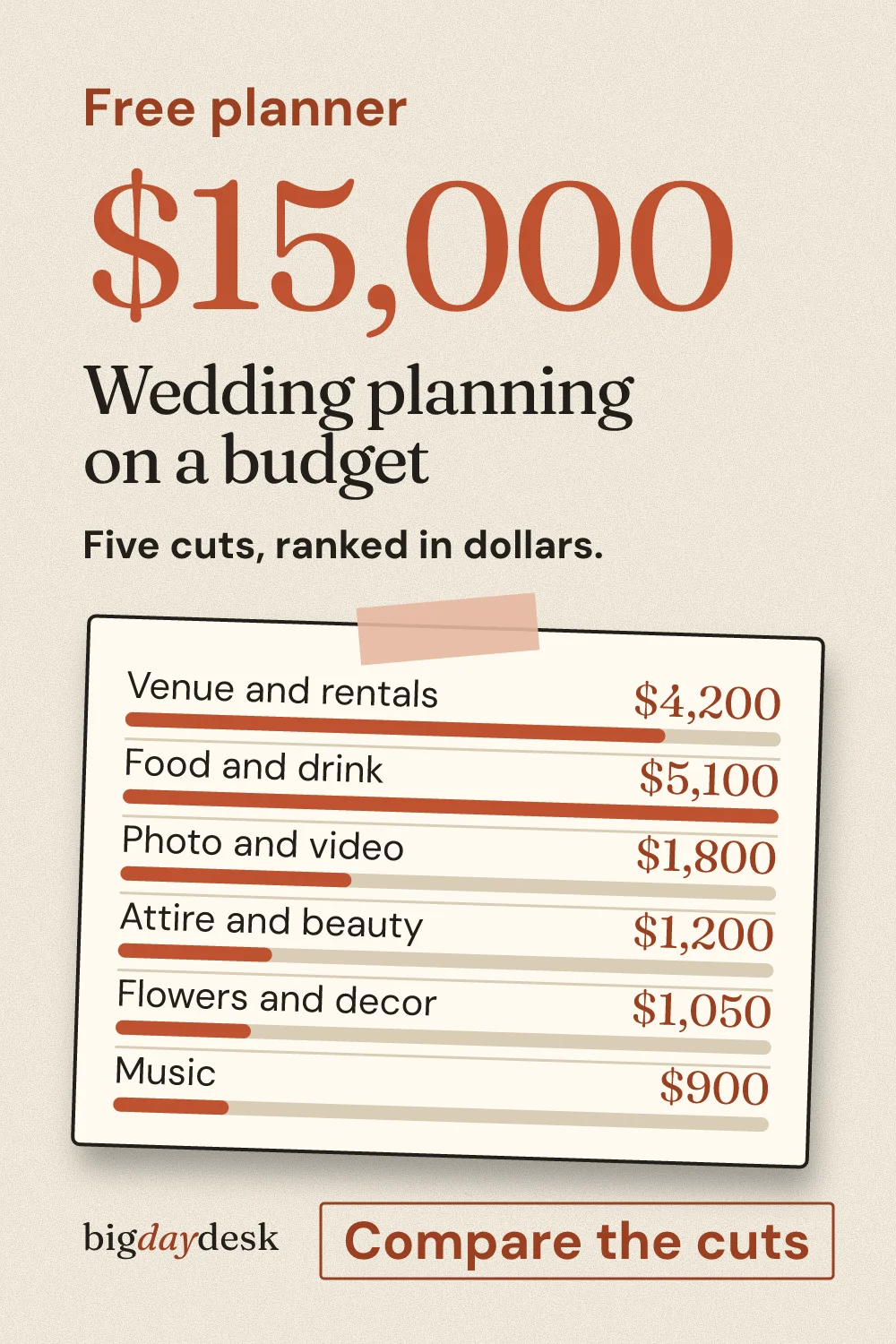
Treating percentages as fixed when the total moves. A venue quote is a dollar figure. If your total falls from $20,000 to $15,000, 28% becomes $4,200, and that may no longer buy your venue. See the same shares at $25,000, then reset your venue line.
Pulling points from the cushion first. It is the easiest line to raid and the most expensive one to lack. Raid decor and music before you touch it.
Splitting by percent without a guest count. Food and drink scale with headcount and photo does not. A 34% food share means $68 per guest at 100 people, but $136 per guest at 50. Check the dollars per guest before you accept the share. The 100-guest cost per person view shows that side.
Leaving a one percent gap. Points that add up to 99 leave $200 with no job at $20,000. It always turns into a surprise later.
Send the split to your partner
Percentages are easy to argue about because they are small numbers. Send the sheet, not a screenshot, and ask one question.
I put 34% on food and drink and 5% in a cushion. If you could move five points, where would they come from?
The link opens your exact percentages, so your partner starts from your version. When you want ranked cuts instead of single trades, the five common cuts page ranks them. When the numbers settle and the first deposits go out, track what you have paid in the planned, paid and left sheet.
Questions people ask
How do you break down a wedding budget by percentage?
Pick your total, then give each category a share that adds up to 100. A common starting point is venue and food together near the biggest block, then photo, attire, decor and music, plus a cushion. Multiply each share by your total for dollars, then check every line against a real quote.
Which category takes the biggest share?
Food and drink, in our default for 100 guests: 34%, or $6,800 of $20,000. Venue and rentals come second at 28%. Published sources also put the venue, catering and bar group at the top, though their share is lower than ours. Your quotes decide the real order, so edit the percentages to match them.
How much should the cushion be?
Our default is 5%, which is a floor. Zola measured unplanned costs near 9% of spend, and one planner recommends at least 10%. At $20,000 that is $1,800 to $2,000. If your budget is tight, raise the cushion to 9% and take the points from food and drink before anything else.
Do the percentages change with guest count?
Our starting split does. Up to 50 guests, food and drink get 30%. From 51 to 120 guests, 34%. With 121 or more, 40%, because meals and drinks scale with headcount while photo and music stay fixed. These bands are our own rule of thumb, not measured data, so edit any line that does not match your quotes.
Why must the percentages add up to exactly 100?
Because each share is a slice of one total. If they add up to 98, two percent of your money has no job, and if they add up to 103 you have planned to spend more than you have. The sheet shows a warning until the points add up to 100, and it only trusts the dollar amounts once they do.
Sources
- www.zola.com/expert-advice/what-weddings-really-cost (opens in a new tab) : Unplanned costs averaging $3,314, about 9% of total spend; 75% of couples met at least one unexpected fee; venue, catering and bar combined often 40-45% of budget; service charges and gratuities often 18-22% of vendor costs.
- northwesternmutual.com/life-and-money/how-to-create-a-wedding-budget-for-every-important-cost (opens in a new tab) : One planner recommends reserving at least 10% of the budget for forgotten costs and emergencies; one published guideline puts venue and catering near half of the budget.
- www.theknotww.com/press-releases/weddings-shine-bright-in-2025-the-knot-study-reveals-couples-prioritize-celebration-joy-and-connection-amid-socioeconomic-instability (opens in a new tab) : The Knot 2025 Real Weddings Study: 54% of couples whose starting budget fell short responded by adjusting the guest list and decor.
Updated by bigdaydesk editorial
Keep planning
-
Ranks five common cuts (guests
Ranks five common cuts (guests, hours, season, day, venue type) by dollars saved at the same total, using our own percentages.
-
Wedding budget spreadsheet: planned, paid and left
Adds planned, actual and paid columns to the split and exports as tab-separated rows for Sheets or Excel.
-
10k wedding budget
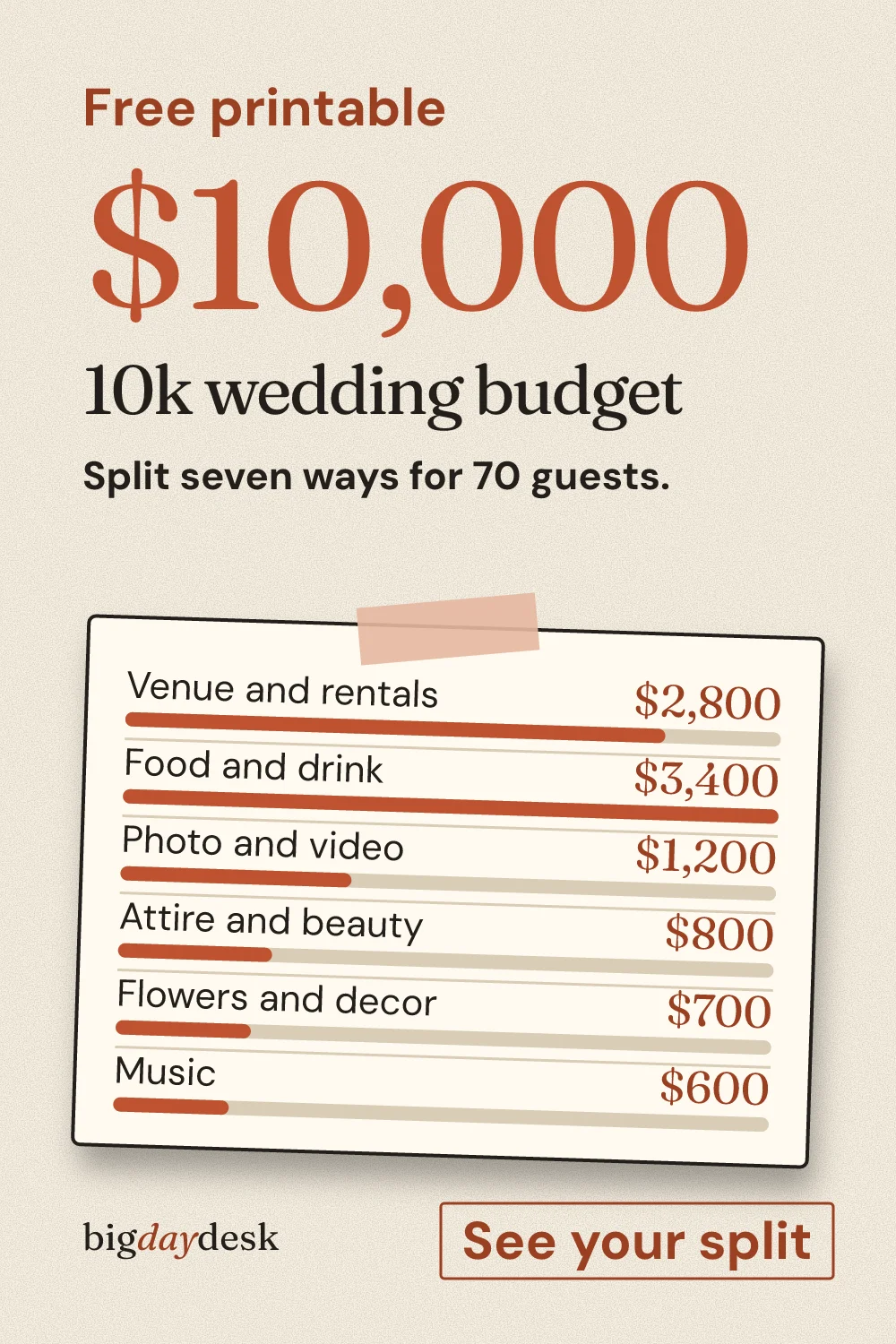
Mid-small total: how a $10,000 budget moves when guests go from 70 to 50, and where the cushion sits.
-
Elopement wedding: how to plan one for two
Separates elopement from a micro wedding by headcount (two to ten, our rule) and lists the steps that remain.