How long will it take to say?
Type the word count of your draft. We use 130 words per minute as our assumption for speaking pace.
Each example below has its own Copy button.
Aim for three to four minutes, which is about 390 to 520 words at 130 words per minute. That pace is our assumption. Parents and hosts can go a minute or two longer, and a guest toast should be one or two minutes. Type your word count in the box above to see your minutes.
Length is the one thing every guest notices and nobody remembers. A speech that ends a little early is almost never a problem. One that runs long is.
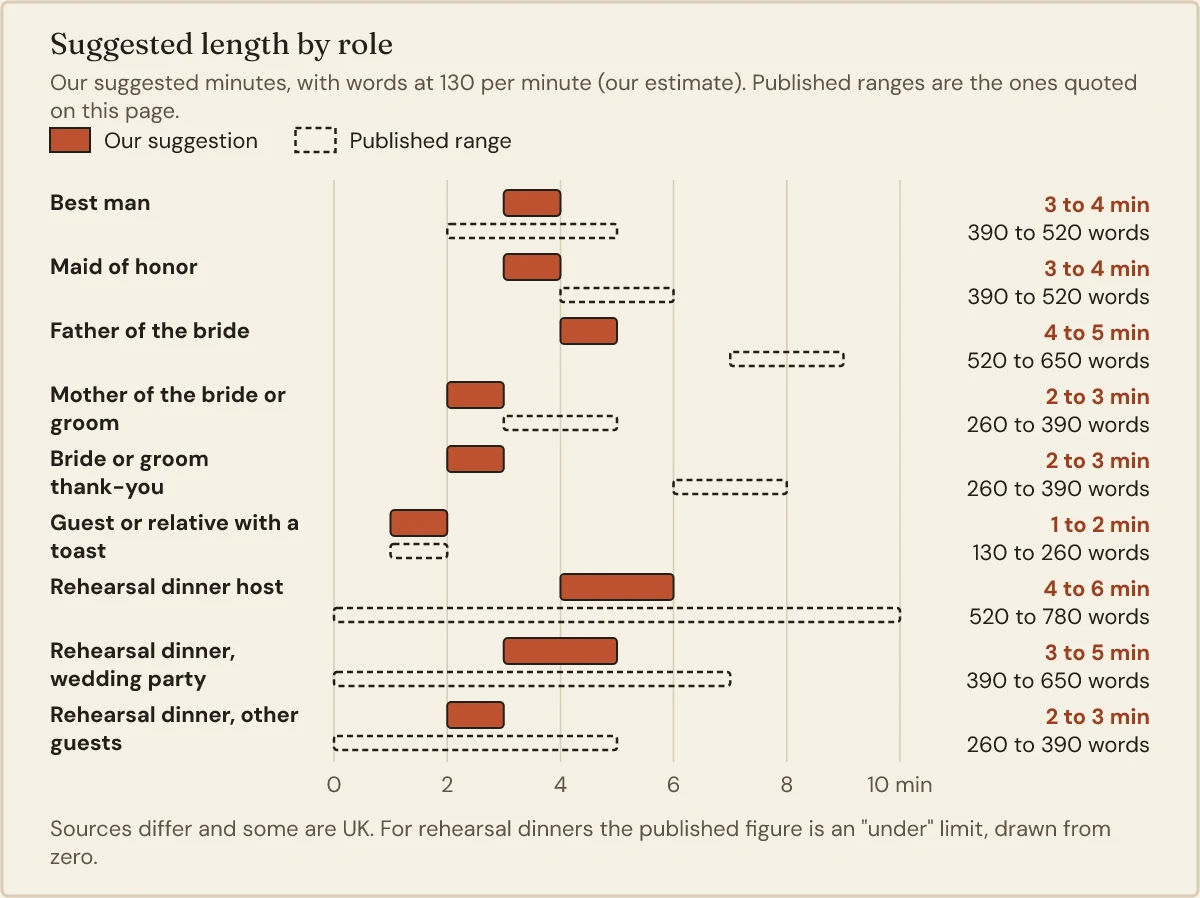
Length table: words and minutes for each role at 130 words per minute
Table: suggested speech length by role in minutes and words, next to what published guides say (our estimate, assumptions below)
| Role | Our suggestion | Words at 130 per minute | Published range |
|---|---|---|---|
| Best man | 3 to 4 min | 390 to 520 | 2 to 5 min (Zola), about 5 min (Bridebook, UK) |
| Maid of honor | 3 to 4 min | 390 to 520 | 4 to 6 min (Bridebook, UK) |
| Father of the bride | 4 to 5 min | 520 to 650 | 7 to 9 min (Bridebook, UK) |
| Mother of the bride or groom | 2 to 3 min | 260 to 390 | 3 to 5 min for the groom’s mother (Bridebook, UK) |
| Bride or groom thank-you | 2 to 3 min | 260 to 390 | 6 to 8 min for the groom (Bridebook, UK) |
| Guest or relative with a toast | 1 to 2 min | 130 to 260 | A minute or two at most (Inside Weddings) |
| Rehearsal dinner host | 4 to 6 min | 520 to 780 | Under 10 min (Zola) |
| Rehearsal dinner, wedding party | 3 to 5 min | 390 to 650 | Under 7 min (Zola) |
| Rehearsal dinner, other guests | 2 to 3 min | 260 to 390 | Under 5 min (Zola) |
Assumptions: 130 words per minute, words rounded to the nearest ten, and no time added for laughter. The Our suggestion column is our own judgment. We set it a little below the UK figures because those guides describe longer British reception speeches, and we picked the low side of the overlap for a US dinner room.
For all nine roles our suggested maximum is at or below the published maximum.
If your role is not listed, use the guest row. Shorter is the safer mistake.

Why published advice does not agree
Every guide here is editorial advice, not a survey. None of them measured how long real speeches ran or how guests reacted.
One guide says a best man can talk for two to five minutes. Another says to stay under five and aim nearer three. A third says a toast should be a minute or two. The UK guide gives a father of the bride seven to nine minutes, which would feel long at most US receptions.
The overlap is the useful part. Almost everyone agrees that two to five minutes is safe for a friend, and that going past five needs a reason. If you are unsure, pick the low end of your row. If your speech is a surprise to the couple, pick it even more firmly.
For the full order of speakers and how long each slot adds up to, see who speaks and when.
Turn your word count into minutes
Count the words in your draft, then find the nearest row. The three columns are three speaking paces.
Table: minutes and seconds to say a draft of each length at three paces (our estimate, assumptions below)
| Words in your draft | Slow, 111 per minute | Calm, 130 per minute | Brisk, 150 per minute |
|---|---|---|---|
| 150 | 1:21 | 1:09 | 1:00 |
| 300 | 2:42 | 2:18 | 2:00 |
| 450 | 4:03 | 3:28 | 3:00 |
| 600 | 5:24 | 4:37 | 4:00 |
| 750 | 6:45 | 5:46 | 5:00 |
| 900 | 8:06 | 6:55 | 6:00 |
Assumptions: the slow column uses 111 words per minute, the median in one vendor sample of practice presentations. That sample was not made up of toasts, so it is a reminder, not a measurement of wedding speakers. The brisk column is 150, a common figure for casual conversation. We use 130 as the middle for a speaker who is a little nervous and speaking clearly.
Nobody speaks at one pace. Most people speed up when nervous, then slow down for the emotional lines. The only way to know yours is to read the draft aloud once with a timer.
How to count: paste the draft into any word processor and read its word count. Do not guess from the number of pages, because page size and font change the total a lot.
Worked example: fit a draft into a four-minute slot
Example: a four-minute slot, with laughs and breaths included (our estimate)
- Slot given by the couple: 4:00, or 240 seconds
- Laughs and applause: 3 pauses of 5 seconds, so 15 seconds
- Breaths between sections: 4 pauses of 3 seconds, so 12 seconds
- Time left for talking: 240 minus 15 minus 12, so 213 seconds
- Words that fit at 130 per minute: 213 divided by 60, times 130, so about 460 words
- Words that fit at 111 per minute: 213 divided by 60, times 111, so about 394 words
Assumptions: the pause lengths are our planning guesses. Change them to match how long you expect a room to laugh.
So a draft meant for four minutes should be near 460 words, not 520. If you are a nervous speaker who talks slowly, aim for 390 and let the room fill the rest.
The lesson is simple. Plan for the slot minus about 30 seconds, then see how the draft actually reads aloud.
Words to cut to save time
Most drafts come in over. This table turns a time you want to save into a number of words to remove.
Table: words to cut to save a given number of seconds at 130 words per minute (our estimate, assumptions below)
| Time to save | Words to cut | What that usually looks like |
|---|---|---|
| 15 seconds | 33 | One long sentence |
| 30 seconds | 65 | A short paragraph or one joke setup |
| 60 seconds | 130 | A whole second story |
| 90 seconds | 195 | A story and the thank-you list |
| 120 seconds | 260 | Half of a four-minute draft |
Assumptions: 130 words per minute, so one second is a little over two words. If you speak at 111, each minute you need to save is about 111 words, so the cuts are a little smaller.
Cut in this order. Background on how you met comes first, then a second story, then lists of thank-yous. Keep your opening line, your one real story and the final toast. A speech with those three parts feels complete even at two minutes.
Short toasts at set lengths
Here are two toasts you can copy and change, each with its true word count and minutes at our assumed pace. They show what a shortened speech can still hold.
A 20-second toast
Friends and family, thank you for being here. I’m [Your name], and I have known [Name] for [number] years. In all that time I have never seen them as happy as they are tonight. [Partner], you have made a good person better. Please raise a glass to [Name] and [Partner].
A one-minute toast
Good evening, everyone. I’m [Your name], and I have the honor of being [Name]‘s [role]. I get one minute, so I will use it on one story. When [Name] first told me about [Partner], we were at [place]. They talked for ten minutes and never once looked at their phone. I have known [Name] for [number] years, and that had never happened before. I knew then that this was different. [Partner], since you arrived, [Name] laughs more, worries less and finally arrives on time. Thank you for that. To both of you, I wish a home full of people you love and a marriage that gets easier to explain with every year. Please raise a glass to [Name] and [Partner].
The numbers under each card are counted by the page when you load it, so they stay right if you edit your copy. For a longer outline with timed parts, use the best man speech outline, or start from the role-neutral template.
What makes a speech feel longer than it is
These are the habits that stretch a speech past its word count, each with the reason it hurts.
- Starting with an apology. “I’m not good at this” costs ten seconds and tells the room to worry. Start with your name and a thank you.
- Reading every guest’s name. A list of thank-yous is dull to everyone except the people named. Thank the hosts, then move on.
- Telling the story with every detail. The room does not need the date, the weather and the route. Keep what makes the point.
- Inside jokes. A joke only three people understand takes the same time as one everyone understands. Explain it in a line or cut it.
- A second ending. Saying “one more thing” after the toast line restarts the clock and loses the room. End on the glass.
- Reading from a phone with small text. You slow down when you squint. Print the speech in a large font.
If you are one of several speakers, check the lineup before you finalize. A short speech right after a long one lands better than a second long one.
Check the whole evening
Add every speaker’s slot to see how long the speeches take together. The UK guide above says 20 to 30 minutes in total is common and 40 is the ceiling.
Example: five speakers and the room’s attention (our estimate)
- Best man, 4 minutes: 520 words
- Maid of honor, 4 minutes: 520 words
- Father of the bride, 5 minutes: 650 words
- Mother of the groom, 3 minutes: 390 words
- Couple’s thank-you, 3 minutes: 390 words
- Total: 19 minutes of speaking and 2,470 words
- Add 2 minutes for walking up and handing over the microphone: 21 minutes
Assumptions: 130 words per minute and about 24 seconds of change-over per speaker. Change the minutes to your own lineup.
That is inside the UK 20 to 30 minute range. If your lineup is longer, ask one speaker to shorten rather than asking all of them to trim a little. For the father’s slot specifically, there is more in the father of the bride speech, and the wedding toast guide covers the shortest form.
Send this to your speaker
If you are the couple or the planner, you can send the limit before anyone starts writing. Copy this and change the numbers.
Hi [Name], thank you for saying yes to a speech. We would love about [3] minutes, which is about [390] words at a calm pace. No need to go longer. Send us a draft if you want and we will read it aloud with a timer.
Pass the same range along with the page link, so each speaker can see the numbers for their own role.
Vows follow the same math, only shorter. Look at the vow examples with word counts to see what one or two minutes of vows looks like. More guides for each speaker are in the full list of wedding speech guides.

Save for later
Pin it now and find it when you are ready to plan.
Questions people ask
How long should a wedding speech be?
Most wedding speeches work best at three to four minutes, which is about 390 to 520 words at 130 words per minute, our assumed pace. Hosts and parents can run a minute or two longer. A guest toast should stay near one or two minutes. Published guides disagree, so use the range for your role in the table and trim to fit.
How many words should a wedding speech be?
Plan on about 130 words for each minute you want to speak. A three-minute speech is roughly 390 words and a four-minute one about 520. That pace is our assumption for a calm, clear speaker. If nerves slow you down, use 111 words per minute instead and plan on 333 words for three minutes.
Is three minutes too long for a toast?
Not for a speech, but it can be long for a toast. One source says a toast should run a minute or two at most. Another says stay under five minutes and aim near three. If the evening already has several speakers, aim for two minutes. If you are a main speaker, three is fine.
Do laughs and pauses add time?
Yes. In our worked example, three laughs of five seconds and four breaths of three seconds take 27 seconds out of a four-minute slot. Those are our own planning numbers, not measured ones. Read your draft aloud once, standing, with a timer running, and you will see your real pace within a minute.
What should I cut if my speech runs over?
Cut in this order: a second story, a long thank-you list, then background on how you met. Keep your opening line and the toast. At our assumed pace, removing about 130 words saves one minute. Read the draft aloud again after cutting, because a shorter draft can still run long.
How long should all the speeches together last?
One UK guide suggests 20 to 30 minutes for all speeches combined and no more than 40. Add each speaker's slot from the table to check your lineup. Five speakers at three to five minutes each come to roughly 15 to 25 minutes. Tell every speaker their limit in advance so no one squeezes the others.
Sources
- bridebook.com/uk/article/how-long-should-a-wedding-speech-be (opens in a new tab) : UK-oriented length guidance by speaker (father of the bride 7 to 9 minutes, groom 6 to 8, best man about 5, maid of honour 4 to 6, mother of the groom 3 to 5), a general 5 to 7 minutes, and 20 to 30 minutes for all speeches combined with a 40 minute ceiling.
- zola.com/expert-advice/how-long-should-the-best-man-speech-be (opens in a new tab) : Best man speech of two to five minutes, with one minute or less risking a rushed feel.
- weddingwire.com/wedding-ideas/who-gives-a-speech-at-a-wedding (opens in a new tab) : Keep any wedding speech under five minutes, and aim nearer three if possible.
- www.insideweddings.com/news/expert-advice/the-must-know-rules-for-making-a-wedding-toast/1622 (opens in a new tab) : A reception toast of a minute or two at most, and speakers should confirm the list and order with the couple.
- zola.com/expert-advice/how-to-write-a-rehearsal-dinner-speech (opens in a new tab) : Rehearsal dinner lengths of under 10 minutes for the host, under 7 for wedding party members and under 5 for everyone else.
- virtualspeech.com/blog/average-speaking-rate-words-per-minute (opens in a new tab) : Median pace of 111 words per minute in a vendor sample of practice presentations (not toasts), and a suggested presentation range of roughly 120 to 160.
Updated by bigdaydesk editorial
Keep planning
-
Write toast
Toast, not speech: a word budget per part, a 50-word fill-in and six guest toasts, each ending on the toast sentence.
-
Wedding quotes for speeches, cards and signs
Every quote is either public domain with a linked source or an original line labeled as ours, never an unsourced attribution.
-
Wedding speech father of the groom: outline and examples
Centered on welcoming the bride's family and a single story about the son, which is the usual gap in this speech.
-
Wedding vows examples: 20 originals across five tones
The broad collection: twenty originals across funny, short, traditional, emotional and modern, each with a word count and a time.