
How long will it take to say?
Type the word count of your draft. We use 130 words per minute as our assumption for speaking pace.
Each example below has its own Copy button.
A father of the bride speech has six parts: thanks, a story about your daughter, how you met the groom, a welcome to his family, a few words to the couple, and a toast. At five minutes that is about 650 words, using 130 words per minute as our assumption. If you only have time for one line right now, this one is yours to use:
[Groom], when I watch how [Bride] is around you, I stop worrying. Welcome to our family.
Jump to eight openings, two full speeches or the groom welcome.
Your job is different from the best man’s. You are one of the few speakers who gets to welcome the groom and his family on behalf of the bride’s side, in front of both of them.
Outline table: six parts of a five-minute speech
Table: seconds and words for each part of a five-minute speech (our estimate, assumptions below)
| Part | What goes in it | Seconds | Words (est.) |
|---|---|---|---|
| 1. Thanks and welcome | Your name, thank the hosts and guests, one light line | 25 | 54 |
| 2. Your daughter | One story that shows who she is, with a place and a detail | 85 | 184 |
| 3. Meeting the groom | The first time you met him and what you noticed | 50 | 108 |
| 4. Welcome to the family | Say his name, welcome his parents and relatives | 45 | 98 |
| 5. To the couple | What you see in the two of them together, one wish | 55 | 119 |
| 6. The toast | One sentence, then ask everyone to raise a glass | 40 | 87 |
| Total | 300 | 650 |
Assumptions: we use 130 words per minute and round each part to whole words. Laughter and pauses add a few seconds, so a real room runs slightly over. People also tend to speak slower than they expect. One vendor sample of practice presentations had a median of 111 words per minute (not toasts), so read your draft aloud once, standing up, and time it. Type its word count into the box at the top of this page for the minutes. Other lengths are in how long wedding speeches run.
The same six parts, hosting and not hosting
Hosting changes where the seconds go. If you and your family are paying for and hosting the reception, you are also the host, and part 1 grows. If someone else hosts, part 1 shrinks to a thank you and the time goes into the story and the groom.
Table: seconds for each part of a five-minute speech when you host and when you do not (our own split, not sourced)
| Part | You are hosting | You are not hosting |
|---|---|---|
| 1. Thanks and welcome | 40 | 15 |
| 2. Your daughter | 80 | 90 |
| 3. Meeting the groom | 40 | 55 |
| 4. Welcome to the family | 45 | 50 |
| 5. To the couple | 50 | 55 |
| 6. The toast | 45 | 35 |
| Total | 300 | 300 |
When you host, the welcome grows from 15 to 40 seconds and the story about your daughter shrinks from 90 to 80.
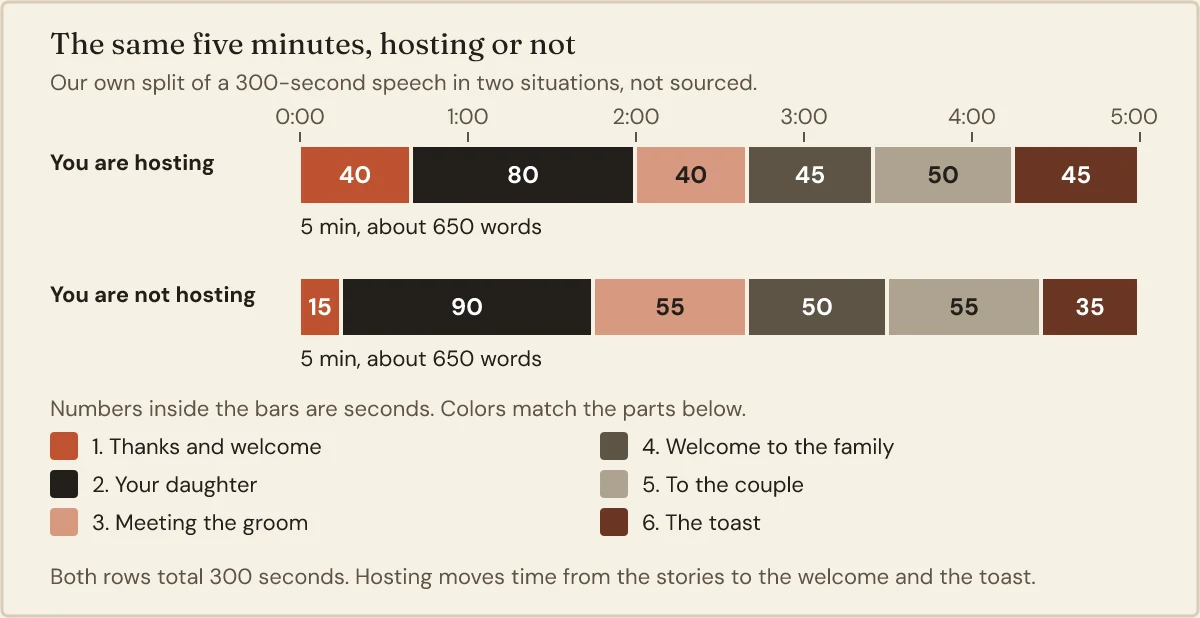
If you need to cut, trim part 3 first, then part 5. Keep the story, the welcome and the toast.

Eight openings to copy and bend
Swap the bracketed parts for real names and places. Tap Copy under any card to put the text on your clipboard. Word counts include the bracketed placeholders as written. Openings 3, 4 and 6 are the funny ones, 5 is the shortest, and 8 is for a father who expects to be moved.
1. Warm and plain (49 words)
Good evening, everyone. I’m [Your name], [Bride]‘s father. Thank you to everyone who traveled to be with us, and to [Host names] for tonight. I would like to say a few words about my daughter, a few more about the man she chose, and then we can all eat.
2. Thank the other parents first (43 words)
Before I say a word about my daughter, thank you to [Groom’s parents] for raising a man we are proud to welcome. [Co-host name, if any] and I are grateful to you, and to this room full of people who love these two.
3. The first phone call (35 words)
I remember the call. [Bride] said she had met someone, and then she talked for twenty minutes straight. I said “mm-hm” a great deal. I knew it was serious by the time I stopped counting.
4. The job description (33 words)
Tradition gives the father of the bride three jobs: walk her down the aisle, stand in the right photographs, and not cry. I managed the first two. Please be kind about the third.
5. Short and honest (33 words)
I have three things to say tonight. I love her, I trust him, and I am very glad you are all here. That is the speech. The next four minutes are the details.
6. Looking back at her as a child (40 words)
When [Bride] was six, she told me she would marry someone who could fix a bike and make her laugh. I’m delighted to report that [Groom] now owns a toolbox, and the laughing has been going on for some time.
7. For a speaker who is nervous (39 words)
I’m nervous, so I wrote this down, and you’ll forgive me for looking at the page. I’m [Your name], and tonight I get to say something about the girl I walked into kindergarten and the man she is marrying.
8. A quiet beginning for a tearful moment (34 words)
Give me a moment. I promised myself I would get through the first line. I’m [Your name], and today my daughter asked me to say a few words, and I could not say no.
Other wording for the toast and shorter forms is collected in wedding toast examples.
What to say about the groom
This is the part dads worry about most. Build it from three sentences, in this order.
Table: a three-sentence groom welcome, what to fill in and a made-up example
| Sentence | Fill in | Example (invented) |
|---|---|---|
| 1. What you noticed | One thing you saw him do, with a place | “At the first dinner, [Groom] cleared the table before anyone asked and then stayed to dry.” |
| 2. What you trust him with | One plain sentence | “I trust him with her, and that is the biggest thing I have.” |
| 3. The welcome | His full name once, then his parents’ names | “[Groom full name], welcome. [Groom’s parents], we are glad to be family.” |
Put them together and you have a welcome of about forty words. Skip a list of qualities. One specific moment says more than five adjectives.
Three more welcome lines, each ready to adapt:
Welcome line A (35 words)
[Groom], at our first dinner you carried the folding chairs in from the car before anyone asked, then asked what else needed doing. I knew what kind of man you were. Welcome to our family.
Welcome line B (30 words)
[Groom’s parents], we have not known each other long, but we share something rare. We both raised someone who knows how to love well. I’m glad we are family now.
Welcome line C, if you only just met him (36 words)
[Groom], I know I have only known you a short while. What I have seen is how my daughter is when you are in the room. She is lighter. That is all I needed to see.
If the groom’s father plans to speak too, compare notes so you do not repeat each other. What the groom’s father might say shows how he can cover his side of the welcome.
Two full speeches, hosting and not hosting
Each speech is close to the 650 words of the five-minute outline above (622 and 641 words) and follows its six parts. The first uses the hosting split of seconds and the second the not-hosting split. The stories are invented, so replace them with something that really happened to you. If you read this aloud at 130 words per minute (our assumption), each runs about five minutes.
Speech 1: hosting, with a co-host (622 words)
Good evening, everyone. For those who do not know me, I’m [Your name], [Bride]‘s father. [Co-host name] and I are so glad you came, some of you from a long way off, and we want to thank you for it. Thank you to [Caterer or venue] for looking after us tonight, and to [Officiant] for today’s ceremony. The food is coming, I have been told, so I will be quick. Well, I will be five minutes. For a father, that is quick.
When [Bride] was fourteen, she decided her bedroom needed repainting, and she decided she would do it herself. I suggested we talk about colors first. She had already bought three. By Sunday night the walls were a green she called Tuesday, and there was a stripe of it on the ceiling, on the dog and on me. I was holding the ladder. I was told I was holding it wrong.
I could have fixed the ceiling. I left the stripe there for two years, and every time I walked past, it reminded me of her. She decides what she wants, she does the work, and she lets other people help even when they help badly. When a friend moved house, [Bride] arrived with tape and boxes before the friend had finished asking. She is the most capable person I know, and also the most generous with it.
Last spring she told me she had decided to learn to swim properly, at thirty, because she did not like being scared of something. She signed up for lessons on Wednesday nights and told no one. I found out when I noticed her hair was wet. That is [Bride]. She does not announce a plan. She starts, and then she gets on with it.
The first time I met [Groom], I was in the garage losing a fight with a shelf. He did not say anything. He took the other end. We finished the shelf, and then he asked what the next job was. [Bride] was watching from the doorway. She was not watching the shelf.
Afterward I asked [Bride] what she thought. She said, “He did not try to impress you, Dad.” She was right, and I have thought about that line many times. Most people who want a father’s approval perform a little. [Groom] just worked. He has done the same since, at family dinners, on moving days, and once at two in the morning with a flat tire.
[Groom’s parents], [Groom’s mother] and [Groom’s father], thank you. You raised a man who sees a job and picks up the other end, and that is not an accident. We have known each other a short time, and already I can see both of you in him. [Groom], today you gained a family on this side too. You are welcome at our table and welcome in our house. Knock once, then come in.
[Bride] and [Groom], here is what I see when I look at you. I see two people who laugh at the same things and are kind about the same things, and who each make the other a little braver. Most of your days will be ordinary ones, and I hope you spend them well. Be on each other’s side when it is easy, and especially when it is not. [Co-host name] and I have had our share of days that needed patience, and we are still here because we kept choosing it. Choose each other on the easy mornings and the hard ones. Say sorry first, sometimes. Say thank you more often than you think you need to.
Everyone, please stand and raise a glass. To [Bride] and [Groom], and to a very long run of good Tuesdays. Cheers.
Speech 2: not hosting, speaking on your own (641 words)
Good evening. I’m [Your name], [Bride]‘s father. Thank you to [Host names] for a wonderful night, and to all of you for being here.
When [Bride] was seventeen, she drove me to my sister’s wedding. Four hours, a borrowed car, and a phone that died an hour in. She had a paper map from the glove box and total confidence. At the second junction she took an exit I was sure was wrong. I said so. She said, “Dad, I know. I want to see something.”
Twenty minutes later we were sitting outside a pie shop in a town I could not name, and she was asking the owner how long she had run it. We were late. My sister forgave us, mostly because we brought pie. But I have never forgotten it. [Bride] gets where she is going, and on the way she finds out about the people around her. She asks. She listens to the answer. A year later she remembers it and asks how the knee is doing.
I am proud of what she does for a living. I am prouder of that. You do not learn it from a book, and I cannot take much credit. I only sat in the passenger seat and learned to keep quiet.
Since then I have watched her do it in smaller ways. She knows the names of the people who work in her building. She sends birthday messages to my cousins, whom she has met twice. Last year she drove six hours to sit with a friend who had no one else that weekend, and she did not mention it afterward. I only know because the friend told me.
I met [Groom] properly at [Place]. I was ready to be polite, which is how a father says suspicious. Then [Groom] said, “Is this the pie-shop dad?” She had told him the whole story. And he had asked for more: what she was like at seventeen, what she wanted then. I understood that he was not trying to impress me. He was trying to know her. Over the next year I watched him do it again and again. He asks, he listens, and he remembers. He even remembered the name of the waitress at our first dinner and asked about her daughter the next time. [Bride] looked at me across the table, and I understood she had found her match.
[Groom’s parents], I want to say this to you directly. I do not have a thank you for [Groom] that is big enough, so I will say it plainly and hope it carries. We have met only a handful of times, and each time I felt we were already on the same side. [Groom], welcome to our family. We are not a quiet bunch, as you may have noticed. There is always an opinion, a second helping and a seat. Yours is waiting. [Groom’s parents], if you want to see how she is when she is happy, come and visit. We will have pie.
[Bride] and [Groom], I have no advice you have not already heard. Here is what I have seen. You are curious about each other. That is rarer than people admit, and it keeps a marriage interesting long after today is over. A marriage is a lot of ordinary evenings, and the ones that matter are the ones where one of you says, “Tell me about your day,” and means it. You two already do that. Please never stop. Keep asking each other questions. Take the wrong exit once in a while. Eat the pie. And when you are lost, as everyone is at some point, remember you are riding with the one person who will never mind stopping to ask.
Please raise your glasses. To [Bride] and [Groom]: a long road, good detours, and each other. Cheers.
If your family looks different
Both speeches and several openings assume two parents who are still together. Adapt them like this.
- Stepmother or stepfather. Name them in part 1 or 5 with the same warmth: “[Stepparent’s name] and I” replaces the co-host line.
- Her mother has died. Give her one sentence in part 2 or 5, a detail rather than a tribute, and keep the story as the center. Opening 8 gives you room to pause.
- Divorced or not speaking together. Drop the “we” lines. Speech 2 works as written.
- Two dads, or you speak with someone. Split the parts before the day: one takes the story and the groom, the other takes the welcome and the toast.
- You are not the one giving her away. Say who you are in part 1, then use the same six parts.
What to leave out, and why
- Warnings to the groom. “Take care of her or else” is a joke that is not funny to the groom, and it reads badly from a father in front of two families.
- Embarrassing stories about her dating life. The groom’s grandparents are in the room, and she did not agree to this one.
- Money talk. Who paid for what belongs in a private conversation, not at the microphone.
- Comparisons to the ex or to old partners. Even a kind comparison puts the old relationship in the room.
- Inside jokes only your family gets. Half of the guests are from his side. If it needs explaining, cut it.
- Reading a list of her achievements. It sounds like a résumé. Pick one story and let it stand for the rest.
- Going long because of the pause. Applause and crying take time. Plan for a draft that is a little under your limit.
If you want a lighter tone, keep the tease on yourself, as opening 4 does. Do not tease the groom or her.
Make it yours in five questions
- What did she do as a child that she still does as an adult? Write it as a scene, not a trait.
- What did you first notice about the groom? Use something you saw, not what you were told.
- What do his parents mean to you now? Write one honest sentence.
- What do you wish for the two of them? Keep it to a line you can say without looking down.
- Who can listen to it? Read it to one person who knows you both and ask what confused them.
If your daughter plans to speak herself, compare notes before you finish. A speech from the bride can cover the thanks, so yours can stay with the story.
Order, timing and who to tell
In the traditional US order the best man and maid of honor often go first, and the hosting parents speak after. UK guides often put the father of the bride first. Sources differ, so the couple decides. If you host, say so when you ask where you fall. The full running order is in the order of wedding speeches.
At the rehearsal dinner the host usually toasts first, traditionally the groom’s father, and the bride’s father often returns a toast. If you plan to speak at both, plan different stories, and use the guide to toasts at the rehearsal dinner.
If the mother of the bride is speaking too, agree who covers the thanks. Her outline, the mother of the bride speech, shows what she might take.
Copy this note and send it to your daughter or your co-host. It gives them your plan in a few seconds.
My father of the bride speech outline, about five minutes and 650 words. 1. Thanks and welcome, 25 seconds. 2. A story about you, 85 seconds. 3. Meeting [Groom], 50 seconds. 4. Welcome to his family, 45 seconds. 5. A few words to the two of you, 55 seconds. 6. The toast, 40 seconds. The story I plan to tell is about [topic]. Is there anything you would like me to leave out, or to add?

Save for later
Pin it now and find it when you are ready to plan.
Questions people ask
What should a father of the bride speech be about?
Your daughter first, the couple second. Pick one real moment that shows who she is, say what you have noticed in the groom, welcome his family, and end with a toast. Thanks to guests and hosts go at the start and stay short.
How long should a father of the bride speech be?
One UK guide suggests 7 to 9 minutes for the father of the bride. A general US guide says to keep any wedding speech under five minutes, and it is not written for fathers in particular. We suggest about five minutes, which is 650 words at 130 words per minute. That pace is our assumption. If you run slow when nervous, aim for 555 words.
What do I say about the groom?
Name one specific thing you noticed, such as how he acts when she is tired or upset. Say what you now trust him with, then welcome his parents by name. Skip jokes that warn him and keep the welcome warm. The three-sentence builder on this page gives you a three-sentence version to fill in.
What do I say in a father of the bride speech?
Start from the six parts, then use words you can say out loud. The openings and the two full speeches on this page are written to be copied and changed. Swap the bracketed parts for real names, replace the stories with your own, and read it aloud once before the day.
Do I speak before or after the best man?
It depends on where you are and who hosts. The traditional US reception order has the best man and maid of honor first and the hosting parents after, while UK guides often put the father of the bride first. Ask the couple where you fall, as the order is theirs to set.
Can the stepfather also speak?
Nothing stops two fathers from speaking. Tell the couple early so the order can be planned, and split the material so you do not repeat each other. One can take childhood and the other the couple, or one can speak at the reception and the other at the rehearsal dinner.
What if I cry halfway through?
Stop, breathe, and let the room wait. Guests read it as love, not failure. Mark a safe sentence to restart from, keep that part of the speech short, and put the toast last so you can finish with a line you know by heart. Opening 8 is written for this.
Sources
- bridebook.com/uk/article/how-long-should-a-wedding-speech-be (opens in a new tab) : UK-oriented guidance of 7 to 9 minutes for the father of the bride, 20 to 30 minutes for all wedding speeches combined, and a UK order that often puts the father of the bride first.
- weddingwire.com/wedding-ideas/who-gives-a-speech-at-a-wedding (opens in a new tab) : Traditional US reception order with the best man and maid of honor first and the hosting parents after, and general advice to keep any wedding speech under five minutes.
- www.insideweddings.com/news/expert-advice/the-must-know-rules-for-making-a-wedding-toast/1622 (opens in a new tab) : Fathers of the bride and groom often speak, especially when hosting, and speakers should confirm the list and order with the couple in advance.
- zola.com/expert-advice/how-to-write-a-rehearsal-dinner-speech (opens in a new tab) : At a rehearsal dinner the host toasts first, traditionally the groom's father, and the bride's father often returns a toast.
- virtualspeech.com/blog/average-speaking-rate-words-per-minute (opens in a new tab) : Median pace of 111 words per minute across a vendor sample of practice presentations (vendor data, not toasts).
Updated by bigdaydesk editorial
Keep planning
-
wedding speech father of the groom
Centered on welcoming the bride's family and a single story about the son, which is the usual gap in this speech.
-
Wedding toast examples
Toast, not speech: a word budget per part, a 50-word fill-in and six guest toasts, each ending on the toast sentence.
-
Maid of honor speech: structure, openers and examples
The role landing: five-part structure with timings, ten ways to start and what not to say about the couple.
-
Written to be said to a wife
Written to be said to a wife or bride, with sentence starters for the memory and for a promise she would notice.


