
How long will it take to say?
Type the word count of your draft. We use 130 words per minute as our assumption for speaking pace.
Each example below has its own Copy button.
A mother of the groom speech has four parts: a welcome, one story about your son, what you see in him now, and a toast to the couple. In two to three minutes that is 260 to 390 words, using 130 words per minute as our assumption. Use the table, copy an opening, then add your own story.
You are not there to give a biography. You are there to welcome someone new and say one true thing.
Outline table: four parts of a three-minute speech
Table: seconds and words for each part of a three-minute speech (our estimate, assumptions below)
| Part | What goes in it | Seconds | Words (est.) |
|---|---|---|---|
| 1. Welcome | Your name, a thank you to the hosts, the bride or partner by name | 40 | 87 |
| 2. One story | A small moment from your son’s life that shows who he is | 70 | 152 |
| 3. What you see now | One change or habit you noticed after he met his partner | 40 | 87 |
| 4. The toast | One wish for the two of them, then the glass | 30 | 65 |
| Total | 180 | 391 |
Assumptions: 130 words per minute, rounded to whole words, with no pauses for laughter or tears. A real room adds ten to twenty seconds. The story gets the biggest share on purpose, because it is the part guests repeat afterward.
The story takes 70 seconds, the longest of the four parts, and the toast is the shortest at 30.
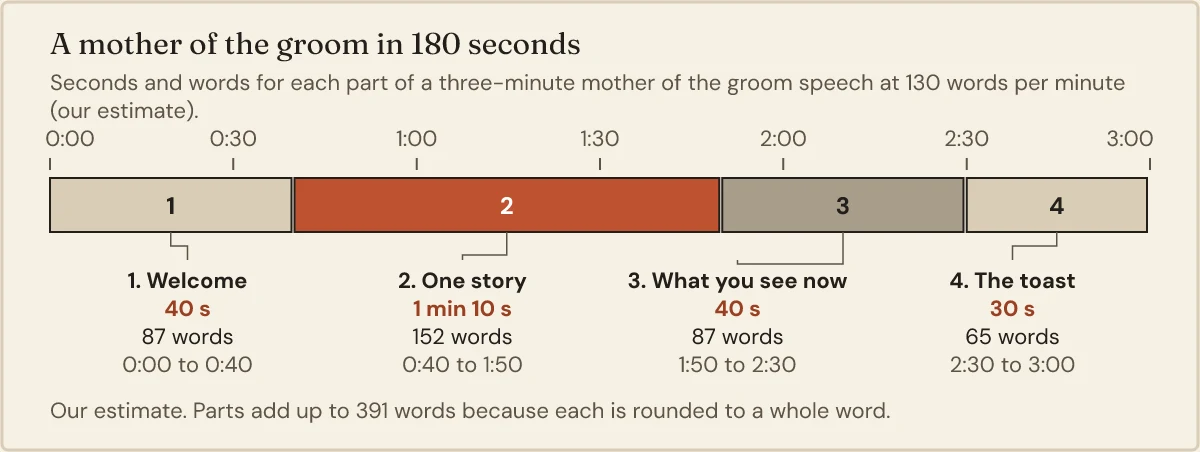
For a two-minute toast, keep all four parts and trim the story to about 40 seconds. Never drop the welcome. For many mothers of the groom, it is the sentence the bride remembers.

How many words fill your time
Table: words needed for each speech length at two speaking paces (our estimate, assumptions below)
| Minutes aloud | Words at 130 per minute | Words at 111 per minute |
|---|---|---|
| 1 | 130 | 111 |
| 2 | 260 | 222 |
| 3 | 390 | 333 |
| 4 | 520 | 444 |
| 5 | 650 | 555 |
We use 130 as a calm, clear pace. The 111 column is the median pace in one vendor sample of practice presentations. Emotional speakers often slow down, so the lower column is the safer one to plan with. Read your draft aloud once, standing, before you trust either.
Type your own word count into the box above the page text to see minutes for your draft.
How long mothers of the groom actually speak
Published advice disagrees, so here is the spread. A UK wedding guide suggests three to five minutes for the mother of the groom. Another source advises a minute or two for any reception toast. A third says to keep every wedding speech under five minutes.
UK speeches run longer than US ones. If your reception is in the US, aim for the short end. Two to three minutes leaves room for the other speakers, and the UK guide puts the whole speech block at 20 to 30 minutes. See how long a wedding speech should run for each role side by side.
Eight openings to copy and bend
Swap each bracketed part for a real name or place. Tap Copy under any card to put it on your clipboard. Word counts include the bracketed gaps, so your final count will shift slightly.
1. Plain and warm (34 words)
Good evening, everyone. I’m [Your name], [Groom]‘s mother. [Bride], I want to say one thing before anything else. Welcome. You have made my son happier than I knew he could be, and I’m grateful.
2. Thank the hosts (32 words)
Thank you to [Host names] for this beautiful evening, and to all of you for traveling to be here. I’m [Your name], and I have the great luck of being [Groom]‘s mom.
3. Straight into a memory (36 words)
When [Groom] was seven, he gave away his entire allowance to a boy at school who wanted a new bike. He didn’t tell us. The boy’s mother did. I’ve been proud of that kid ever since.
4. The surprise phone call (37 words)
The first time [Groom] mentioned [Bride], he called me on a Tuesday for no reason. He never calls on a Tuesday. By the end of the conversation, I had a strong feeling I’d be needing a dress.
5. Short and honest (22 words)
I promised [Groom] I would keep this short. I also promised myself I wouldn’t cry. Let’s see which one I break first.
6. Speaking to the bride directly (35 words)
[Bride], I’ve waited a long time to say this. I hoped my son would find someone who makes him laugh at himself. You do. I’m [Your name], and today I get to say thank you.
7. For two families at once (33 words)
[Bride’s parents], thank you for raising [Bride]. We’ve known her a short time, and we already can’t imagine our family without her. I’m [Your name], [Groom]‘s mother, and I have a few words.
8. For a nervous speaker (33 words)
I’m a little nervous, so I wrote this down, and you’ll all be kind about it. I’m [Your name]. I have something to say to my son and to the person he married.
More wording for any speaker is in the fill-in speech template.
Example 1: a short toast (73 words)
Use this when the couple asks for something brief, or when many people are speaking. About 35 seconds at 130 words per minute (our assumption). The details are invented, so replace them with your own.
Good evening, everyone. I’m [Your name], [Groom]‘s mother. Thank you to [Host names] for tonight.
[Bride], welcome to our family. [Groom] has always been the one who remembers everyone’s birthday, and since he met you, he remembers yours first.
[Groom], I’m proud of you, and I’m happy you found each other. Please raise a glass. To [Groom] and [Bride]. May your home always be loud, kind and full of people who love you.
Example 2: a full speech of about two minutes (243 words)
This follows the four parts in the outline table. About 1.9 minutes at 130 words per minute (our assumption), before any pauses. The story is invented. Use it for its shape.
Good evening, everyone. I’m [Your name], [Groom]‘s mother. Thank you to [Host names] for hosting us tonight, and thank you all for coming.
[Bride], before I say anything about my son, I want to say something about you. When [Groom] brought you to meet us, I noticed that you asked my husband about his garden, and then you stayed to hear the answer. That told me something. Welcome to the family. We are so glad you are in it.
Now, a story about [Groom]. When he was nine, he built a go-kart from scrap wood in our garage. It had no brakes. He rode it down our street at full speed, hit the neighbor’s hedge, and climbed out with a scratch on his chin. His first words were, “Okay, what do I fix?”
That is [Groom]. He tries the bold thing, he laughs at the crash, and he goes back to fix it. For a long time I wondered who would ride alongside him.
Then you appeared. [Bride], he is calmer with you, and he is braver too. He listens more. He calls ahead. He stops to ask what you need before he decides what he wants.
So here is my wish. May you build things together, and may you laugh at every crash. May you always ask each other, “What do we fix?” and never, “Whose fault was it?”
Everyone, please raise your glass. To [Groom] and [Bride]. We love you both.
Notice the proportions. The welcome to the bride comes early, the story is the longest block, and the toast is two sentences.
What to leave out, and why
- Embarrassing childhood stories. A laugh from the room is not worth your son’s face. If you wonder whether he would approve, he would not.
- Comparisons to his ex. Even a kind comparison puts a former partner in the room. Leave her out entirely.
- Advice about marriage. A short wish is welcome. A list of rules sounds like a review of the couple, so keep it to one sentence.
- Remarks about the guest list or the cost. Save logistics for a private conversation. A toast is the wrong place for a complaint, even a joke.
- Reading the whole life story. Stay with one story. A string of memories drags and loses the bride entirely.
- Jokes about grandchildren. The couple may be trying, may be waiting, or may have decided against it. Pressure in public can hurt, so say nothing.
If you are the only parent of the groom speaking, say so lightly and move on. A single warm line works better than an apology.
Make it yours in four questions
- What is one small moment that shows who your son is? Pick one scene with a place and a detail, not a list of traits.
- What did you notice after he met his partner? Describe one habit, one call or one laugh that is new.
- What do you want to say to the bride directly? Write one sentence, and make it specific to her.
- What do you wish for them? Write it as a short sentence that a guest could repeat.
Read it to someone who knows the family. If your husband is also planning to speak, compare notes with the father of the groom’s speech outline so you do not tell the same story. It also helps to peek at the speech from the bride’s mother so the two speeches rhyme instead of repeat.
Order, timing and who to tell
In the traditional US order the best man speaks first, then the maid of honor, then the hosting parents. Hosting parents may include you. Sources differ by country and by who is paying, so the couple decides. Ask them for your place in the order before you write anything.
One source advises that speakers confirm the list and order in advance, and that anyone not on the list should ask the couple first. Send your son the draft and the time. See who speaks when at a reception for the full running order.
Many families toast at the rehearsal dinner instead of the reception. The template is the same, but the tone can be looser, and inside jokes are easier because the room is smaller. For that setting, see the rehearsal dinner toast guide.
If you only want a line or two, a short toast for the couple is a perfectly good answer. Pick the form that lets you speak clearly and sit down smiling.
Practice plan
- Read the speech aloud once to hear where it drags.
- Cut every sentence that explains a joke.
- Time it standing up, with the paper in your hand.
- Print it in 16 point type with wide line spacing.
- Mark two pauses, one after the welcome and one before the toast.
- Practice once more the night before, then stop.
Bring a tissue and a glass of water. Crying a little is fine. Pause, breathe and go on.

Save for later
Pin it now and find it when you are ready to plan.
Questions people ask
What does the mother of the groom say in a speech?
Four things carry most of the weight. Welcome the new family member by name, share one short story about your son, say what you have noticed about him since he met his partner, then raise a glass. Thank the hosts in one line if it fits. Skip the full life story.
How long should it be?
Published advice ranges from a minute or two for a toast up to about five minutes for a full speech. We suggest two to three minutes, roughly 260 to 390 words at 130 words per minute, which is our pace assumption. Shorter is safer if other family members are also speaking.
Should I mention the bride's family?
Yes, briefly. One sentence that thanks the bride's parents, or welcomes her family by name, makes the evening feel shared. Keep it warm and specific. Do not compare families, do not joke about differences, and do not spend more time on them than on the couple.
Does the mother of the groom have to give a speech?
No rule requires it. In many weddings the groom's parents never speak, and in others they speak at the rehearsal dinner instead. Ask the couple what they have planned. If they want you to speak, a short toast is a complete and welcome answer.
Is it fine to read from notes?
Yes, and most people should. Print the speech in a large font, or use two or three index cards with a few lines each. Looking down at a page is far better than going blank at the microphone. Practice twice so you can look up at the ends of sentences.
Should I toast the couple or just my son?
Toast the couple. The last lines should name both of them and wish them something specific together. You can tell the story about your son, but the toast belongs to the marriage. End with the glass raised and both names, then sit down.
Sources
- bridebook.com/uk/article/how-long-should-a-wedding-speech-be (opens in a new tab) : UK-oriented guidance of three to five minutes for the mother of the groom, and 20 to 30 minutes for all speeches combined.
- www.insideweddings.com/news/expert-advice/the-must-know-rules-for-making-a-wedding-toast/1622 (opens in a new tab) : Mothers may also speak at a reception, speakers should confirm the list and order in advance, unscheduled speakers should ask the couple first, and one source advises a minute or two for a toast.
- weddingwire.com/wedding-ideas/who-gives-a-speech-at-a-wedding (opens in a new tab) : Traditional US order with the best man first and the hosting parents after, and keeping any wedding speech under five minutes.
- zola.com/expert-advice/how-to-write-a-rehearsal-dinner-speech (opens in a new tab) : Rehearsal dinner speeches follow the same template as reception speeches, with a more casual tone and a host who traditionally speaks first.
- virtualspeech.com/blog/average-speaking-rate-words-per-minute (opens in a new tab) : Median pace of 111 words per minute across a vendor sample of practice presentations (vendor data, not toasts).
Updated by bigdaydesk editorial
Keep planning
-
Write speech father of the groom
Centered on welcoming the bride's family and a single story about the son, which is the usual gap in this speech.
-
Writes for a speaker who is not
Writes for a speaker who is not expected to speak, so it leads with a three-sentence toast before a full speech.
-
Write toast
Toast, not speech: a word budget per part, a 50-word fill-in and six guest toasts, each ending on the toast sentence.
-
Curious about vows for her?
Written to be said to a wife or bride, with sentence starters for the memory and for a promise she would notice.


