
Wedding vows from the Bible usually mean one of two things. Either a reading from scripture, or a personal vow built on a verse. Below are ten original vows, each tied to the passage behind it, with the translation named and a link to the text.
Pick one in the generator above, copy it, and change the one line that should be yours.
Verse table: ten vows and the passage behind each
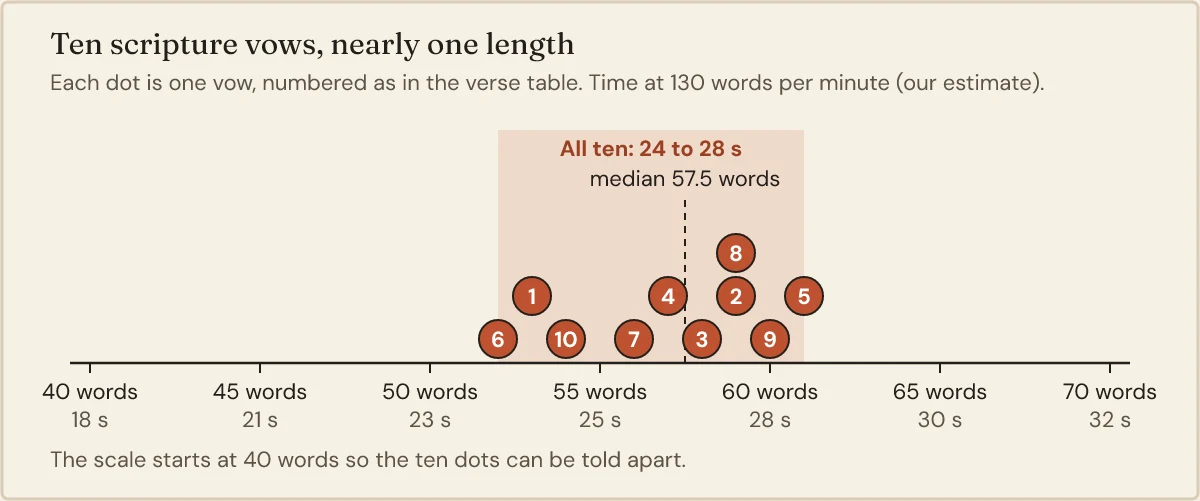
Table: ten vows, their source passage and how long each takes to say (our estimate, assumptions below)
| # | Theme | Passage | Translation | Vow words | Time to say |
|---|---|---|---|---|---|
| 1 | Wherever you go | Ruth 1:16-17 | KJV | 53 | 24 seconds |
| 2 | Patience and kindness | 1 Corinthians 13:4-7 | KJV | 59 | 27 seconds |
| 3 | Two are better than one | Ecclesiastes 4:9-12 | KJV | 58 | 27 seconds |
| 4 | Love that lasts | Song of Solomon 8:6-7 | KJV | 57 | 26 seconds |
| 5 | One household | Genesis 2:24 | KJV | 61 | 28 seconds |
| 6 | Forgiveness | Colossians 3:13-14 | KJV | 52 | 24 seconds |
| 7 | Trust the road | Proverbs 3:5-6 | KJV | 56 | 26 seconds |
| 8 | A blessing | Numbers 6:24-26 | KJV | 59 | 27 seconds |
| 9 | An open home | Joshua 24:15 | KJV | 60 | 28 seconds |
| 10 | What God has joined | Mark 10:9 | KJV | 54 | 25 seconds |
The vow words are our own, written for this page. The verses are quoted from the King James Version, which is public domain in the United States. The time to say each vow assumes 130 words per minute. That pace is our assumption, a little slower than normal speech, because people slow down at an altar.

What the Bible says about vows, and what it does not
The Bible does not hand you a marriage vow script. It does talk about keeping a vow made to God. Ecclesiastes 5:4-5 says to pay what you have vowed, and that it is better not to vow than to vow and not pay.
The familiar words to have and to hold, for better for worse, in sickness and in health come from the Book of Common Prayer. That is a church liturgy, not scripture. If you want that classic wording as a base, our page on the classic vow wording gives it with its history.
So a Christian vow can be built three ways:
- Say the prayer book words your church uses.
- Read a passage, then say your own promise.
- Write a vow that echoes a verse, like the ten below.
The ten vows in full
Each vow has the verse, a note on where it comes from, the vow, its length and one line to personalize.
1. Wherever you go (Ruth 1:16-17)
Whither thou goest, I will go; and where thou lodgest, I will lodge: thy people shall be my people, and thy God my God.
Ruth says this to her mother-in-law Naomi, not to a spouse. Couples borrow it for its loyalty.
I will go where you go. If work moves us across the country, I will pack the boxes and learn the new streets. Your family will be my family. Your hard seasons will be mine. I do not promise to be easy company every day. I promise to be there, and to stay.
53 words, about 24 seconds. Fits couples who expect a move, a deployment or a long-distance start. Make it yours: Replace the first sentence of the second line with the real place you are heading, or the real thing you will both have to carry.
2. Patience and kindness (1 Corinthians 13:4-7)
Charity suffereth long, and is kind; charity envieth not; charity vaunteth not itself, is not puffed up.
The King James Version uses “charity” where most modern translations say “love”.
I promise to be patient when you are tired and kind when I am. I will not keep score of old mistakes. I will believe the best of you before I assume the worst. When we disagree, I will aim for the truth and not for the win. I will keep choosing this, one ordinary day at a time.
59 words, about 27 seconds. The most requested passage, so pair the vow with a different reading if it is already in your program. Make it yours: Name one fight you both know and say how you will handle it differently.
3. Two are better than one (Ecclesiastes 4:9-12)
Two are better than one; because they have a good reward for their labour. For if they fall, the one will lift up his fellow.
The passage ends with the threefold cord, which many couples read as a nod to God joining them.
I am better with you than without you, and I want to say so out loud. When you fall, I will help you up. When I fall, I will let you. I promise to share the heavy things and the small wins. We are two people holding one rope, and I plan to keep my hands on it.
58 words, about 27 seconds. Works for couples who describe their relationship as a team. Make it yours: Swap “one rope” for the real image you use, such as a trail, a boat or a shared business.
4. Love that lasts (Song of Solomon 8:6-7)
Set me as a seal upon thine heart, as a seal upon thine arm: for love is strong as death. Many waters cannot quench love, neither can the floods drown it.
This is a love poem. It is one of the few passages in the Bible written about romantic love.
Keep me close, and I will keep you close. I want my love for you to be something the hard years cannot wash out. When money is tight, when work is loud, when we are both worn thin, I will come back to you first. That is my promise, and I mean it for the long run.
57 words, about 26 seconds. Suits a quieter, more romantic ceremony. Make it yours: Replace “money is tight” with the pressure you actually expect to face.
5. One household (Genesis 2:24)
Therefore shall a man leave his father and his mother, and shall cleave unto his wife: and they shall be one flesh.
The verse is worded for a man and a wife. The vow below drops that framing and keeps the idea of a new household.
Today we start one household out of two. I will put our home first among the people I love. I will ask what you think before I say what I want. I will share the closet, the calendar and the quiet mornings. I promise to build a place where both of us are at ease, and both of us are known.
61 words, about 28 seconds. A good fit for couples who already live apart from their parents and are merging two lives. Make it yours: Name one habit you will stop doing alone, like deciding on a trip or a purchase.
6. Forgiveness (Colossians 3:13-14)
Forbearing one another, and forgiving one another, if any man have a quarrel against any: even as Christ forgave you, so also do ye.
Verse 14 continues with charity as “the bond of perfectness”, which ties it back to the love passage.
I will say sorry quickly and mean it. I will forgive without making you earn it twice. I will not drag yesterday into today’s argument. When we get it wrong, and we will, I promise to start again with you, gently, and keep love as the thing that holds everything else together.
52 words, about 24 seconds. For couples who want a vow that admits they will fight. Make it yours: Add the apology you are best at and the one you are worst at.
7. Trust the road (Proverbs 3:5-6)
Trust in the Lord with all thine heart; and lean not unto thine own understanding. In all thy ways acknowledge him, and he shall direct thy paths.
A general verse about trust that was not written for weddings. Couples use it for the future.
We do not know what is coming, and I am at peace with that, because I will face it beside you. I promise to pray with you, to plan with you, and to say plainly when I am afraid. I will trust you with the hard decisions, and I will trust the road we walk together.
56 words, about 26 seconds. Right for couples facing a big unknown, like a career change, a first child or a health worry. Make it yours: Replace “the hard decisions” with one specific decision you have already shared.
8. A blessing (Numbers 6:24-26)
The Lord bless thee, and keep thee: The Lord make his face shine upon thee, and be gracious unto thee: The Lord lift up his countenance upon thee, and give thee peace.
This is a priestly blessing spoken over a group. Many officiants use it to close a ceremony.
I promise to be a blessing to you. I will speak well of you at home and away. I will protect your rest, your peace and your dreams. When you walk into a room, I want to be the person who is glad you came. May our home be a place where peace lives and you are always welcome.
59 words, about 27 seconds. Good as the last vow of the set, because the verse itself works as a closing. Make it yours: Name one dream of theirs you will protect, in their own words.
9. An open home (Joshua 24:15)
As for me and my house, we will serve the Lord.
Joshua says this to a whole people about choosing whom to follow. Couples use it for the home they are building.
Today I promise that you and I will make a home that serves God and our neighbors. We will keep our table open to friends and strangers. We will give before we are asked. I will lead this home with you, side by side, with honesty, with humor and with a door that stays open for people who need us.
60 words, about 28 seconds. Suits couples who plan to host, volunteer or foster. Make it yours: Name the first person or group you want at your table.
10. What God has joined (Mark 10:9)
What therefore God hath joined together, let not man put asunder.
Many officiants say this line themselves right after the vows, so check before you also use it in a vow.
What God has joined, I will not pull apart. I will guard what we have built from busy schedules, from other people’s opinions and from my own pride. I promise to protect our marriage the way I would protect something fragile and priceless. We start this together today, and together we will finish it.
54 words, about 25 seconds. A strong fit for couples who want the vow to sound like a commitment first and a poem second. Make it yours: Replace “busy schedules” with the thing most likely to crowd you out, like travel or screens.
A worked example: two vows and one reading
Say you want a reading and two short vows. This is the length you are planning for.
Example: two vows and one reading, timed at 130 words per minute (our assumption).
- Partner one says vow 1, Wherever you go: 53 words, 24 seconds.
- Partner two says vow 3, Two are better than one: 58 words, 27 seconds.
- The officiant reads the Ruth lines first: 38 words, 18 seconds.
- Total spoken: 149 words, 1 min 09 sec. This is an estimate and does not include pauses, laughter or tears.
That is enough room inside a normal ceremony without crowding the rest of it. If you want a shorter set, trim a sentence from each vow, or try the versions under a minute.
All ten vows run 52 to 61 words, so each takes 24 to 28 seconds to say.
How to use a verse in the ceremony
-
Ask your pastor or officiant what your church allows. Some require set vows. Some welcome personal ones.
-
Choose where the verse goes. Most couples read it as a reading before the vows, not inside them.
-
Pick one vow above. Copy it and change the personalize line so it names something real.
-
Read it aloud twice. Cut any line you stumble on, and match the length to your partner’s.
-
Print the card in a large font and give a copy to your officiant. The ceremony script for a church service shows where vows and readings sit in the order of service.
Mistakes to avoid
- Using old language you do not speak. Thee and thou are fine in a reading. In a vow, they can make you sound like someone else. Use the verse as an echo and keep the vow plain.
- Doubling up on 1 Corinthians 13. It is the most read wedding passage. If it is already your reading, pick a different verse for the vow.
- Two vows that do not match in length. If one partner speaks three times as long, the moment feels uneven. Match them with the live word count above.
- Copying a vow without changing a word. Guests can tell. Swap one line for a detail only the two of you know. If you need help, see how to write your own wedding vows.
Pass it to your officiant
Not sure which verse fits? Send your officiant a short note. Here is wording you can copy.
Hi, I found ten Bible verses paired with short vows for our ceremony. Could you look at the list and tell me which ones fit our service? Here is the page: [link]. Our favorites so far are numbers ___ and ___.
If you are choosing as a couple, each of you can pick a favorite separately, then compare. If you also want a reading from outside scripture, browse readings that are not from scripture as well.

Save for later
Pin it now and find it when you are ready to plan.
Questions people ask
What does the Bible say about wedding vows?
The Bible does not give a script for marriage vows. It does speak about vows made to God, and Ecclesiastes 5:4-5 says to keep them and warns that not vowing is better than breaking a vow. The familiar words to have and to hold come from the Book of Common Prayer, not from scripture.
What are Christian wedding vows?
Christian wedding vows are promises made before God and the guests, often in the wording of a prayer book or a church's own liturgy. Many couples now write their own and add a Bible reading. Ask your pastor first, because some churches require set words and some allow personal vows.
Which verses are used in wedding vows?
The most common are Ruth 1:16-17 for loyalty, 1 Corinthians 13:4-7 for love, Ecclesiastes 4:9-12 for partnership, Genesis 2:24 for a new household and Colossians 3:13-14 for forgiveness. Most are read aloud as a reading, then answered with a personal vow like the ten above.
Can we use a modern translation instead of the King James Version?
Yes, but check the permission terms of that translation before you print its text in a program or on a sign. We quote only the King James Version, which is public domain in the United States. The meaning of each verse is the same, and your officiant can read a modern version aloud.
Should the vow quote the verse word for word?
Usually not. Reading the verse as a separate reading, then speaking a vow in your own words, sounds more natural than a vow stuffed with old language. Use a short phrase from the verse as an echo, such as wherever you go, and let the rest of the vow sound like you.
Sources
- www.biblegateway.com/passage/?search=Ruth+1%3A16-17&version=KJV (opens in a new tab) : King James Version text of Ruth 1:16-17, the loyalty passage in vow 1.
- www.biblegateway.com/passage/?search=1+Corinthians+13%3A4-7&version=KJV (opens in a new tab) : King James Version text of 1 Corinthians 13:4-7, including the word charity, behind vow 2.
- www.biblegateway.com/passage/?search=Ecclesiastes+4%3A9-12&version=KJV (opens in a new tab) : King James Version text of Ecclesiastes 4:9-12, the two are better than one passage behind vow 3.
- www.biblegateway.com/passage/?search=Song+of+Solomon+8%3A6-7&version=KJV (opens in a new tab) : King James Version text of Song of Solomon 8:6-7 behind vow 4.
- www.biblegateway.com/passage/?search=Genesis+2%3A24&version=KJV (opens in a new tab) : King James Version text of Genesis 2:24 behind vow 5.
- www.biblegateway.com/passage/?search=Colossians+3%3A13-14&version=KJV (opens in a new tab) : King James Version text of Colossians 3:13-14 behind vow 6.
- www.biblegateway.com/passage/?search=Proverbs+3%3A5-6&version=KJV (opens in a new tab) : King James Version text of Proverbs 3:5-6 behind vow 7.
- www.biblegateway.com/passage/?search=Numbers+6%3A24-26&version=KJV (opens in a new tab) : King James Version text of Numbers 6:24-26 behind vow 8.
- www.biblegateway.com/passage/?search=Joshua+24%3A15&version=KJV (opens in a new tab) : King James Version text of Joshua 24:15 behind vow 9.
- www.biblegateway.com/passage/?search=Mark+10%3A9&version=KJV (opens in a new tab) : King James Version text of Mark 10:9 behind vow 10.
- www.biblegateway.com/passage/?search=Ecclesiastes+5%3A4-5&version=KJV (opens in a new tab) : King James Version text of Ecclesiastes 5:4-5, the Bible's own words about keeping a vow made to God.
- www.churchofengland.org/liturgy/book-of-common-prayer/form-solemnization-matrimony (opens in a new tab) : The Book of Common Prayer marriage service is the source of the wording to have and to hold, for better for worse, in sickness and in health.
Updated by bigdaydesk editorial
Keep planning
-
Wedding vows to wife
Written to be said to a wife or bride, with sentence starters for the memory and for a promise she would notice.
-
Gives the classic text with its public-domain
Gives the classic text with its public-domain source and a line-by-line modern rewording, including options for the word obey.
-
Replaces classic lines with promises about everyday
Replaces classic lines with promises about everyday life, for secular and unconventional ceremonies.
-
Wedding speech mother of the groom: what to say
Gives a short welcome-to-the-family frame and two examples, one for a short toast and one for a full speech.


