Make it yours (all optional)
Finish each sentence in your own words. Leave a line empty and we skip it. Names and details stay in your browser. A shared link carries them after the # so no server receives them. Your edits to the text are not in the link.
Wedding vowsbigdaydesk.com
Your vows (edit them here)
Your settings changed. This replaces your edits.
Share this result
Send this exact result. The link opens it the same way for them.

Save this result to Pinterest
Pin it now and find it when you are ready to plan.
Non traditional wedding vows keep the commitment and drop the stock phrases. You say what you will actually do, in everyday words, and you can still use a classic line where it fits. Pick a style in the builder above, or copy one of the twelve below and see which old line it replaces.
What you are really changing
The classic English vows are older than most people expect. A page summarizing the history of marriage vows traces the 1549 prayer book wording back to an earlier Salisbury rite. It also notes that “till death us do part” was once “till death us depart,” and was reworded in 1662 because the word had shifted in meaning.
So the wording has always moved. Your edits continue a long habit. What stays is the job each line does: stay, care, be faithful, start now. Non traditional vows do those jobs with your own words.
If you want to keep a few classic lines, the traditional wedding vows page shows the standard text. You can mix and match.

Vow list: twelve non traditional vows and the classic line each replaces
Each vow below has a visible word count, the classic line it stands in for, and a plain-language version of that classic line. Read them aloud. Keep the ones that sound like you, then change the details.
At a glance, classic line on the left, modern vow on the right:
- “To have and to hold”: showing up for the boring parts
- “For better, for worse”: staying on the same side
- “For richer, for poorer”: talking about money out loud
- “In sickness and in health”: the night shift
- “To love and to cherish”: saying it with details
- “Till death us do part”: choosing again
- “Forsaking all others”: being straight with each other
- “From this day forward”: starting on purpose
- “To love, honor and obey”: equal voices
- “I take you to be my lawfully wedded spouse”: partner on paper
- “With this ring, I thee wed”: a ring you can point to
- “I plight thee my troth”: giving your word
1. Showing up (25 words)
I promise to show up for the boring parts: the dishes, the paperwork, the long drives. I will hold your hand through all of them.
Replaces: “to have and to hold.” Plain version: Stay close to each other in daily life. Make it yours: Swap in the chore you both dread.
2. Same side (27 words)
I promise to stay on your team when things go badly. When I think you are making a mistake, I will tell you kindly, then help anyway.
Replaces: “for better, for worse.” Plain version: Stay through good times and bad ones. Make it yours: Name one rough stretch you already got through.
3. Money out loud (29 words)
I promise to talk about money in plain words. I will tell you before the big purchase, and when the account runs low, we will make a plan together.
Replaces: “for richer, for poorer.” Plain version: Stand together whatever your finances look like. Make it yours: Add the one money habit you plan to share, such as a monthly check-in.
4. Night shift (33 words)
I promise to bring you soup, take the night shift, and keep you laughing when you feel terrible. I will also look after my own health, so I can be around for you.
Replaces: “in sickness and in health.” Plain version: Care for each other when one of you is unwell. Make it yours: Mention a time you looked after each other. The in sickness and in health page goes deeper on this line.
5. Say it with details (22 words)
I promise to keep telling you what I love about you, with specifics, long after the wedding photos are in a drawer.
Replaces: “to love and to cherish.” Plain version: Love each other actively and value each other. Make it yours: Put one real detail in, like how you laugh at your own jokes.
6. Choosing again (25 words)
I promise to choose you again whenever the choice comes up, for as many years as we get. I will not take today for granted.
Replaces: “till death us do part.” Plain version: Stay committed for life. Make it yours: Add where you picture yourselves in old age.
7. Straight with you (24 words)
I promise to be faithful to you. I promise to tell you when something feels off between us before it grows into something bigger.
Replaces: “forsaking all others.” Plain version: Be faithful and honest. Make it yours: Keep it plain. This is one place where jokes can undercut the promise.
8. Starting on purpose (24 words)
Starting today, I promise to build this life with you on purpose. We will keep a regular date night, even when we are tired.
Replaces: “from this day forward.” Plain version: The commitment begins now and continues. Make it yours: Name your actual ritual, whether it is Friday tacos or a Sunday walk.
9. Equal voices (27 words)
I promise to treat your opinion as equal to mine. I will share the work at home, and I will never win an argument by being louder.
Replaces: “to love, honor and obey.” Plain version: Respect each other as equals. The Episcopal Church voted to drop “obey” from the bride’s vow in 1922, so this edit is not new. Make it yours: Add the household task you will take over.
10. Partner on paper (30 words)
I take you as my partner and my best friend, and as the person I most want to argue about restaurants with. I am glad the paperwork makes it official.
Replaces: “I take you to be my lawfully wedded spouse.” Plain version: I accept you as my spouse. Make it yours: Swap the restaurant joke for your own running argument.
11. A ring you can point to (24 words)
I give you this ring as a reminder that I made these promises on purpose. You can hold me to every one of them.
Replaces: “with this ring, I thee wed.” Plain version: The ring marks the commitment. Make it yours: Add a line about where the ring came from.
12. My word (19 words)
I give you my word, and I will keep it, including on the days when keeping it is inconvenient.
Replaces: “and thereto I plight thee my troth.” Plain version: I pledge my honesty and loyalty. Make it yours: End with something short enough to say without looking down.
Four add-ons to drop in anywhere
- “I promise to keep dating you.” (6 words)
- “I promise to apologize quickly and mean it.” (8 words)
- “I promise to protect our time together.” (7 words)
- “I promise to give you room to grow and be there when you need me.” (15 words)
Worked example: the default result, and how long a set takes
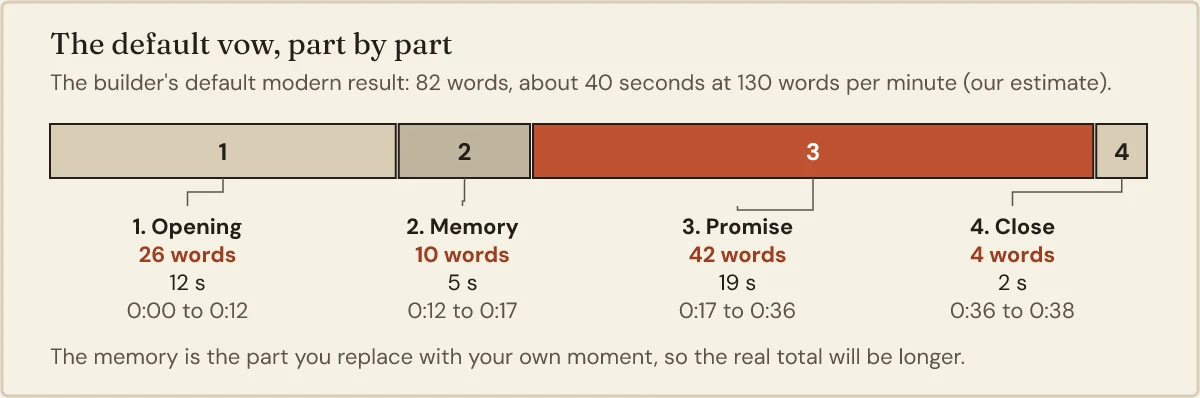
The builder above opens on the modern style with no personal details filled in. It produces an opening of 26 words, a memory of 10, a promise of 42 and a close of 4.
Total: 82 words, about 40 seconds at our assumption of 130 words per minute (an estimate, not a rule).
All twelve vows above add up to 309 words, about 2.4 minutes. That is far too long for one ceremony, so pick between two and four.
A trio such as vows 2, 4 and 6 comes to 85 words, about 39 seconds.
Table: words to speaking time at our assumed 130 words per minute (our estimate, assumptions below)
| Words | Time to say |
|---|---|
| 65 | 30 seconds |
| 130 | 1 minute |
| 195 | 1.5 minutes |
| 260 | 2 minutes |
| 390 | 3 minutes |
The 130 pace is our own assumption for emotional delivery. A speaking-rate guide from Baruch College puts normal English speech at about 150 words per minute, so we assume you will slow down. Joy gives 1 to 2 minutes per person for a non-religious ceremony, which is about 130 to 260 words at that pace.
Until you add your own details, the default result is 82 words, and 42 of them are promises.
How to mix classic and modern
You do not have to pick a side. Three combinations work well.
- Classic frame, modern middle. Keep “from this day forward” and “till death us do part,” and put your own promises between them.
- Modern frame, one classic line. Write everything yourself, then end on “in sickness and in health” because it still lands.
- Quoted reading plus your vows. Add a short reading before you speak. Texts from the Bible are one source, and poems or a favorite book are others.
If you are stuck on the first draft, the steps for writing your own page walks through it. The fill-in vows template gives you a four-part frame with a live word count.
Three mistakes and how to fix them
Too many inside jokes. Guests who do not know the reference tune out. Keep one joke, explain it in a clause, and put the sincere promise right after it. The funny wedding vows page shows how to balance the two.
Promises you will not keep. “I will never get angry” sets you up to fail. Promise a behavior, such as “I will apologize quickly,” instead of a feeling.
Mismatched length. If one of you speaks for 40 seconds and the other for three minutes, the contrast stings. Count words in advance and trim. For short options, see shorter vows.
Before you finalize
- Ask your officiant if any specific words are required for your ceremony or license.
- Read the vows aloud and time them. The word count and time panel in the builder does the math.
- Send your draft to your partner or a trusted friend for a quick read. Use the share buttons above.
- Print the card, or save it on your phone, so you are not hunting for it on the day.
One poll of nearly 2,000 Australian respondents found 43% planned to write their own vows, and 57% planned to use traditional prewritten ones. You are in good company either way.
Questions people ask
What are non traditional wedding vows?
They are vows that skip the fixed historic phrases and say the same commitments in your own words. Instead of "to have and to hold," you might promise to share the housework or keep dating each other. They can be serious, funny or both, and they work in any ceremony your officiant allows.
Can vows be non religious?
Yes. Nothing about a promise needs a religious phrase. Many couples keep the structure of an opening, a memory, promises and a close, and drop the religious language. Check with your officiant and your license office about any wording your ceremony must include, then add your own vows around that.
What can I promise instead of the classic lines?
Promise things you will actually do. Honesty, a fair share of the work at home, open talks about money, care when one of you is ill, and time set aside for each other all replace the old lines well. Pick promises you could be held to on an ordinary Tuesday.
How long should non traditional vows be?
Sources put vows at 1 to 2 minutes per person in a non-religious ceremony, with some guides calling 2 to 3 minutes ideal. At our assumed 130 words per minute, that is roughly 130 to 390 words. Shorter lands better for most people, so read yours aloud once and cut anything that drags.
Should both partners write the same style of vow?
It helps if the length and tone are close, so neither of you feels outdone. Style can differ. One partner can be funny and the other plain, and the contrast often reads as honest. Compare word counts before the day and trim until you are within a few lines of each other.
Sources
- en.wikipedia.org/wiki/Marriage_vows (opens in a new tab) : History of the classic English wording, including "till death us do part" (changed in 1662) and the removal of "obey" from the bride's vow in the Episcopal Church in 1922.
- withjoy.com/blog/wedding-ceremony-order-of-events (opens in a new tab) : In a non-religious ceremony, vows take 1 to 2 minutes per person, and the whole ceremony runs 20 to 30 minutes.
- bridebook.com/uk/article/how-long-should-wedding-vows-be (opens in a new tab) : Ideal vow length of 2 to 3 minutes per person, within a range of 1 to 4 minutes.
- tfcs.baruch.cuny.edu/speaking-rate (opens in a new tab) : Average English speaking rate of about 150 words per minute. Our 130 words per minute for vows is our own slower assumption.
- easyweddings.com.au/wedding-polls/will-you-be-writing-your-own-vows (opens in a new tab) : One Australian poll of nearly 2,000 respondents found 43% planned to write their own vows and 57% planned to use traditional prewritten ones.
Updated by bigdaydesk editorial
Keep planning
-
Wedding vows in the bible
Pairs each vow with the verse behind it, quoted from a public-domain translation with a link to the source.
-
Wedding vows standard
Gives the classic text with its public-domain source and a line-by-line modern rewording, including options for the word obey.
-
Curious about vows in sickness and in health?
Takes one famous phrase apart and offers rewrites for couples who want the promise in plainer language.
-
The role landing
The role landing: a five-part structure with timings, ten opening lines and a short what-not-to-say list with reasons.


