Make it yours (all optional)
Finish each sentence in your own words. Leave a line empty and we skip it. Names and details stay in your browser. A shared link carries them after the # so no server receives them. Your edits to the text are not in the link.
Wedding vowsbigdaydesk.com
Your vows (edit them here)
Your settings changed. This replaces your edits.
Share this result
Send this exact result. The link opens it the same way for them.
Save this result to Pinterest
Pin it now and find it when you are ready to plan.
Pick a tone in the builder above, type one real detail into each blank, and you get a short vow with its word count and speaking time. Print the card or copy the text. Every part stays editable. This page covers the four-part structure and how two partners keep their vows the same length. For tone and wording ideas, start at the wedding vows hub.
Each of you fills in a version on your own, then you compare word counts before you read a line of the other’s. To do that, send the clean page address, from a fresh tab before you type anything.
Template example: the four parts, labeled
Every vow in the builder has the same four parts. This is the default result, with each part labeled and counted. The tool built it with no personal details, so it is a bare frame: stock wording to replace, not a model to copy. The memory is only 10 words here, well under the 30 to 50 word budget in the next section, on purpose, because that is the part you fill in.
Opening, 27 words. When I look at you, I see the life I always hoped for. Today, in front of the people we love, I make this promise to you.
Memory, 10 words. With you, I stopped waiting for my life to start.
Promise, 45 words. I promise to celebrate your wins as if they were mine. I promise to build a home where we can both rest. I promise to be your teammate in the big decisions and the small ones. I promise to tell you the truth, gently, always.
Close, 12 words. You are my home, and I am so grateful to be yours.
Total: 94 words, about 45 seconds at our assumption of 130 words per minute (an estimate, not a rule).
Notice where the weight sits. The promise is nearly half the vow, and the memory is the shortest part. The memory is the part only you can write, so it should grow as you fill it in. Stock lines such as “I stopped waiting for my life to start” are what to swap out. A concrete version sounds like “I knew on the drive home from your cousin’s wedding, when you handed me the last of the fries.” That sentence is our illustration of the difference, not a line to use.
A filled-in sample with real details
Here is the same frame after a few details went into the blanks: a name, how you met, a small habit, and a place you want to go. The tool kept the four-part structure, and it also re-drew the promises and the close, so these two blocks differ in more than the details. The wording is still the tool’s stock phrasing.
Opening, 28 words. Sam, when I look at you, I see the life I always hoped for. Today, in front of the people we love, I make this promise to you.
Memory, 23 words. We met at a friend’s backyard barbecue, and something in me finally settled. When you hum while you cook, I feel at home.
Promise, 45 words. I promise to build a home where we can both rest. I promise to keep choosing love on the days it is difficult. I promise to hold you when words are not enough. My favorite future has us ready to see Lisbon, hand in hand.
Close, 12 words. Thank you for loving me. I will never take it for granted.
Total: 108 words, about 50 seconds at 130 words per minute (an estimate).
Compare only the memory part, since the rest was re-drawn: it grew from 10 words to 23, more than double. A name, a place and a habit are the cheapest ways to make a vow sound like one person wrote it.
A full vow to copy and fill in
Prefer to write by hand or in your notes app? Copy this whole scaffold and replace everything in [brackets]. Make the promises ones you could check after a bad week, and see traditional wording if you want the classic phrasing for them.
[Partner's name],
Today, in front of the people we love, I want to tell you something true.
I knew I loved you when [a specific moment: where you were, what happened].
I love the way you [a small habit], and how you [something you do for other people].
I promise to [an everyday promise, such as a chore or a routine].
I promise to [what you will do on a hard day].
I promise to [something fun you will keep doing].
I promise to [a promise only the two of you would recognize].
[One short last line.]
Each part has a rough word budget, which is our own suggestion and not a sourced rule.
Table: suggested word budget per part (our estimate, assumptions below)
| Part | Blank to fill | Words to aim for |
|---|---|---|
| Opening | “[Name], today I stand here to tell you something true.” | 20 to 30 |
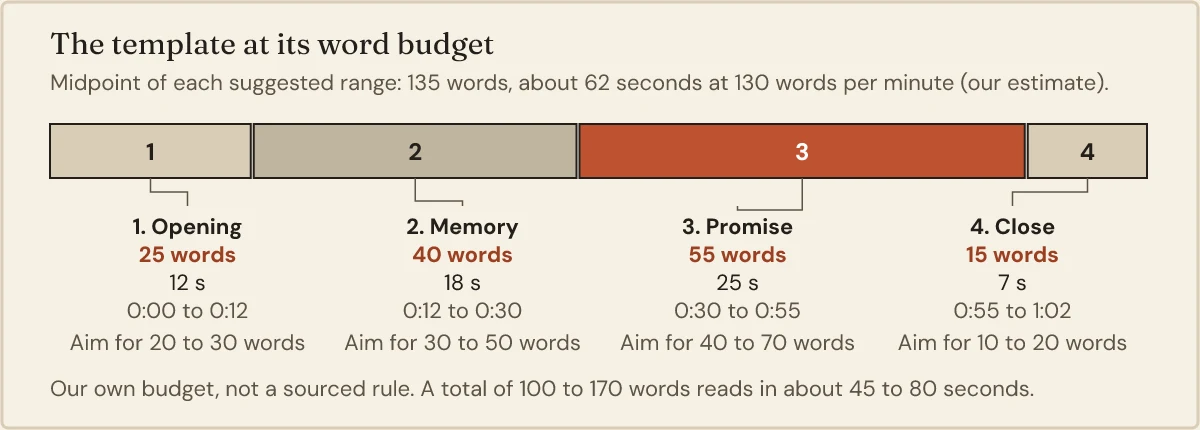
| Memory | “I knew when [moment]. I love the way you [small habit].” | 30 to 50 |
| Promise | “I promise to [everyday]. I promise to [hard day]. I promise to [something fun].” | 40 to 70 |
| Close | “[One short last line].” | 10 to 20 |
Assumption: a total of 100 to 170 words, which at 130 words per minute reads in about 45 to 80 seconds. If you want something shorter, start from short vows. If you want laughs, try funny wedding vows.
At the middle of each range the vow runs 135 words, a little over a minute, and the promise gets the most room.
How long your vow will take to say
Speaking time is words divided by pace. We use 130 words per minute, a bit slower than the English average of about 150 words per minute that the Baruch College speaking-rate page gives. Vows are said with pauses, a shaky breath, and a pause for the guests to react, so slower is the safe assumption.
Table: words and speaking time at 130 words per minute (our estimate, assumptions below)
| Speaking time | Words | Fits |
|---|---|---|
| 30 seconds | 65 | Below the budget: an opening and one short promise |
| 1 minute | 130 | Inside the budget, near its midpoint of 135 |
| 1.5 minutes | 195 | Above the budget: room for a second memory |
| 2 minutes | 260 | Well above it, with two memories and a longer close |
| 3 minutes | 390 | Top of the Zola range |
| 4 minutes | 520 | Top of the Bridebook range |
The default medium build in the builder is 94 words, just under the budget floor. Its shortest build, in the short style, comes in at 42 words, about 20 seconds. These come from our own logic, not a survey. Your pace may differ, so read yours aloud with a timer once. For the published ranges and ceremony fit, see the writing guide.
Two partners, two lengths: a worked comparison
The template’s job is to keep two vows in the same range. Take one partner at the default 94 words and one at 260 words. At 130 words per minute, the first is about 45 seconds and the second is 2 minutes. The gap is 166 words, about 75 seconds (our estimate). Together they run 354 words, about 2 minutes 45 seconds, and the guests will hear the difference in effort even if the content is equal.
Here is how the two fix it with this page. The 260-word writer is 90 words above the 170-word top of the budget, so they cut a second memory and trim each promise to one sentence. The 94-word writer is 6 words under the 100-word floor, and their memory has 10 words where the budget says 30 to 50, so they grow that part by 30 words or so. Both then sit inside 100 to 170 words, within about 30 seconds of each other. See where both vows fall in your ceremony script.
From draft to card
- Pick the tone that sounds most like how you talk.
- Replace the memory first. It is the hardest part, so do it while you are fresh. Finished vows to borrow structure from are in the examples section of the hub above.
- Read it aloud and mark where you breathe.
- Trade word counts with your partner, not the text.
- Print the card in a large font, check the order vows follow, or paste it into a printed vow booklet.
Questions people ask
What should I include in my wedding vows?
Four things cover it. Say who you are talking to, share one specific memory, make a few promises you can keep, and end on a short closing line. Skip inside jokes the guests cannot follow, and skip anything you would not say to your partner in private.
How long should wedding vows be?
Plan on 1 to 2 minutes each, which is about 130 to 260 words at our 130 words per minute pace. The four-part word budget on this page adds up to 100 to 170 words, so most vows land near the bottom of that range. The sources paragraph below has the published ranges. Check your own count in the builder above.
How do I write wedding vows from a template?
Pick a tone, then replace each blank with something only you could say. Use a real moment, not a general feeling. Read the result aloud once and cut any line that sounds like a greeting card. Then trim until both partners land near the same word count.
Can we use the same template and still sound different?
Yes, if the blanks hold different material. Two people using the same frame will still write different memories and different promises. Fill yours in separately, do not peek, and compare only the word count. Share the clean page address, not a link copied after you typed, because that link carries your text.
Sources
- www.zola.com/expert-advice/average-wedding-vow-length (opens in a new tab) : Personal vows are said in 30 seconds to 3 minutes.
- bridebook.com/uk/article/how-long-should-wedding-vows-be (opens in a new tab) : Vows per person run from 1 to 4 minutes, with 2 to 3 minutes called ideal.
- withjoy.com/blog/wedding-ceremony-order-of-events (opens in a new tab) : Vows take 1 to 2 minutes per person inside a ceremony of 20 to 30 minutes.
- tfcs.baruch.cuny.edu/speaking-rate (opens in a new tab) : Average English speaking rate of about 150 words per minute. Our 130 words per minute for vows is our own slower assumption.
Updated by bigdaydesk editorial
Keep planning
-
Seating chart for wedding
Paste a guest list, set table sizes and seat people with checks for overfull tables and keep-apart rules, then print the table cards.
-
A mirror layout calculator
A mirror layout calculator: block grid, name capacity and lettering height from the mirror size, with chalk guide measurements to mark on the glass.
-
Curious about seating chart ideas?
Display ideas only: filter twenty styles by guest count, budget and effort, send the shortlist as a link, and see which still fit at 30, 80 and 150 guests.
-
Wedding emergency kit for bride
Quantities scale with the size of the wedding party and you tick items off for each bag so nothing is packed twice.