Make it yours (all optional)
Finish each sentence in your own words. Leave a line empty and we skip it. Names and details stay in your browser. A shared link carries them after the # so no server receives them. Your edits to the text are not in the link.
Wedding vowsbigdaydesk.com
Your vows (edit them here)
Your settings changed. This replaces your edits.
Share this result
Send this exact result. The link opens it the same way for them.

Save this result to Pinterest
Pin it now and find it when you are ready to plan.
To write your own wedding vows, answer six short questions in plain words, then join the answers into one page. Start with a memory, not a feeling. The builder above assembles a rough draft from your answers, and you edit it in place. Plan 30 minutes for the first draft and a second sitting for the edit.
Prompt list: six questions, a sample answer and the sentence it becomes
Answer each prompt in one rough sentence. Do not polish. The right column shows how a sample answer turns into a line you could say aloud. The sample couple is invented, so use it only as a model.
Table: six vow prompts with an invented sample answer, the finished sentence and its word count (our own example, counted by spaces)
| # | Prompt | Sample answer | The sentence it becomes | Words |
|---|---|---|---|---|
| 1 | Who are they to you, in one plain line? | The person I call first | You are the person I call first, and today I get to say that in front of everyone we love. | 20 |
| 2 | Which moment made you sure? | Car died outside Tulsa, you made a picnic | I knew on the roadside outside Tulsa, when the car died and you spread a picnic on the hood. | 19 |
| 3 | What small habit do you love? | Hums off key making coffee | I love how you hum off key while the coffee brews, and how you never learned the second verse. | 19 |
| 4 | When did they show up on a hard day? | Slept in the hospital chair for my dad | When my dad was in the hospital, you slept in that plastic chair for three nights and never said it was a favor. | 23 |
| 5 | What will you do, in daily terms? | Say sorry first, cook Sundays | I promise to say sorry first when it is my turn, to cook on Sundays, and to keep the hazard lights joke alive. | 23 |
| 6 | Where are you headed, in one line? | Staying together on the road | Wherever the road goes, I choose the seat next to yours. | 11 |
Example: the six sentences above read in order make one vow.
- Total: 115 words.
- Speaking time at our assumed 130 words per minute: about 53 seconds.
- Biggest cut available: the habit line in row 3, which saves 19 words and about 9 seconds.
Notice what the sentences share. Each holds one object or place: a roadside, a coffee pot, a plastic chair. Those details are why a stranger in row eight still feels something. Prompts 2 to 4 carry the vow, and prompts 1, 5 and 6 are the frame around them.

How long each part should run
People overwrite the opening and run out of steam at the promises. Give each prompt a share of the total before you write.
Table: share of a 130 word vow for each prompt (our own suggested split, an estimate you can change)
| Prompt | Share | Words in a 130 word vow |
|---|---|---|
| 1 Who they are | 15% | 20 |
| 2 The moment | 20% | 26 |
| 3 The habit | 15% | 20 |
| 4 The hard day | 20% | 26 |
| 5 Your promises | 20% | 26 |
| 6 The close | 10% | 13 |
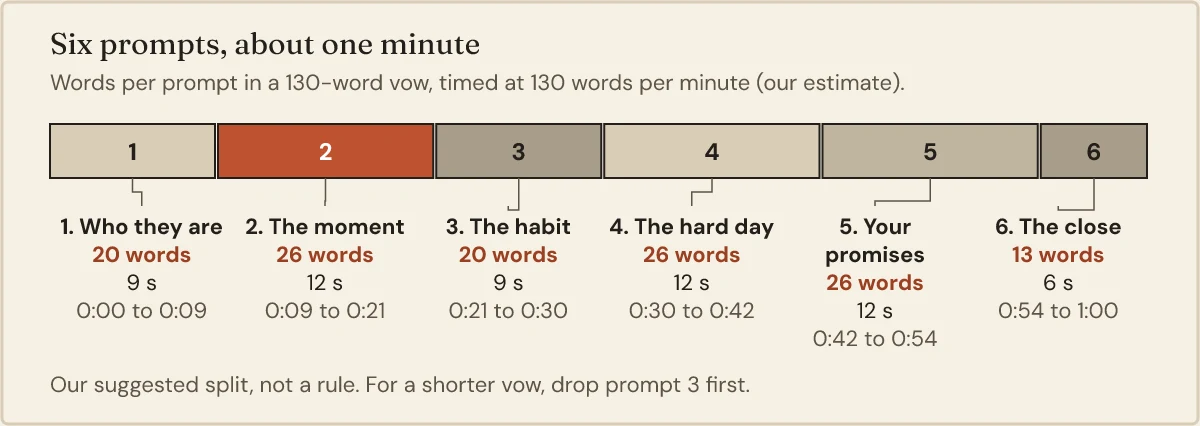
The split totals about 131 words, which is about one minute. If you want a shorter vow, drop prompt 3 first. If you want a longer one, add a second memory under prompt 2 instead of lengthening every line.
The moment, the hard day and your promises get 26 words each, while the close needs only 13.
Steps: a 30 minute first draft
This schedule is our suggestion, not a study. It works because it stops you from editing while you are still gathering material.
- Minutes 0 to 5: Open the builder above and pick the style closest to your voice. Read the sample draft once, then ignore it.
- Minutes 5 to 15: Answer prompts 1 to 6 in rough sentences. Use names, places and objects. Keep going when a line feels clumsy.
- Minutes 15 to 20: Read the assembled draft aloud. Mark every line that makes you wince.
- Minutes 20 to 27: Replace each marked line with a concrete detail or cut it. Cut first, rewrite second.
- Minutes 27 to 30: Check the live word count and time. Save the link or copy the text.
Then stop. Come back in two or three days for a second read. Weak lines stand out once you are no longer attached to them.
Scenarios that change how you write
You and your partner both write. Agree on a word count first, within about 20 words of each other. One long vow beside one short one feels uneven in the room. Do not swap drafts until both are final, unless you want to hear them fresh at the ceremony.
Your officiant prompts you line by line. Some ceremonies have you repeat short phrases. Then write in phrases of about eight words or fewer, and send your text to the officiant a week ahead. Long sentences are hard to repeat from memory.
You get nervous speaking. Write shorter sentences, and put a full stop where you want to breathe. Print the card in large type. A vow you can read slowly beats a clever one you rush.
It is a second wedding. Skip the “I never knew love until you” frame. Write about what your partner does now, and promise things about the life you share, such as the kids, the dog or the house.
You want some privacy. Some couples say short vows aloud and write longer ones as letters to read alone that morning. That is a fine split. Put the quiet details in the letter.
Length: how many words is enough
Sources give a wide range. Zola puts personal vows between 30 seconds and 3 minutes. Joy lists 1 to 2 minutes per person inside a ceremony of 20 to 30 minutes. Bridebook calls 2 to 3 minutes ideal, with 1 to 4 as the outer limits.
We assume 130 words per minute for vows, a bit slower than normal talk because you pause and feel it. Baruch College’s speaking-rate page puts the English average near 150 words per minute.
Table: word counts and speaking time at our assumed 130 words per minute (our estimate)
| Words | Time to say | Fits which source range |
|---|---|---|
| 65 | about 30 seconds | Bottom of Zola’s range |
| 130 | about 1 minute | Joy’s lower end |
| 195 | about 1.5 minutes | Inside Joy’s range |
| 260 | about 2 minutes | Joy’s upper end, Bridebook’s lower ideal |
| 390 | about 3 minutes | Top of Zola’s range, Bridebook’s upper ideal |
A good target for most people is 130 to 195 words. That is one to one and a half minutes, which feels long enough to matter and short enough to remember. The short vows page goes further with versions under a minute.
Three mistakes and the fix for each
Describing feelings instead of showing events. “You make me so happy” tells guests nothing. Fix: replace the feeling with the scene that caused it, like the roadside picnic above.
Promising things you will not do. “I will never go to bed angry” invites a quiet laugh from anyone who has been married. Fix: promise behaviors, such as “say sorry first when it is my turn.”
Telling a story only you two follow. Two inside jokes in a row lose the room. Fix: keep one inside reference, and give the guests one line of setup so they can join in.
Choose a voice before you write
The prompts work in any tone, but the tone changes which answers you choose. A tender vow leans on prompts 2 and 4. A light vow leans on prompts 3 and 5. A formal vow keeps prompts 1 and 6 and borrows older wording for the promises.
If you want the classic base, start from the traditional wording and add your memory in the middle. If one line matters most to you, build around in sickness and in health. To see how a heavier vow is built, read how emotional vows hold together.
Do you have to write them yourself
No. Consent in front of an officiant is what the law cares about in most places, and the words are your choice. One Australian reader poll, date not shown, found 43% of respondents planned to write their own and 57% to use traditional vows. It is not a US survey, so treat it as a rough signal only.
A middle path works well for many couples. Keep one classic line and write two or three sentences of your own. Or use a fill-in vows template and replace each blank with a real detail from the prompts above.
From draft to ceremony
After the edit, do three things.
- Time it once aloud, standing, at the pace you will use in the ceremony.
- Print it in large type, and bring a spare copy. A vows script shows where an officiant usually cues you.
- Tell your partner only the word count, not the words.
If a parent or friend will also speak at the reception, the same prompts work with the nouns changed. See how the structure shifts in the father of the bride speech.
Send it to your partner
Copy a line and send it with your link. The share buttons above keep your picks in the link, so it opens the same draft.
- To your partner: “I made my six prompt answers. Want to do yours and swap only the final drafts?”
- To a friend: “Can you read my vows aloud and tell me which line you remember?”
- To your officiant: “Here is my draft. It runs about a minute. Can we go over the cue points before the rehearsal?”
Questions people ask
How to write your own wedding vows
Answer six short questions in plain words, then join the answers. Say who your partner is to you, give one specific memory, add a small habit you love, name a hard moment they stood by you, make two or three promises you can keep, and close in one line. Read it aloud and cut anything you would not say at dinner.
Do you have to write your own wedding vows?
No. In most places the law only needs you to consent in front of an officiant and witnesses, so repeating classic words is fully valid. One Australian reader poll, date not shown, found 43% planned to write their own and 57% to use traditional vows. Many couples mix both, a classic line plus a few of their own sentences.
How long does it take to write vows?
A first draft takes about 30 minutes with the prompts above, based on our own suggested schedule, not a study. Plan a second sitting a few days later for edits, because you will see weak lines with fresh eyes. Read the draft aloud once with a timer, since spoken length is what guests will actually hear.
What should I leave out of my vows?
Leave out jokes only a few guests will understand, old partners, money complaints, and promises you do not intend to keep. Skip lines a greeting card could print, like "you complete me." Cut any story longer than three sentences. If you would be embarrassed to say it to your partner alone, it does not belong at the microphone.
Sources
- www.zola.com/expert-advice/average-wedding-vow-length (opens in a new tab) : Personal vows are said in 30 seconds to 3 minutes.
- withjoy.com/blog/wedding-ceremony-order-of-events (opens in a new tab) : Vows take 1 to 2 minutes per person inside a non-religious ceremony of 20 to 30 minutes.
- bridebook.com/uk/article/how-long-should-wedding-vows-be (opens in a new tab) : Vows per person run from 1 to 4 minutes, with 2 to 3 minutes called ideal.
- tfcs.baruch.cuny.edu/speaking-rate (opens in a new tab) : The English speaking average is about 150 words per minute. Our 130 words per minute for vows is our own slower assumption.
- easyweddings.com.au/wedding-polls/will-you-be-writing-your-own-vows (opens in a new tab) : One Australian reader poll, date not shown, with nearly 2,000 respondents, found 43% planned to write their own vows and 57% to use traditional ones. It is not a US survey.
Updated by bigdaydesk editorial
Keep planning
-
Write your vows traditional
Gives the classic text with its public-domain source and a line-by-line modern rewording, including options for the word obey.
-
Wedding vows sickness and health
Takes one famous phrase apart and offers rewrites for couples who want the promise in plainer language.
-
Write your vows examples
The broad collection: twenty originals across funny, short, traditional, emotional and modern, each with a word count and a time.
-
Curious about father of the bride speech?
Covers the groom welcome and the toast, which this role must handle and others skip, with eight timed openings.


