
An officiant vows script is a card with two voices on it: what the officiant says, and what each partner repeats. Below you get one for three wording styles, the ring exchange, and the closing lines. Type your names in the tool above, pick a style and print it. Your officiant can mark it up before the rehearsal.
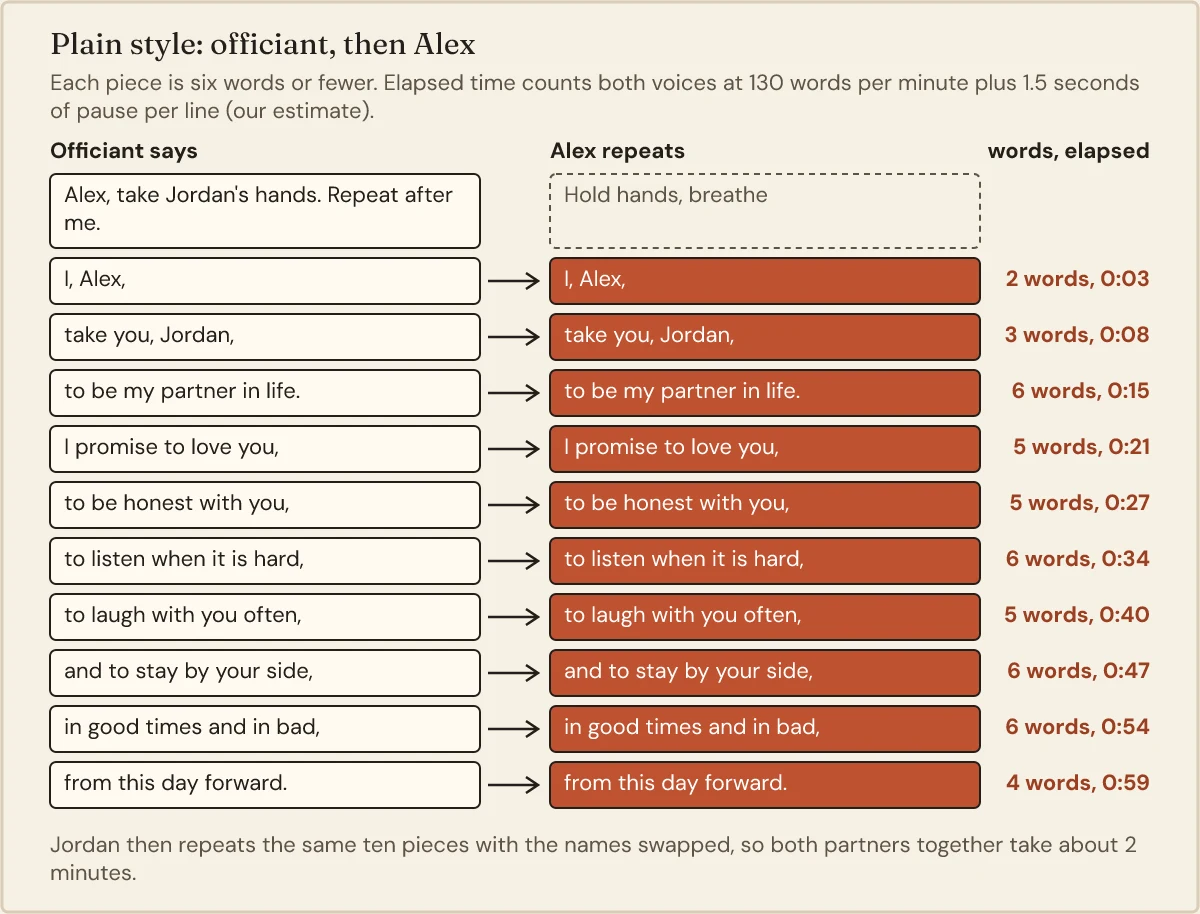
Script table: officiant lines and what the couple repeats
This is the plain style, written for two partners called Alex and Jordan. Alex goes first. After the last line, Jordan repeats the same ten lines with the names swapped. Each piece is six words or fewer, which is our own rule so a nervous partner never has to hold a long sentence.
Table: plain style script with the officiant line, the couple’s repeat and the word count (our estimate, assumptions below)
| # | Officiant says | Alex repeats | Words | Cue |
|---|---|---|---|---|
| 0 | Alex, take Jordan’s hands. Repeat after me. | (none) | 0 | Hold hands, breathe |
| 1 | I, Alex, | I, Alex, | 2 | Look at your partner |
| 2 | take you, Jordan, | take you, Jordan, | 3 | Pause one beat |
| 3 | to be my partner in life. | to be my partner in life. | 6 | Slow down here |
| 4 | I promise to love you, | I promise to love you, | 5 | Smile is fine |
| 5 | to be honest with you, | to be honest with you, | 5 | Keep eye contact |
| 6 | to listen when it is hard, | to listen when it is hard, | 6 | Pause one beat |
| 7 | to laugh with you often, | to laugh with you often, | 5 | Laughter is fine |
| 8 | and to stay by your side, | and to stay by your side, | 6 | Voice drops a little |
| 9 | in good times and in bad, | in good times and in bad, | 6 | Pause one beat |
| 10 | from this day forward. | from this day forward. | 4 | Full stop, hold the pause |
The repeated words add up to 48 per partner. Estimates use 130 words per minute, our assumption, plus 1.5 seconds of pause after each line.
Alex repeats ten pieces of six words or fewer, 48 words in all, and one partner exchange takes about a minute once the officiant lines and pauses are counted.
Ring exchange lines
The rings come right after both sets of vows. The officiant holds the ring or asks the ring bearer to bring it, then cues the partner. These lines are also five pieces or fewer, and the officiant says each one before the partner does.
- Officiant: “Jordan, place the ring on Alex’s finger and repeat after me.”
- Jordan repeats: “Alex, with this ring,” (4 words)
- Jordan repeats: “I give you my promise,” (5 words)
- Jordan repeats: “my love,” (2 words)
- Jordan repeats: “and my loyalty,” (3 words)
- Jordan repeats: “today and always.” (3 words)
Then Alex does the same for Jordan. If the ring is stuck, the officiant says “take your time” and the line starts over. Nobody minds a pause at this moment.
Closing lines for the officiant
After the rings, the officiant has a short job. Say one blessing line if you want it, then the closing, then the kiss cue.
- Optional blessing: “May the promises you made today be the ones you keep.”
- Closing statement: “Alex and Jordan have made their promises and given their rings. I now present you as married.”
- Kiss cue: “You may kiss.”
- Presentation: “Please welcome Alex and Jordan.”
A civil ceremony may need a legal phrase here, such as the officiant naming the authority they act under. Ask your officiant to add that line, because it differs by place.
Pick your wording style
The same script works in three registers. The table compares them for two partners, each repeating after the officiant, using Alex and Jordan again.
Table: three wording styles compared for length and tone (our estimate, assumptions below)
| Style | Lines per partner | Words said by the couple | All voices, both partners | Time with pauses |
|---|---|---|---|---|
| Plain | 10 | 96 | 192 | about 2:00 |
| Classic | 10 | 82 | 164 | about 1:46 |
| Short | 5 | 36 | 72 | about 0:48 |
Time equals all spoken words at 130 words per minute, plus 1.5 seconds of pause after each line. The classic style borrows the prayer-book rhythm (“to have and to hold, from this day forward”), and you can read where those lines come from in our guide to traditional vows. The short style is for couples who want the repeat to take under a minute, and our page of vows under a minute goes further in that direction.
Worked example: a script with rings, timed
Here is the plain style plus the ring exchange for two partners, counted with our own logic.
Plain vows, both partners: 192 words across all voices, about 2:00 with pauses.
Ring lines, both partners: 17 words said by each partner, 68 words across all voices, about 0:46 with pauses.
Total: about 2:45. If you add one personal sentence of 20 words per partner, add about 0:11 per partner, so about 3:07.
Estimates at 130 words per minute with 1.5 seconds of pause per line. Your pace and your officiant’s pace will differ.
Joy puts the vow exchange at 3 to 8 minutes and the ring exchange at 2 to 3 minutes, inside a non-religious ceremony of 20 to 30 minutes. Those ranges include walking, handling the rings and reactions. A repeat-after-me exchange at our pace sits near the bottom of that range, which leaves room for readings and music.
Repeat-after-me or “I do”: which fits you
There are three common ways to deliver vows. Pick by how comfortable the two of you are speaking in front of a crowd.
- Repeat after me. The officiant leads, you echo. It is the safest choice if either of you freezes in front of people. This page covers it.
- Question and answer. The officiant asks “Will you take this person?” and each partner says “I will” or “I do.” It is the shortest option, about two lines per partner.
- Read your own. Each partner reads from a card. It takes the most time and the most rehearsing. Our guide to the order, length and structure of vows lays out where a personal reading fits.
Many couples blend these. Repeat a three-line promise together, then read a short personal note. The officiant’s cue in the script is what keeps the handoff smooth.
What the officiant needs from you
Send your officiant three things before the rehearsal. First, the script with the names filled in. Second, the order: who goes first, who holds the rings, whether there is a blessing. Third, anything you do not want said, such as a word, a name or a joke.
A short email is enough. Ask them to read it aloud once so the pacing is theirs, not yours. They know how their voice carries and where a line needs a breath. If your officiant is a friend, give them a printed copy in large type, because folded phone screens do not read well in sunlight.
Three mistakes and how to fix them
Long chunks. A line of ten words is too long to repeat from memory. The fix is to split it at a comma or a natural pause, as the table does.
Reading too fast. Nerves speed everyone up. Mark a pause after every line and have the officiant count to two in their head. Pauses cost seconds, and they make the moment feel calm.
Changing the words on the day. An extra phrase that was not rehearsed throws off your partner’s echo. If you want to add something, say it in the rehearsal first so the officiant can cue it.
Rehearse it in ten minutes
- Print the script, one copy for the officiant and one each for you.
- Stand where you will stand on the day, facing each other.
- Have the officiant read, you repeat, and use a phone timer.
- Mark any line that stumbled and rewrite it shorter.
- Run the ring lines once with the real rings.
If a line trips you twice, cut a word. Shorter is almost always easier to say and easier to hear. If you want to add your own promise, a step-by-step writing guide breaks it into short steps, and the wedding day timeline shows where the ceremony sits in the day.
Send it to your partner or officiant
Use the share buttons under the tool to send the script by email or text. The link reopens your wording, so your officiant sees what you saw. For more wording ideas, browse wedding vows examples or start from a vows template and split the lines yourself.
Save for later
Pin it now and find it when you are ready to plan.
Questions people ask
What does the officiant say during vows?
The officiant introduces the moment, then reads each vow in short pieces for the couple to repeat. After the last piece they cue the rings, repeat the same pattern for the ring lines, and finish with a closing line that names the couple. Your script marks every cue so nobody has to guess.
How do repeat-after-me vows work?
The officiant says a few words, pauses, and the partner says the same words back. Then the next few words follow. Keep each piece under about six words so nobody has to hold a long sentence in their head. One partner finishes the whole set before the other begins, so the rhythm stays steady and easy to follow.
What comes after the vows?
The rings come next. The officiant introduces the ring, each partner places it on the other's finger while repeating a short promise, and then the officiant makes the closing statement. The kiss follows that statement. Some couples add a short blessing between the rings and the closing, which the script below leaves as an optional line.
Can the couple read their own vows instead of repeating?
Yes. The officiant simply hands over the floor. Many couples mix both. They repeat a short promise together, then read two or three personal sentences from a card. Keep the cue line in the script so the officiant knows when to step back in. Our length table shows how much time each approach adds to the ceremony.
How long should the officiant take to read the vows?
At our pace of 130 words per minute with a short pause after each line, the plain script takes about two minutes for both partners. The classic style takes a little under that, and the short style well under one minute. Rehearse once aloud with a timer, because pauses change the total more than the words do.
Sources
- withjoy.com/blog/wedding-ceremony-order-of-events (opens in a new tab) : Vow exchange of 3 to 8 minutes, ring exchange of 2 to 3 minutes, and a non-religious ceremony of 20 to 30 minutes.
- tfcs.baruch.cuny.edu/speaking-rate (opens in a new tab) : Average English speaking rate of about 150 words per minute. Our 130 words per minute is our own slower assumption for emotional delivery.
- en.wikipedia.org/wiki/Marriage_vows (opens in a new tab) : The classic English vow lines in the prayer books, used as the model for our classic style.
Updated by bigdaydesk editorial
Keep planning
-
Wedding vows standard
Gives the classic text with its public-domain source and a line-by-line modern rewording, including options for the word obey.
-
Wedding vows in sickness and in health: wording and rewrites
Takes one famous phrase apart and offers rewrites for couples who want the promise in plainer language.
-
wedding vows examples
The broad collection: twenty originals across funny, short, traditional, emotional and modern, each with a word count and a time.
-
Father of the bride speech examples
Covers the groom welcome and the toast, which this role must handle and others skip, with eight timed openings.


