Make it yours (all optional)
Finish each sentence in your own words. Leave a line empty and we skip it. Names and details stay in your browser. A shared link carries them after the # so no server receives them. Your edits to the text are not in the link.
Wedding vowsbigdaydesk.com
Your vows (edit them here)
Your settings changed. This replaces your edits.
Share this result
Send this exact result. The link opens it the same way for them.

Save this result to Pinterest
Pin it now and find it when you are ready to plan.
The traditional wedding vows are the promises from the 1662 Book of Common Prayer. The full text is below, then a table that puts every line next to two modern rewordings. Use the vow builder above to mix them and print a card. Tell your officiant which version you picked before the rehearsal.
The classic vows, word for word
This is the wording most people mean by “traditional.” Each partner says it to the other, usually repeating after the officiant. Replace [name] with the first name.
I, [name], take thee, [name], to be my wedded wife, to have and to hold from this day forward, for better, for worse, for richer, for poorer, in sickness and in health, to love and to cherish, till death us do part, according to God’s holy ordinance; and thereto I plight thee my troth.
The other partner’s classic form changes two things. It says “wedded husband” and “I give thee my troth.” In the 1662 book it also reads “to love, cherish, and to obey” in place of “to love and to cherish.”
The classic vow is nine phrases and 54 words, about 25 seconds, with the officiant leading and the partner echoing each phrase.
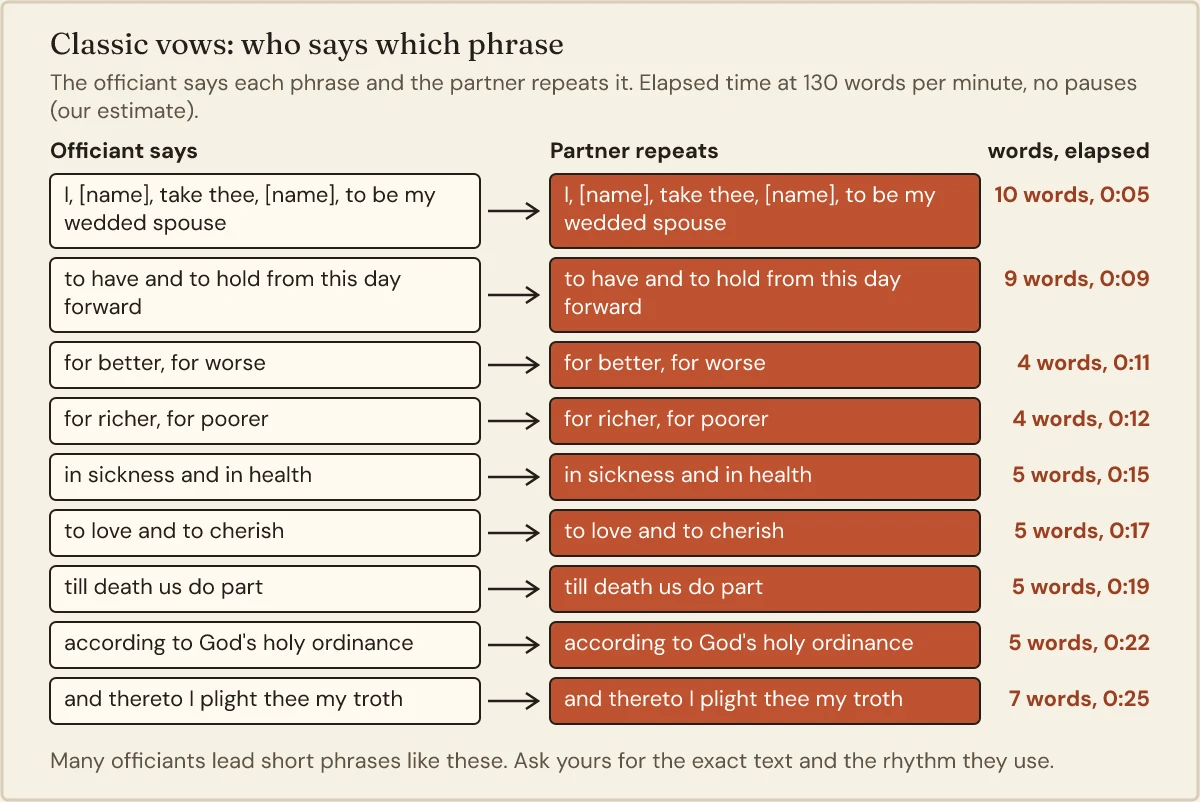
Two old words need a gloss for guests. “Plight” means to pledge. “Troth” means faithfulness, so “I plight thee my troth” is “I pledge you my faithfulness.”

Wording table: each classic line with two rewrites
Table: classic vow lines, two modern rewordings each, and the words per phrase (our own rewrites and counts, assumptions below)
| Classic line | Words | Plain modern | Words | Warmer modern | Words |
|---|---|---|---|---|---|
| I, [name], take thee, [name], to be my wedded spouse | 10 | I, [name], take you, [name], to be my spouse | 9 | [name], I choose you to be my partner in life | 10 |
| to have and to hold from this day forward | 9 | to have and to hold, starting today | 7 | to hold you close from this day on | 8 |
| for better, for worse | 4 | in good times and in hard ones | 7 | through the easy days and the ones that test us | 10 |
| for richer, for poorer | 4 | when money is easy and when it is tight | 9 | whether we have plenty or are counting coins | 8 |
| in sickness and in health | 5 | when we are well and when we are not | 9 | caring for you when you are ill and cheering when you are well | 13 |
| to love and to cherish | 5 | to love you and to treasure you | 7 | to love you out loud and treasure you quietly | 9 |
| till death us do part | 5 | for as long as we both live | 7 | until our last day together | 5 |
| according to God’s holy ordinance | 5 | before our families and friends | 5 | in front of everyone we love | 6 |
| and thereto I plight thee my troth | 7 | and I give you my word | 6 | and this is my promise to you | 7 |
| to love, cherish, and to obey (1662 bride) | 6 | to love, cherish, and respect you | 6 | to love, cherish, and stand beside you as an equal | 10 |
Assumptions: the first row says “spouse” so one table fits every couple, and “wife” or “husband” has the same word count. We count words by spaces, so “[name]” is one word. The “obey” row replaces the “love and to cherish” row, so a full vow uses one of the two, not both. The rewrites are ours and free to use.
Mix freely across columns. A classic opening with a plain closing works well, because the old rhythm carries the first half and the modern words land the last line. Keep one grammar throughout: “thee” lines sit badly next to “you” lines.
The full versions, with word counts and time
Example: full vows built from the table, timed at our assumed 130 words per minute.
- Classic, wife or spouse form: 54 words, about 25 seconds.
- Classic with the 1662 “obey” line: 55 words, about 25 seconds.
- Plain modern (column 3, no obey line): 66 words, about 30 seconds.
- Warmer modern (column 5, no obey line): 76 words, about 35 seconds.
- Both partners saying the classic form: 108 words, about 50 seconds.
Pick the length you want at the ceremony, not the text you like best on paper. Short vows read well in a long ceremony. If you want something longer, add one personal sentence before the last line rather than stretching every line.
What to do with the word obey
The 1662 prayer book gives the bride “to love, cherish, and to obey” and the groom “to love and to cherish.” The Episcopal Church voted to remove “obey” from the bride’s vows on 12 September 1922. The Church of England’s Common Worship, in use since 2000, lets couples choose to add it.
Most couples today pick one of three routes:
- Cut it. Use “to love and to cherish” for both partners. This is the simplest and needs no explanation.
- Swap it. Use “to love, cherish, and respect you.” It keeps the three-beat rhythm of the original line.
- Match it. Both partners say the same line, for example “to love, cherish, and stand beside you as an equal.” Nobody promises anything the other does not.
If either family is religious, mention the change to your officiant first. Some denominations set the text, and a short chat beats a surprise at the altar.
Where the words come from
The English marriage vows grew out of the medieval Sarum (Salisbury) rite. The 1549 prayer book took its marriage service mainly from that rite, and the vows stayed close to it. The Sarum text already says “in seknesse and in helthe,” so “in sickness and in health” is older than the prayer book.
One line changed on purpose. The 1549 and 1552 books read “till death us depart.” The 1662 book made it “till death us do part,” because “depart” had stopped meaning “separate.” Knowing that helps if a relative asks why the line sounds odd.
Three mistakes and the fix for each
Mixing eras in one sentence. “I take thee to have and to hold, and I love you lots” jars. Fix: choose old or modern for the whole vow, or change at a line break and keep a pause.
Rewording only your half. If one partner says a long modern vow and the other the 54-word classic, it feels lopsided. Fix: compare word counts in the table and trim to within about 15 words.
Skipping the officiant. Many officiants lead you through short phrases to repeat, and they plan the rhythm around the text they know. Fix: send them your card a week ahead, and ask whether they will prompt you line by line.
Make your card in five steps
- Open the builder above and choose the traditional style.
- Read the classic text aloud once. Mark any line that stumbles in your mouth.
- Swap those lines for a rewording from the table. Keep one grammar.
- Check the live word count and time. Aim for the length you chose above.
- Print the card for your officiant, and keep a copy for your pocket.
If one line matters most to you, build a whole vow around it. The in sickness and in health version does that.
How long the vows take
Table: words to speaking time at our assumed 130 words per minute (our estimate)
| Words | Time to say |
|---|---|
| 54 (classic) | about 25 seconds |
| 100 (builder default) | about 45 seconds |
| 130 | about 1 minute |
| 195 | about 1.5 minutes |
| 260 | about 2 minutes |
We assume 130 words per minute because vows are read slower than normal talk. Baruch College’s speaking-rate page puts the English average near 150 words per minute. Joy’s ceremony guide lists 1 to 2 minutes per person for vows inside a 20 to 30 minute ceremony. The classic text alone is well under that, so adding a line of your own is fine.
Beyond the classic
If the old wording feels too formal, a non-traditional approach keeps the structure and changes the voice. Faith readings sit between the two, and vows from the Bible gives public texts you can read in full. If you want to write the whole thing yourself, writing your own wedding vows walks through the four parts. For a fill-in version of the same shape, try the vows template, or see a script you can read from for the officiant’s side.
More wordings to compare sit in the full examples collection, and the printable vows booklet turns your final text into a small card for guests.
Send it to your partner or officiant
Copy a line and send it with your link. The share buttons above keep your picks in the link, so they open the same card.
- To your partner: “I read the old vows and the modern ones side by side. Which lines feel like us?”
- To your officiant: “This is the version we want to use. Can you check the wording against yours before the rehearsal?”
- To a friend: “Here are the classic wedding vows next to modern rewrites. Pick your favorite line.”
Questions people ask
What are the traditional wedding vows?
They are the promises from the 1662 Book of Common Prayer, still the base for many church ceremonies. Each partner promises to have and to hold, for better or worse, for richer or poorer, in sickness and in health, to love and to cherish, till death us do part. The full text is above, word for word.
What are standard wedding vows?
There is no single legal standard. In most places the law only needs you to consent in front of an officiant and witnesses. "Standard" usually means the classic prayer book wording or a lightly updated copy of it. Ask your officiant which text they use, because some faiths and venues require their own.
Can I leave out the word obey?
Yes. Churches have dropped it from the bride's vow for a century, and the Church of England's Common Worship lets couples choose whether to add it. Most couples now either cut it, swap in "respect", or have both partners say the same line. Tell your officiant early so the printed order matches.
Where do traditional vows come from?
The English wording comes mainly from the medieval Sarum rite, adapted in the 1549 prayer book and settled in 1662. Lines such as "in sickness and in health" already appear in the Sarum rite in older spelling. "Till death us depart" became "till death us do part" in 1662 because the word depart had changed meaning.
How long do traditional vows take to say?
Very little time. The full classic vow runs 54 words, which is about 25 seconds at our assumed 130 words per minute. Many officiants read it in short phrases for you to repeat, which adds a few seconds. If you want closer to a minute, add a personal line before or after.
Sources
- en.wikipedia.org/wiki/Marriage_vows (opens in a new tab) : Vow wording history, including the Sarum rite, the 1549 and 1662 prayer books, "till death us depart" becoming "till death us do part", and the dates for "obey".
- tfcs.baruch.cuny.edu/speaking-rate (opens in a new tab) : English speakers average about 150 words per minute. Our 130 words per minute for vows is our own slower assumption.
- withjoy.com/blog/wedding-ceremony-order-of-events (opens in a new tab) : Vows run 1 to 2 minutes per person inside a ceremony of 20 to 30 minutes.
Updated by bigdaydesk editorial
Keep planning
-
Write your vows in sickness and in health
Takes one famous phrase apart and offers rewrites for couples who want the promise in plainer language.
-
The broad collection
The broad collection: twenty originals across funny, short, traditional, emotional and modern, each with a word count and a time.
-
wedding vows script
Officiant view: repeat-after-me phrases split into short lines, then the ring exchange, with names filled in as you type.
-
Maid of honor speech: structure, openers and examples
The role landing: five-part structure with timings, ten ways to start and what not to say about the couple.