“In sickness and in health” promises that you will stay and care for your partner when they are unwell, not only when life is easy. In the classic vow it sits here: “for better, for worse, for richer, for poorer, in sickness and in health, to love and to cherish.” You can say it as written or rewrite it, and for your personal vows the rewrite is your call. The table below gives ten versions, each with a word count and a tone.
Rewrite table: the phrase in ten versions
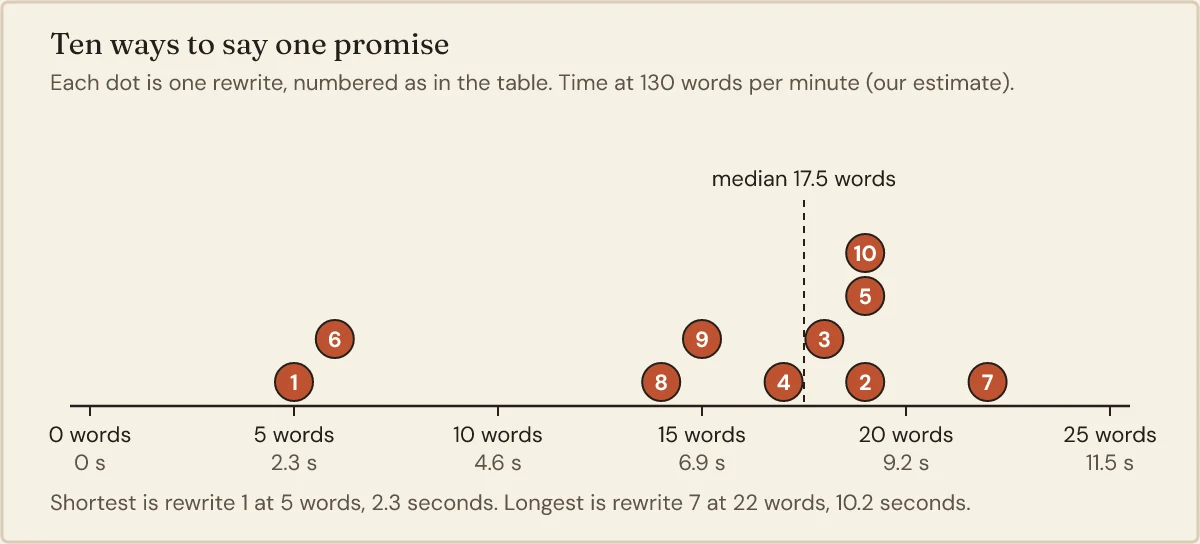
These versions keep the promise to varying degrees, noted in the tone column. Word counts are exact counts of the words in each line. Speaking time uses our assumption of 130 words per minute.
Table: ten rewrites of in sickness and in health with word count and speaking time (our estimate, assumptions below)
| # | Tone | Version | Words | Time to say |
|---|---|---|---|---|
| 1 | Traditional | In sickness and in health. | 5 | 2.3 s |
| 2 | Plain | When you are sick, I will take care of you. When you are well, I will still be here. | 19 | 8.8 s |
| 3 | Warm | I will love you on your strong days and on the days you need to lean on me. | 18 | 8.3 s |
| 4 | Funny | I will bring the soup, hold the bucket and keep the remote within reach through every flu. | 17 | 7.8 s |
| 5 | Serious | If illness comes, I will stay. I will go to the appointments, ask the questions and not look away. | 19 | 8.8 s |
| 6 | Short | Well or unwell, I am yours. | 6 | 2.8 s |
| 7 | Mutual | When one of us is ill, the other steps in. Today I promise to be the one who steps in for you. | 22 | 10.2 s |
| 8 | Practical | I will notice when you are struggling and help before you have to ask. | 14 | 6.5 s |
| 9 | Gentle | On the slow days, the tired days and the scared days, I will be there. | 15 | 6.9 s |
| 10 | Long view | We will not always feel strong. When illness comes in any year, I will be the one beside you. | 19 | 8.8 s |
Assumption: 130 words per minute is our own slower pace for emotional delivery. The Baruch speaking-rate page puts the average English rate near 150. Times are rounded to a tenth of a second and are estimates, not rules.
To keep the table, use Print this page: the ten rewrites print as a one-page card with word counts. To send your shortlist, pick two versions in the tool and use the Share control. The link carries only your two picks, so your partner opens the same pair.

What comes before and after the phrase
In the classic vow the lines run in this order: “to have and to hold from this day forward, for better, for worse, for richer, for poorer, in sickness and in health, to love and to cherish, till death us do part.” The phrase is the third of three pairs of opposites, and it is followed by the only two verbs of feeling in the whole vow, love and cherish.
That position matters when you rewrite it. A rewrite sits between money and love, so it works best when it is short enough not to stall the run of pairs (versions 1, 6 and 8) or when it opens a new sentence of its own (versions 2, 5 and 7). The wider history of these lines, including the change from “depart” to “do part”, is on the page about traditional vows.
What the phrase promises
The line makes three promises.
- Presence. You will be there, whether or not you can fix anything.
- Care. You will do the practical work: the pharmacy run, the phone calls, the cooking.
- Staying. The promise holds when the news is bad and the timeline is unclear.
Version 2 covers all three in two short sentences. Version 6 covers only presence and trades detail for rhythm. Versions 9 and 10 promise presence in the first person and say nothing about specific care. Each is a different bet on what your guests need to hear. For a short vow built around version 6, see the page on vows under a minute.
Which version fits which couple
These are our suggestions, not rules.
- You want to keep the old rhythm. Keep version 1 and add one sentence of your own after it.
- Your guests are mixed ages and faiths. Versions 2 and 3 use everyday words, which suits a mixed room.
- Your vows are mostly jokes. Version 4 gets the laugh, but its last clause is the joke. Add a plain sentence after it, such as “I mean it.” For more lines in that mood, see funny wedding vows.
- One of you is ill now, or has a chronic condition. Versions 5, 8 and 9 fit. Name the condition only if you both agree, and say it the way you say it at home. The how-to-write guide has a step for drafting the personal part.
- Your vows are already long. Version 6 closes a paragraph in six words.
- You want both partners to say the same thing. Version 7 works in either voice, and it makes the promise about action.
- You are borrowing a reading. Match tone with the reading. Our page of Bible passages to borrow lists public-domain readings that sit well beside version 1 or 2.
The ten rewrites run 5 to 22 words, so even the longest takes about ten seconds.
Fit it into your vows: a worked example
Below is a vow with a gap marked [phrase] before the closing line. We wrote it for this page, with the placeholder name Priya, and counted it with our own tool logic.
The vow with the gap. Priya, I did not expect to meet you in a laundromat queue in March, but I did. You label the leftovers. You wave at every bus driver. You turned a borrowed flat into a place I hurry back to. Today I promise to listen before I fix, to tell you the truth kindly, and to keep learning how you take your tea. I promise to cheer for your plans and to sit beside you when the plans fall through. [phrase] I am glad it is you, and I am glad it is for good.
Version 2 in place, 112 words. Same vow, with the gap filled: “…when the plans fall through. When you are sick, I will take care of you. When you are well, I will still be here. I am glad it is you, and I am glad it is for good.”
Timing at 130 words per minute. Without a phrase the vow is 93 words, about 43 seconds.
- With version 1: 98 words, about 45 seconds (+2 s).
- With version 2: 112 words, about 52 seconds (+9 s).
- With version 7: 115 words, about 53 seconds (+10 s).
Estimates at 130 words per minute. Your pace will differ. Zola gives 30 seconds to 3 minutes as the usual range for personal vows, so these examples are on the short side and have room for more.
The phrase costs very little time whichever version you pick, so choose by sound. Put it before the last line, as above, so the vow ends on “for good” and not on illness.
Three mistakes to avoid
Saying it without hearing it. Read the line aloud with your partner in the room. If you both wince, change it.
Making it a joke the whole way down. One funny line is a gift. A whole vow of hospital jokes can feel brittle to a guest who has sat in a real waiting room. End on the sincere part.
Surprising your partner with a heavy version. If you plan to name a real condition, tell them first. Nobody should hear their own health spoken to a crowd for the first time at the altar.
Ask your officiant or registrar first
Ceremonies differ by place and by faith. Some places require set legal wording in the ceremony, and a religious officiant may have fixed wording of their own. Ask early and ask plainly: “Can we say a plainer version of this line, and where do we need the set words?” Most will tell you what is allowed, and some will help you phrase it. For the order of the whole ceremony, see the ceremony script.
Next steps
Start from a vows template and drop your favorite rewrite in. Renewing vows instead? The vow renewal page covers how the wording changes.

Save for later
Pin it now and find it when you are ready to plan.
Questions people ask
What does in sickness and in health mean in vows?
It is a promise to stay and care for your partner when they are ill, not only when life is easy. It covers the flu and the long illness alike, and it works both ways. Many couples hear it as a promise about showing up, whatever shape the hard days take.
Where does in sickness and in health come from?
The phrase appears in the medieval Sarum marriage rite and carried into the English prayer books of 1549 and 1662. The full history of those books is on our page about traditional vows.
Can I rewrite the phrase in my own words?
Yes, for your personal vows. This phrase is a tradition, not a legal requirement. Some places require set legal wording in the ceremony, so confirm with your officiant or registrar, and treat your vows as the personal part. Many religious officiants allow changes if you ask first. Keep the promise (you will stay when health fails) and change the language.
How long does the phrase take to say?
The traditional line is five words and takes about two seconds at our assumed 130 words per minute. The longer rewrites run 14 to 22 words, or about 6 to 10 seconds. Either one barely moves the length of a full vow, so you can pick by sound instead of by length.
Should I include the phrase if one of us is already ill?
Only if it feels true when you say it aloud. Some couples keep it plain because the promise is already in daily use. Others write a version that names what they are living with. Talk it over first so neither of you is surprised in front of guests.
Sources
- en.wikipedia.org/wiki/Marriage_vows (opens in a new tab) : The phrase appears in the medieval Sarum rite and in the 1549 and 1662 prayer books, and 'till death us depart' became 'till death us do part'.
- www.zola.com/expert-advice/average-wedding-vow-length (opens in a new tab) : Personal vows are said in 30 seconds to 3 minutes.
- tfcs.baruch.cuny.edu/speaking-rate (opens in a new tab) : Average English speaking rate of about 150 words per minute. Our 130 words per minute for vows is our own slower assumption.
Updated by bigdaydesk editorial
Keep planning
-
Write your vows traditional
Gives the classic text with its public-domain source and a line-by-line modern rewording, including options for the word obey.
-
Curious about vows script?
Officiant view: repeat-after-me phrases split into short lines, then the ring exchange, with names filled in as you type.
-
Curious about vows examples?
The broad collection: twenty originals across funny, short, traditional, emotional and modern, each with a word count and a time.
-
Wedding quotes for speeches, cards and signs
Every quote is either public domain with a linked source or an original line labeled as ours, never an unsourced attribution.