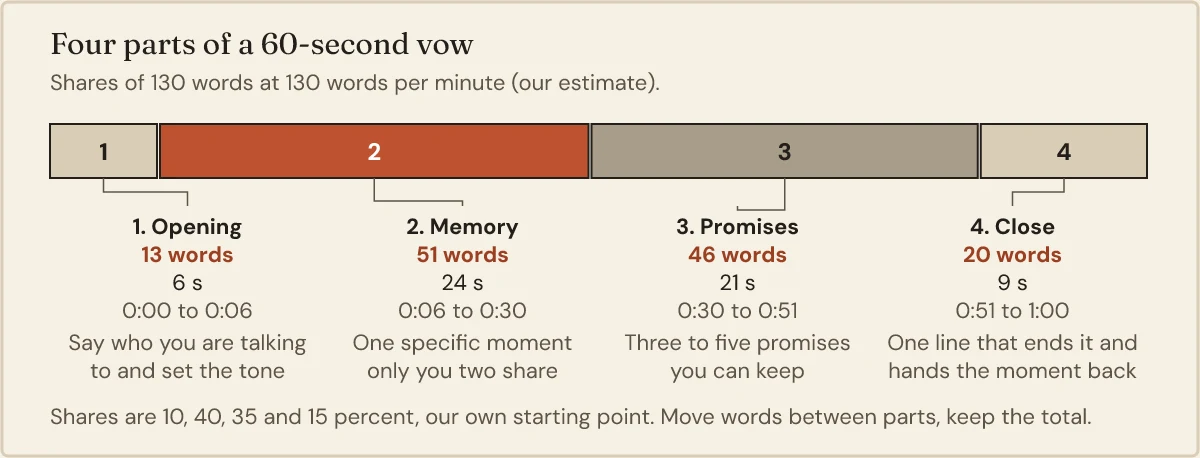
A wedding vow has four parts: an opening that names your partner, one specific memory, a few promises, and a short close. For a 60-second vow at our assumed 130 words per minute, that is about 130 words, split roughly 13, 51, 46 and 20. Use the vow builder above to set your own minutes, then print the outline.
Structure table: the four parts of a 60-second vow
Table: share of words and seconds for each part of a 60-second vow (our estimate, assumptions below)
| Part | Job | Share | Words | Seconds |
|---|---|---|---|---|
| 1. Opening | Say who you are talking to and set the tone | 10% | 13 | 6 |
| 2. Memory | One specific moment only you two share | 40% | 51 | 24 |
| 3. Promises | Three to five promises you can keep | 35% | 46 | 21 |
| 4. Close | One line that ends it and hands the moment back | 15% | 20 | 9 |
| Total | 100% | 130 | 60 |
Assumptions: we speak vows at 130 words per minute, so 60 seconds is 130 words. The shares are our own starting point, not a rule from a source. We rounded each part to whole words and gave the leftover word to the memory so the parts add up. Move words between parts if your story needs it, but keep the memory the largest part.
The memory is the largest part because it is the only part nobody else could have written. Promises are the part guests remember, so they get the second largest share. Openings and closes stay short on purpose. A long opening is throat clearing, and a long close makes people wonder if you are finished.
The memory takes 51 of the 130 words, and the opening only 13.
The same four parts at any length
Pick your minutes, then read across. The shares stay the same and only the room changes. These are our computed splits at 130 words per minute.
Table: words per part at six vow lengths (our estimate, assumptions below)
| Length | Total words | Opening | Memory | Promises | Close |
|---|---|---|---|---|---|
| 30 seconds | 65 | 7 | 25 | 23 | 10 |
| 45 seconds | 98 | 10 | 39 | 34 | 15 |
| 1 minute | 130 | 13 | 51 | 46 | 20 |
| 1.5 minutes | 195 | 20 | 78 | 68 | 29 |
| 2 minutes | 260 | 26 | 104 | 91 | 39 |
| 3 minutes | 390 | 39 | 155 | 137 | 59 |
Assumptions: same 130 words per minute and the same 10, 40, 35 and 15 percent shares as the first table. Each part is rounded, and the memory absorbs any leftover word.
How long should you pick? Sources disagree, which helps. Zola gives 30 seconds to 3 minutes. Joy puts the exchange at 1 to 2 minutes per person inside a ceremony of 20 to 30 minutes. Bridebook allows 1 to 4 minutes and calls 2 to 3 ideal. The overlap is 1 to 2 minutes, so aim for 130 to 260 words if you have no strong reason to go longer.
For a gentler rule: if you cry easily, choose the shorter end. A steady 45 seconds beats a 3-minute vow you cannot finish.
One vow built from the four parts
This is a made-up example so you can see the parts in action. Names and details are invented, and you should not copy it as your own. Each part has its own word count, counted by spaces.
Example: a four-part vow with a word count for each part, timed at our assumed 130 words per minute.
Opening (12 words). Sam, I used to think vows were something other people said well.
Memory (40 words). Then you drove four hours in the rain to bring me a charger, a sandwich and a bad joke, and stayed until my flight was rebooked. I stopped worrying about sounding polished that night. You made plain things feel safe.
Promises (45 words). So here is what I promise. I will tell you the truth kindly. I will take the second shift when you are worn out. I will make room for your friends and your silence. I will say sorry first when it is mine to say.
Close (15 words). That is all of it. I am yours today, and on the ordinary Tuesdays after.
Total: 112 words, about 52 seconds at 130 words per minute.
Notice what the memory does. It names three objects and one place in time, so it sounds like a real night rather than “you are always there for me.” Notice what the promises do. Each one is a single sentence with a verb, so none of them can be mistaken for a feeling.
Who goes first, and how the order works
Nothing sets the order for personal vows. Your officiant, your venue or your faith may have a script, so ask early. Where you have a free choice, here are the common choices:
- The officiant decides. Easiest. You each get a card and a cue.
- One partner opens, the other answers. The second vow can echo one line from the first, which makes the pair feel like a conversation.
- Alternate by line. The officiant feeds short phrases to each of you in turn. Best for traditional wording. See the classic wording for lines that split well.
- Say them together. Works for very short vows. It is hard to hear in a large room, so use a microphone.
Whichever order you pick, put it on the outline and give your officiant a copy.
Reading, repeating or memorizing
Read from a card if your vow is over about 45 seconds. A printed card is allowed, nobody minds, and you will not blank at the key line. Print it in large type with each of the four parts on its own line, so your eyes find your place when you look up.
Repeat after the officiant if you want nothing in your hands. This suits classic wording and short vows of eight words per phrase or less.
Memorize only if you are sure. If you memorize, bring a card anyway, because adrenaline erases things.
What to do with the ending
The close has one job: tell people you are done. The simplest endings are your partner’s name, a direct statement of commitment, or the first line of the vow said again. The last thing you say is the thing people carry out of the room.
Three safe closes:
- Say the opening line again with one word changed.
- End on the promise you most want them to hold you to.
- Hand off to the officiant with a plain sentence, such as “I am yours, and I am glad.”
Avoid ending on a joke you must wait out. If you want humor, put it in the middle and let the close be sincere. Not sure which lines carry weight? In sickness and in health lines shows how to rewrite one familiar promise so it still means something.
Three mistakes in vow structure
- The memory is a list. “You are kind, funny and loyal” is an opening, not a memory. Fix it: pick one night and give three details.
- The promises are really compliments. “I promise to always adore your laugh” is a compliment. Fix it: start each promise with “I will” and an action.
- The two vows do not match. One partner reads 90 seconds and the other 3 minutes. Fix: agree on a word count within about 20 percent, which is our own rule of thumb, and use the table above.
Steps: from outline to card
- Pick your minutes together, 1 minute for most couples, and read the word total from the table.
- Each of you writes four short lines, one for each part, before writing full sentences.
- Expand the memory first, then the promises, then trim the opening and close.
- Read the vow out loud with a timer. Cut any line that makes you flinch.
- Swap word counts, not vows, and adjust until the lengths are close.
- Print the card in large type and give your officiant a copy.
If you are starting from nothing, how to write your own vows has prompts for the memory, and the fill-in vows template gives you blanks for each part. For a worked set of finished vows, browse wedding vows examples, or read the one-minute short vow if you want very little to say. When the words are final, a vows script for your officiant shows how to hand them over.
Send the outline to your partner
The most useful thing to share is the outline, not your draft. Send the page, pick a length together, then write separately. The share row under the title has copy link, WhatsApp, text message and email, and the link keeps the page, not your words.

Save for later
Pin it now and find it when you are ready to plan.
Questions people ask
Who says their vows first?
There is no rule, so you choose. Many couples let the officiant decide, and some swap the order at the rehearsal so nobody gets the nerves of going first twice. If one of you is shy, let the more relaxed speaker open, because the second person can then match the tone. Write the order on both cards.
What is the format of wedding vows?
A personal vow has four parts. You open by naming your partner, tell one specific memory, make a few promises you can keep, and close with a short line that ends the vow cleanly. Religious or civil ceremonies may add set wording, so ask your officiant what they require before you write.
How many parts should a vow have?
Four is enough for any length. A 30-second vow squeezes each part into a sentence or two. A 3-minute vow gives the memory and the promises room to grow, but it still opens and closes the same way. More than four parts usually means you are telling a second story, which belongs in a toast.
Should both of us use the same format?
Yes, the shape and the length should match, while the content stays your own. If one of you reads 40 seconds and the other reads 3 minutes, the second vow feels lopsided even when it is lovely. Agree on a word count within about 20 percent of each other and share the outline above.
Do we read the vows or repeat them after the officiant?
Both work. Repeating short phrases after the officiant is easiest to hear and needs no cards. Reading your own vow from a card lets you say more. If you want the officiant to prompt you in phrases, cut the vow into lines of about eight words and give your officiant a copy ahead of time.
Sources
- www.zola.com/expert-advice/average-wedding-vow-length (opens in a new tab) : Personal vows run from 30 seconds to 3 minutes.
- bridebook.com/uk/article/how-long-should-wedding-vows-be (opens in a new tab) : Vows per person run from 1 to 4 minutes, with 2 to 3 minutes called ideal.
- withjoy.com/blog/wedding-ceremony-order-of-events (opens in a new tab) : Vows take 1 to 2 minutes per person inside a non-religious ceremony of 20 to 30 minutes.
- tfcs.baruch.cuny.edu/speaking-rate (opens in a new tab) : English speakers average about 150 words per minute. Our 130 words per minute for vows is our own slower assumption.
- en.wikipedia.org/wiki/Marriage_vows (opens in a new tab) : The classic English vow wording comes from the Sarum rite and the prayer books of 1549 and 1662.
Updated by bigdaydesk editorial
Keep planning
-
Wedding vows in sickness and in health: wording and rewrites
Takes one famous phrase apart and offers rewrites for couples who want the promise in plainer language.
-
wedding vows examples
The broad collection: twenty originals across funny, short, traditional, emotional and modern, each with a word count and a time.
-
Wedding vows script for officiant
Officiant view: repeat-after-me phrases split into short lines, then the ring exchange, with names filled in as you type.
-
Curious about best man speech template?
Five fill-in sentences that build a full speech, with the speaking time updating as you type.