
How long will it take to say?
Type the word count of your draft. We use 130 words per minute as our assumption for speaking pace.
Each example below has its own Copy button.
A maid of honor speech needs five parts: who you are, one true thing about the bride, one short story, what you saw when she met her partner, and the toast. Fill in the five blanks below and you get a finished speech. Our sample runs 166 words, about 77 seconds, and the interactive list above counts minutes as you type.
Template list: five fill-in sentences with example answers
Each blank is one sentence frame, then a note on what goes in it, then an example answer. The example speech is invented. Names and details are made up, so use them only as a model.
- Who you are. "Good evening, everyone. I'm [your name], [bride]'s maid of honor, and I have known her for [how long], since [how you met]." Keep it to one sentence. Example answer: "I have known her for eleven years, since we shared a dorm hallway and one hair dryer."
- One true thing about her. "If you want to understand [bride], know this: [one habit or trait], and [how she does it]." Pick a habit, not an adjective. Example answer: "she remembers everyone's birthday, and she never makes a fuss about it."
- The story. "[When it happened], [what went wrong or what she did], and [the detail that proves who she is]." Give it a place, a time, an object and one line of her dialogue or yours. Example answer: a late-night lockout, a bag of fries on a stairwell and a locksmith at 1 a.m.
- When she met the partner. "Then she met [partner]. The first thing I noticed was [what changed in her]." Say what you saw, not what you were told. Example answer: "Maya laughed with her whole face."
- The toast. "[Partner], thank you for [one specific thing]. [Bride], I love you. Everyone, please raise a glass to [bride] and [partner]: to [a wish that echoes your story]."
Write fragments first. “Dorm, hair dryer, eleven years” is enough for blank one. Full sentences come after the minutes are set.

The finished speech built from the five answers
This is what the five blanks look like joined together. Each part has a word count, counted by spaces, and the total is timed at our assumed 130 words per minute.
Example: a finished maid of honor speech with a word count for each of the five parts, timed at our assumed 130 words per minute.
1. Who you are (27 words). Good evening, everyone. I’m Priya, Maya’s maid of honor, and I have known her for eleven years, since we shared a dorm hallway and one hair dryer.
2. One true thing (20 words). If you want to understand Maya, know this: she remembers everyone’s birthday, and she never makes a fuss about it.
3. The story (55 words). Three years ago I called her at 11 at night, locked out of my apartment and out of ideas. She drove across town, sat with me on the stairwell with a bag of fries, and stayed until the locksmith finished at 1 a.m. She never once said I told you to leave a spare key.
4. When she met him (29 words). Then she met Daniel. The first thing I noticed was that Maya laughed with her whole face. The second was that Daniel was the reason. He also brings fries.
5. The toast (35 words). Daniel, thank you for being someone she can be that easy with. Maya, I love you. Everyone, please raise a glass to Maya and Daniel: to a home with a spare key under the mat.
Total: 166 words, about 77 seconds at 130 words per minute.
Notice the two echoes. The fries appear in the story and again in blank four. The spare key appears in the story and again in the toast. Those callbacks are what make a short speech feel built rather than read off a list.
Notice also what the speech leaves out. It names no ex, no bachelorette party and no age. Every line is something the bride would happily hear her grandmother repeat.
How many words each blank gets
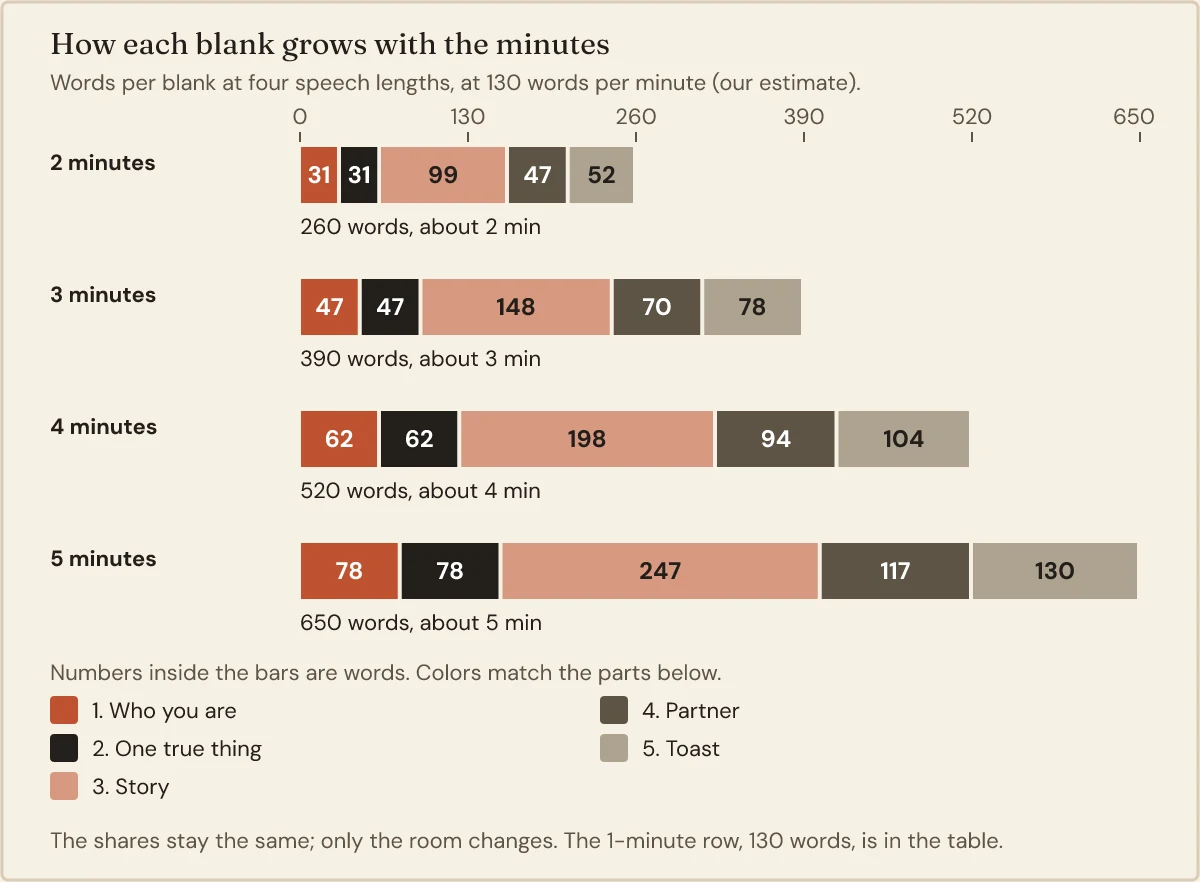
Our sample is short on purpose. If you have more time, give the extra words to the story first. These budgets are our own split, not a rule from a source.
Table: words per blank at five speech lengths (our estimate, assumptions below)
| Length | Total words | 1. Who you are | 2. One true thing | 3. Story | 4. Partner | 5. Toast |
|---|---|---|---|---|---|---|
| 1 minute | 130 | 16 | 16 | 49 | 23 | 26 |
| 2 minutes | 260 | 31 | 31 | 99 | 47 | 52 |
| 3 minutes | 390 | 47 | 47 | 148 | 70 | 78 |
| 4 minutes | 520 | 62 | 62 | 198 | 94 | 104 |
| 5 minutes | 650 | 78 | 78 | 247 | 117 | 130 |
Assumptions: we speak a toast at 130 words per minute, a bit slower than conversation so you can pause for laughs and breathe. The shares are 12, 12, 38, 18 and 20 percent, our own starting point. We rounded each blank to whole words and gave any leftover word to the story. Move words around if your story needs them.
How long is right? Sources disagree, so here is the range. WeddingWire says keep any wedding speech under five minutes and aim nearer three. Inside Weddings says a reception toast is a minute or two at most. Bridebook, writing for the UK, gives a maid of honour four to six minutes. Two to three minutes sits comfortably inside the first two and just under the third.
If the couple gave you a limit, that limit wins. Ask early. How long a wedding speech should run turns any word count into minutes.
The story blank grows from 99 words in a 2-minute speech to 247 in a 5-minute one, always about 38 percent of the total.
Make the template yours
The five blanks stay the same. What goes in them changes with who you are to the bride.
- You are her sister. Blank one can skip how you met. Start with the oldest memory you share. Blank three works best as a small story from a shared childhood room or car. Keep it to a scene only the two of you remember.
- You are her best friend from adulthood. Blank one carries the history, because guests may not know it. Blank three should show her at a hard moment, not a happy one.
- You do not know the partner well. Shrink blank four to one honest sentence about what you saw at one dinner. Never invent warmth you did not see.
- You are shy or tear up easily. Aim for the one-minute row in the table. A steady speech beats a long one you cannot finish.
- You want it funnier. Keep the story, then put the joke in the last line of blank three. The toast should stay warm. Funny, sweet and short ideas is a bank of lines to borrow from.
If you and the best man are writing side by side, his template uses the same five blanks, so the two speeches can echo each other.
Where the toast goes
Most receptions put the best man before the maid of honor, according to WeddingWire, though the couple decides. Ask who speaks before you and what they plan to cover, so you do not tell the same story. The speech order explains the common sequences.
The toast, blank five, has four jobs in about 35 words in our sample. Thank the partner. Tell the bride you love her. Say “please raise a glass” so everyone knows what to do. Name both people in the wish. If you want more on the glass-raising itself, the wedding toast guide covers wording and cues.
Do not add a fifth job. No second thank you, no “just one more thing”. The glass is the end.
What to cut when it runs long
Read your draft aloud with a timer. If it runs over, cut in this order, from least painful to most. Savings are computed from our sample and our assumed 130 words per minute.
Example: ordered cuts for the 166-word sample speech, with words and seconds saved at our assumed 130 words per minute.
- Cut the closing line of blank four, “He also brings fries.” Saves 4 words, about 2 seconds.
- Shorten blank one by dropping “since we shared a dorm hallway and one hair dryer.” Saves 10 words, about 5 seconds.
- Cut blank two entirely. Saves 20 words, about 9 seconds.
- Cut blank four entirely. Saves 29 words, about 13 seconds.
- Cut blanks two and four together. Saves 49 words, about 23 seconds, and leaves 117 words, about 54 seconds.
Never cut the story or the toast. The story is why people listen, and the toast is the reason you are standing there.
Three mistakes in the five-blank structure
- The story is a list. “She is kind, loyal and funny” belongs in blank two as one habit, not blank three. Fix it: pick one night and give three concrete details.
- The toast arrives before the glass is ready. If you start speaking while guests still hold forks, the toast gets lost. Fix it: pause after “Maya, I love you” and wait for glasses to rise.
- The speech is about you. Blank one is the only part where you speak about yourself. Fix it: in every other blank, the bride or the couple is the subject of the sentence.
Rehearsal checklist
- Write the five fragments from the template list before any full sentences.
- Expand the story first, then the partner line, then the toast.
- Read it aloud with a timer, standing up, at the speed you would use with a microphone.
- Cut using the ordered list above until you hit the minutes you chose.
- Send the draft to one other bridesmaid and ask which line might embarrass the couple.
- Print it in large type with each blank on its own line, and bring a second copy.
- Practice the handoff to the toast three times until the cue words feel automatic.
If your speech is for a vow-style moment, vows use a similar shape with four parts, which is useful when the bride asks you to help with hers. For a longer set of openers and a fuller outline, see the full maid of honor guide. If the story is about a best friend you have known for decades, that version shows how to tell it in one scene.
Send the draft to the other bridesmaids
Pasting a speech into a group chat invites fifteen opinions. Send it with one question instead. Ready-made text you can copy:
- “Here is my maid of honor speech draft, 166 words. Does anything in it embarrass Maya or Daniel?”
- “Can you check the story is true? I want to get the details right.”
- “I am timing it at about 77 seconds. Tell me if you think it should run longer.”
Change the names and the numbers to match your own draft, and the share buttons on this page send the link to the template itself.

Save for later
Pin it now and find it when you are ready to plan.
Questions people ask
What is the format of a maid of honor speech?
Open with who you are and how you know the bride. Say one thing that is true about her. Tell one short story. Say what changed when she met her partner. Finish by raising a glass. That is five parts, and a speech built from them lands between one and three minutes without any padding.
How do I end a maid of honor speech?
End by speaking to the couple, then to the room. Thank the partner in one sentence, tell the bride you love her, and invite everyone to raise a glass with a short line that names both of them. Say the cue words out loud, such as "please raise a glass", so guests know when to drink. Then sit down.
How do I outline the speech?
Write five lines before any full sentences, one per blank in the template above. Each line is a fragment, such as "dorm hallway, one hair dryer". Then give the story the most room, since it carries the speech. Read the outline aloud once with a timer, trim to the minutes you want, and only then expand each line.
How long should the speech run if I use this template?
The template fits one to five minutes. The sample speech above runs 166 words, about 77 seconds at our assumed 130 words per minute. Sources suggest a range from a minute or two up to six minutes, so aim for two to three if the couple has not given you a limit, and ask them if you can.
Can I use the template if I am a matron of honor or the bride's brother?
Yes. The five blanks work for any speaker with one story to tell. Change the first blank to your actual role, such as matron of honor, and keep the rest. Swap the maid of honor wording if your title differs. If you do not know the partner well, shorten that blank to one honest sentence and spend the words on the story.
Sources
- bridebook.com/uk/article/how-long-should-a-wedding-speech-be (opens in a new tab) : UK guidance that a maid of honour speech runs 4 to 6 minutes. It is UK-oriented editorial advice, so we show it as one end of a range.
- weddingwire.com/wedding-ideas/who-gives-a-speech-at-a-wedding (opens in a new tab) : Keep any wedding speech under five minutes and aim nearer three. Also the traditional US order, with the best man first and the maid of honor after.
- www.insideweddings.com/news/expert-advice/the-must-know-rules-for-making-a-wedding-toast/1622 (opens in a new tab) : A reception toast is a minute or two at most, and a maid or matron of honor toast alongside the best man is increasingly customary.
- virtualspeech.com/blog/average-speaking-rate-words-per-minute (opens in a new tab) : Conversational English runs about 150 words per minute. Our 130 words per minute for a toast is our own slower assumption.
Updated by bigdaydesk editorial
Keep planning
-
Best man speech template: fill in five blanks
Five fill-in sentences that build a full speech, with the speaking time updating as you type.
-
Write maid of honor speech for best friend
Covers the awkward part: mentioning a partner you know less well without making the speech about yourself.
-
An idea bank sorted by tone
An idea bank sorted by tone, each idea with an opening, a middle story prompt and an ending line.
-
wedding vows format
Anatomy page: the four parts of a vow with the share of words each one takes, and a length calculator.


