
How long will it take to say?
Type the word count of your draft. We use 130 words per minute as our assumption for speaking pace.
Each example below has its own Copy button.
Your best friend asked you to speak, so she trusts you with her story. Keep it to one story, one kind line about her partner and a toast, about three minutes in all. The hard part is the partner, and the table below gives you five lines that work.
Most of what makes this speech good is what you leave out. Guests do not need a history of your friendship. They need to see why you love her, and why the person beside her is in good hands.
The shape of a three minute speech
Plan the speech in five parts. The timings below are our estimate at 130 words per minute, an assumption that suits a calm, slightly nervous speaker. Read yours aloud once and adjust.
Example split for 390 words, about 3 minutes (our estimate)
- Opening and who you are: 45 words, about 21 seconds.
- One line on the friendship: 45 words, about 21 seconds.
- The one story: 170 words, about 78 seconds.
- The partner, using one safe line: 65 words, about 30 seconds.
- The toast: 65 words, about 30 seconds.
The one story gets 78 of the 180 seconds, and the toast keeps its 30 seconds when you cut elsewhere.
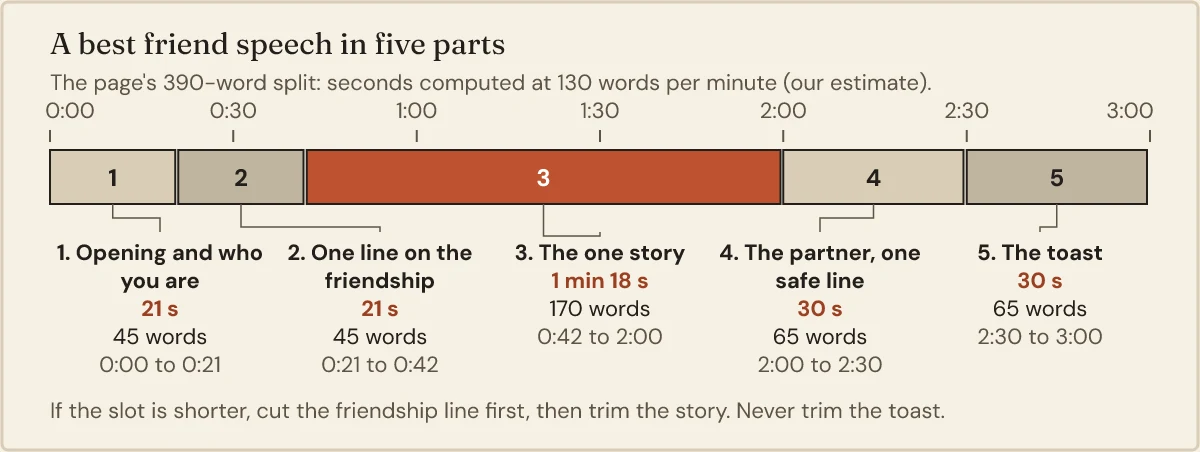
If your slot is shorter, cut the friendship line first, then trim the story. Never trim the toast. It is the part the room has been waiting for.

Mention-the-partner table: five safe lines
You may have met the partner a handful of times. That is fine. You do not have to know him well, you only have to say something true. Each line below is written to be copied, with the friend’s and partner’s names swapped in.
| Safe line | Use it when | Mistake it avoids |
|---|---|---|
| “I have watched [Friend] around [Name], and I have never seen her laugh like that.” | You have only seen them together a few times. | Claiming you know the relationship from the inside. |
| “[Name], the first thing I noticed was how closely you listen to her.” | You can name one specific thing you saw. | Vague praise that sounds like you are reading from a card. |
| “[Friend] told me she knew early. I believed her the moment I saw you two together.” | You did not hear how they met. | Retelling a how-we-met story you may get wrong. |
| “[Name], welcome to the group chat. It has opinions and snacks.” | The room is casual and you are close to her friends. | A joke at the partner’s expense. |
| “I am still your friend, [Friend]. Now I get to be a fan of you both.” | You worry the speech sounds like losing her. | Making the speech about your own feelings of being left behind. |
Pick one line and stop. Two partner lines start to feel like a tour of how well you know him. One honest sentence says everything you need.
If you do not like the partner, you still can say one true thing. Choose the line that matches something you really saw. Never invent a compliment, because the room can hear it.
Pick the one story with three questions
You will think of ten stories. Test each against these.
- Does it show something your friend does, such as showing up, making people laugh or never quitting? A story about a night out only shows the night.
- Can a guest who has never met her follow it in under two minutes? If it needs a cast list, drop it.
- Would she be glad to hear it said aloud with her new in-laws in the room? If you hesitate, it is the wrong story.
The best stories are small. A phone call, a road trip that went wrong, the time she drove four hours with soup. Details do the work, so name the car, the song, the city.
Eight openings to borrow
Use these as starting points. Replace every bracket with a real name or detail, and change a word or two so it sounds like you. Each shows its length at our assumed 130 words per minute.
Example openings with word counts (our estimate for timing)
- “Hi everyone, I’m Dana, [Friend]‘s best friend since the first week of college. I’ve been trying to write this speech for a month. Every draft started with ‘where do I even begin,’ so I’ll begin with the day she called me about [Name].” (43 words)
- “Good evening. For anyone who doesn’t know me, I’m the one [Friend] calls when she needs honesty and snacks, usually in that order. Tonight she has [Name] for the honesty, so I’m only here for the snacks and this toast.” (40 words)
- “I’m Dana. I’ve known [Friend] for twenty years, and I have exactly one story and one toast. The story is short. The toast is the important part.” (27 words)
- “The night [Friend] met [Name], she texted me at midnight: ‘I think I just talked to my person for four hours.’ I told her to go to sleep. She did not, and I have never been so glad to be ignored.” (41 words)
- “Most of our friendship happened over the phone, three time zones apart. So I know [Friend]‘s voice better than almost anyone’s, and I know exactly when it changed. It changed when she started talking about [Name].” (36 words)
- “I’m not a public speaker, and [Friend] knows it. She asked me anyway, which tells you how she treats the people she loves: she picks you first and trusts you to rise.” (32 words)
- “[Friend] and I met when we were nine, in a school hallway, over a lost sweater. It was mine. She kept it for three years. Tonight I’m officially letting her keep [Name] too.” (33 words)
- “[Name], before anything else: thank you for being easy to love. I spent months waiting for a reason to worry about you, and I’m happy to report I couldn’t find one.” (31 words)
Pick the opening that sounds most like how you talk. If you never say “good evening” in real life, do not start there.
A full short speech to adapt
This one runs about two minutes at our assumed pace. It uses the phone-call story, one partner line and a toast. Change the story, keep the shape.
Example speech, 229 words, about 1.8 minutes at 130 words per minute (our estimate)
Hi everyone, I’m Dana, [Friend]‘s best friend since the first week of college. Thank you for letting me hold a microphone near a dessert table.
[Friend] and I have a rule. When something big happens, we call each other before we call anyone else. A job offer. A bad haircut. A breakup, back when those happened.
Two years ago on a Tuesday, she called and said, “I met someone, and I’m not going to be cool about it.” That was it. No details yet. Just the warning.
She was right. She was not cool about it. She talked about [Name] for an hour and used the word “easy” six times. Not easy as in simple. Easy as in she did not have to perform. She could be loud, or quiet, or tired, and [Name] would just say, “Okay, what do you need?”
I have watched that question show up again and again. [Name], I did not know you well then. I know you now, and I have seen you ask it every single time.
So here is what I’m adding to our rule. [Friend], you can call me first about anything except this. This one you call [Name] about, and I’ll hear it from you both.
Everyone, please raise a glass. To [Friend] and [Name]: may you keep asking each other what you need, and may you always answer.
Words to minutes
Silent reading runs fast, so count words and read aloud. Published advice for the maid of honor ranges from a minute or two up to about six. Our pick is three minutes, which fits most receptions.
Table: words needed for each speaking time at three paces (our estimate, assumptions below)
| Minutes | Slow, 110 words per minute | Our pick, 130 words per minute | Quick, 150 words per minute |
|---|---|---|---|
| 2 | 220 words | 260 words | 300 words |
| 3 | 330 words | 390 words | 450 words |
| 4 | 440 words | 520 words | 600 words |
| 5 | 550 words | 650 words | 750 words |
We assume 130 words per minute for a calm speaker with pauses. Nerves, laughter and applause add time, so a speech that runs close to the limit on paper will run over on the day. Ask the couple about the order and how many speeches there are. The speaking order guide shows where the maid of honor usually lands, and the length guide for every speaker compares roles.
What not to say, and why
- Anything about exes, old boyfriends or her dating history. It embarrasses her and her family.
- Inside jokes the room cannot decode. A joke only three people laugh at makes the rest feel shut out.
- A story about drinking too much. It sets the tone for the evening, and she will see the photos later.
- “I was skeptical of him.” Even as a joke, it stays in his mind and in his mother’s.
- A long account of how you will miss her. This is her wedding, not your goodbye.
- Marriage advice you have not lived. Keep advice to one line, or skip it.
- Reading your phone for the whole speech. Print it, or hold note cards you can glance at.
Make it yours
Before you write a word, ask three people close to her for one detail each. Send the bridesmaids a short message. Ask for a small moment, not a summary. The details you did not know are usually the best lines.
Then write the speech by hand in your own voice. Read it aloud to one friend and watch where she smiles and where she looks away. Cut what she looks away from.
If you are speaking at the rehearsal dinner too, keep the reception speech shorter. The rehearsal dinner toasts page covers how to split material between the two. If you are not sure which structure to use, the fill-in speech template gives a blank skeleton, and more ideas for maid of honor speeches has additional angles.
Share the draft
Copy this message and send it to the bridesmaids, or to the groomsman who is best friends with the groom:
I’m writing my toast for [Friend] and [Name]. Could you send me one small thing you have noticed about them as a couple? A sentence is plenty. I’m keeping the speech to about three minutes.
If you are also writing a speech for a sister, see the sister version. The best man usually speaks first, so skim the best man’s version to avoid repeating his story. Add your speech slot to your day with the wedding day timeline so the toast lands before dinner gets cold.

Save for later
Pin it now and find it when you are ready to plan.
Questions people ask
How do I write a maid of honor speech for my best friend?
Pick one story that shows who your friend is, not a list of everything you have done together. Add one kind line about her partner, then end with a toast. Write it out, read it aloud with a timer, and cut anything that needs explaining to strangers.
How do I talk about the groom?
Say only what you have seen yourself. Mention how your friend is around him, thank him for something real, and welcome him in one sentence. Skip jokes about his past, his habits or how little you know him. The five safe lines in the table above are written for this.
How long should it be?
Aim for about three minutes, which is roughly 390 words at our assumed pace of 130 words per minute. Published advice runs from a minute or two up to around six, so three is a safe middle. Time yourself aloud, because silent reading always runs faster.
Should I mention exes or her past?
No. Leave out former partners, old breakups and anything she would not say herself in front of her new in-laws. A story from before the wedding is fine when it shows her character, such as a time she showed up for you, with no one else named.
Can I be funny if I am not a funny person?
Yes, in a small way. One warm, true observation gets a smile from the room, and that is enough. Do not force punchlines or borrow jokes from the internet. A sincere line told plainly lands better than a bad joke delivered with confidence.
What if I cry or lose my place?
Pause, breathe, and take a sip of water. Guests wait for you gladly, because they know why you are emotional. Print the speech in large type with one idea per paragraph so you can find your place fast. Marking the toast line in bold helps too.
Sources
- bridebook.com/uk/article/how-long-should-a-wedding-speech-be (opens in a new tab) : Maid of honour speech length of about four to six minutes (UK-oriented editorial advice) and the 20 to 30 minute total for all speeches.
- weddingwire.com/wedding-ideas/who-gives-a-speech-at-a-wedding (opens in a new tab) : Keep a wedding speech under five minutes, and the traditional US order with the best man first and the maid of honor next.
- www.insideweddings.com/news/expert-advice/the-must-know-rules-for-making-a-wedding-toast/1622 (opens in a new tab) : Reception toasts run a minute or two at most, and speakers should confirm the list and order with the couple in advance.
Updated by bigdaydesk editorial
Keep planning
-
Maid of honor speech ideas: funny, sweet and short
An idea bank sorted by tone, each idea with an opening, a middle story prompt and an ending line.
-
Curious about maid of honor speech template?
Five fill-in sentences build the full speech, with an ending that hands off to the toast.
-
Write speech father of the groom
Centered on welcoming the bride's family and a single story about the son, which is the usual gap in this speech.
-
Written to be said to a husband
Written to be said to a husband or groom, with a prompt list for the one specific memory that makes it his.


