Your progress
Tick each step as you finish it. This device remembers your ticks.
0 steps done
Type your wedding date, give each step an owner and a status, then copy the rows into Google Sheets or Excel, print a blank copy, or send a link that reopens your version. It covers the first ten steps of a 12 month plan. The full list is on the master checklist. Nothing you type leaves your browser.
Your template: ten steps with owner, due date and status
Change the wedding date and every due date moves. Owners are a suggested split, not a rule, and every owner, status and hour figure can be changed. Until you type your own date, the table shows our worked example for a wedding on Saturday, November 13, 2027. Step 2 feeds the guest list template, and step 4 goes better with the venue question list in your hand.
Table: Ten starting steps with suggested owner, due date for a November 13, 2027 wedding, placeholder hours and starting status (our estimate, assumptions below)
| # | Step | Owner | Months out | Due date | Hours | Status |
|---|---|---|---|---|---|---|
| 1 | Set the total budget and who contributes | Both | 12 | Nov 13, 2026 | 2 | Not started |
| 2 | Draft the guest list in two tiers | Both | 12 | Nov 13, 2026 | 3 | Not started |
| 3 | Pick two or three date options | Both | 12 | Nov 13, 2026 | 1 | Not started |
| 4 | Tour venues and book one | Partner A | 11 | Dec 13, 2026 | 10 | Not started |
| 5 | Hire the photographer | Partner B | 10 | Jan 13, 2027 | 4 | Not started |
| 6 | Book the caterer if the venue has none | Partner A | 10 | Jan 13, 2027 | 3 | Not started |
| 7 | Choose the officiant | Partner B | 9 | Feb 13, 2027 | 2 | Not started |
| 8 | Order the wedding attire | Partner B | 8 | Mar 13, 2027 | 8 | Not started |
| 9 | Book the music | Partner A | 8 | Mar 13, 2027 | 3 | Not started |
| 10 | Send the save-the-dates | Partner A | 7 | Apr 13, 2027 | 4 | Not started |
The table is yours to edit. Due date is the wedding date minus the months out, same day of the month. Hours are rounded placeholders for one person, not measured data: overwrite them in the Hours column with your own guesses. The default owner split is four steps for Partner A (4, 6, 9, 10), three for Partner B (5, 7, 8) and three together (1, 2, 3).
Two steps need outside facts. Cloud Bridal reports that gowns are usually ordered 8 to 12 or more months out and that made-to-order gowns commonly take 4 to 6 months. Putting attire at 8 months is our choice, at the late end of that range, so confirm the lead time with your shop. Save-the-dates for a standard wedding go out about 6 to 8 months before, per Greenvelope, and Zola says 7 to 10. Seven months sits inside both, which is why we use it. The venue and date come first because much else depends on them, which is our judgment, not a sourced rule.

Paste it into Google Sheets or Excel
Press Copy as spreadsheet rows, click cell A1 of a blank sheet and paste. The paste has one consistent layout, so the formulas below line up:
- Row 1: the words Wedding date in A1 and your date in B1.
- Row 2: empty.
- Row 3: the header, in columns A to H: #, Step, Owner, Months out, Due date, Hours, Status, Notes. The on-page table leaves out Notes, and the paste adds it empty.
- Rows 4 to 13: the ten steps.
Four small setups make the sheet do the work for you.
- Due dates arrive as text in some locales. In E4 type
=EDATE($B$1,-D4), fill it down to E13, and format column E as a Date (Format, Number, Date in Sheets; Format Cells, Date in Excel). Without the date format the cells show a five digit serial number. This overwrites the pasted dates, so changing B1 moves every row. - Turn column G into a dropdown with Not started, Doing, Waiting and Done.
- Highlight overdue rows with a formula rule on A4:H13:
=AND($E4<TODAY(),$G4<>"Done"). - Add a progress cell:
=COUNTIF(G4:G13,"Done")/COUNTA(G4:G13), formatted as a percentage, and an hours cell:=SUMIF(G4:G13,"<>Done",F4:F13).
Waiting marks a step where you did your part and the vendor owes a reply, so it stops looking like your failure.
Want more than ten steps? Paste further rows from the complete planning checklist under row 13, add Owner, Hours and Status for each, and stretch the ranges in the formulas to the new last row.
Table: Progress when steps 1 to 3 are done, step 4 is in progress and step 5 is waiting (our estimate, using the default placeholder hours)
| Status | Steps | Count | Share of list | Hours left |
|---|---|---|---|---|
| Done | 1, 2, 3 | 3 | 30% | 0 |
| Doing | 4 | 1 | 10% | 10 |
| Waiting | 5 | 1 | 10% | 4 |
| Not started | 6, 7, 8, 9, 10 | 5 | 50% | 20 |
| Total | 1 to 10 | 10 | 100% | 34 |
Waiting and Doing rows still carry their hours, which is why 34 of the 40 placeholder hours remain. The progress formula reads 30% for this example. You can reproduce it on this page by marking steps 1 to 3 Done, step 4 Doing and step 5 Waiting.
Print it blank and fill it by hand
Not every couple wants a shared sheet. The button below prints a one page copy with the step, months out and due date filled in for the wedding date you entered. The Owner, Status and Notes cells are empty. Stick it on the fridge and write initials in the Owner column.
A paper copy works well for two moments. One is a vendor visit, where you tick a step in front of the person you just hired. The other is a weekly check-in, where you both look at the same page without a laptop between you.
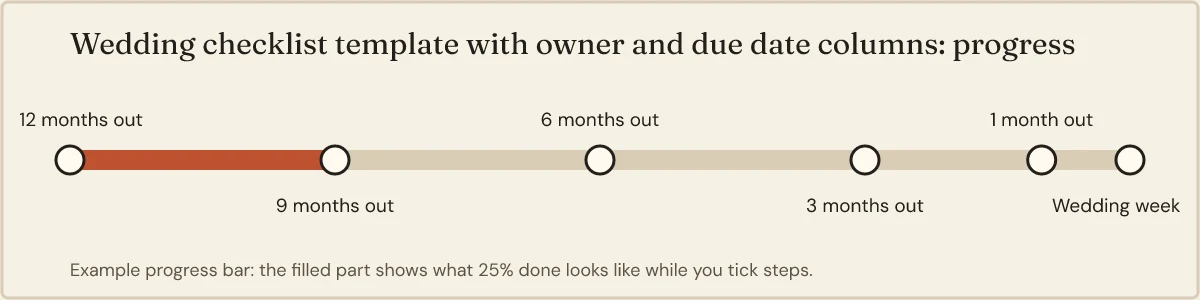
The progress bar picture below shows how the ten steps sit across the first year.
Hours per month for the first ten steps
A due date does not tell you how heavy a month is. Here is the same ten-step plan grouped by month out, using the default placeholder hours.
Table: Placeholder hours of work in each month of the 12 month plan, using the default hours above (our estimate)
| Months out | Steps due | Hours |
|---|---|---|
| 12 | Budget, guest list, date options | 6 |
| 11 | Venue | 10 |
| 10 | Photographer, caterer | 7 |
| 9 | Officiant | 2 |
| 8 | Attire, music | 11 |
| 7 | Save-the-dates | 4 |
| Total | 10 steps | 40 |
Months 8 and 11 are the heaviest, at 11 and 10 hours. Month 11 is almost all venue tours, so start touring in month 12 and no single month carries the whole job. For month 8, book the music in month 9 with the officiant: attire stays at 8 hours in month 8 and month 9 grows from 2 to 5. The totals follow from the placeholder hours, so rerun the sums if you change them.
Splitting owners
An owner column only works if the split feels fair. Here is how to fill it in under ten minutes.
- Read the ten rows aloud and mark each step Both only if a disagreement would hurt.
- Each of you picks the steps you would honestly enjoy.
- Trade until the hour totals are close. In the default split, Partner A has 20 placeholder hours and Partner B has 14, with 6 shared. The line above the table recalculates this when you change an owner.
- Name one person who follows up on every Both step.
- Check the column again in a week. Move anything that nobody touched.
When a parent or planner helps, add a fourth owner label rather than a second name in a cell. One name per row is the whole point.
Three mistakes that break a checklist template
Two owners on one row. It feels polite and it means nobody acts. Write one name. Put the other in the notes column as the person to check in with.
Typed dates instead of calculated ones. When the venue shifts your date by a week, every typed date is wrong. Keep one wedding date cell and calculate the rest.
Never marking Waiting. A step that looks Not started for six weeks makes you feel behind. Mark it Waiting with the date you asked, and chase it when the date passes.
If you have 6 months instead of 12
Halving each lead time and rounding up works for booking steps, where you are limited by how fast you decide. It fails for two steps that run on someone else’s clock: attire and save-the-dates. Halving them would put attire at month 4 and the save-the-dates at month 4, which the sources above contradict.
Table: The ten steps compressed for a November 13, 2027 wedding, halved where it works and not halved for attire and save-the-dates (our estimate, our own compression rule)
| Step | 12 month plan | 6 month plan | 6 month due date | How |
|---|---|---|---|---|
| Budget, guest list, date options | 12 | 6 | May 13, 2027 | Halved |
| Venue | 11 | 6 | May 13, 2027 | Halved; ask what is open first |
| Photographer, caterer | 10 | 5 | Jun 13, 2027 | Halved |
| Officiant | 9 | 5 | Jun 13, 2027 | Halved, rounded up |
| Music | 8 | 4 | Jul 13, 2027 | Halved |
| Attire | 8 | 6 | May 13, 2027 | Not halved: shop now for in-stock or rush gowns, because made-to-order takes 4 to 6 months |
| Save-the-dates | 7 | 6 | May 13, 2027 | Not halved: 6 months is the low end of Greenvelope’s 6 to 8, so send once date and venue are set, or skip them |
Compression has a limit that math cannot fix. Popular venues and photographers book on their own schedule, so ask what is open before you commit to a date. Our last minute checklist is built for short runways. To see which of your steps are already past due, type your real date into the table above.
Where to go next
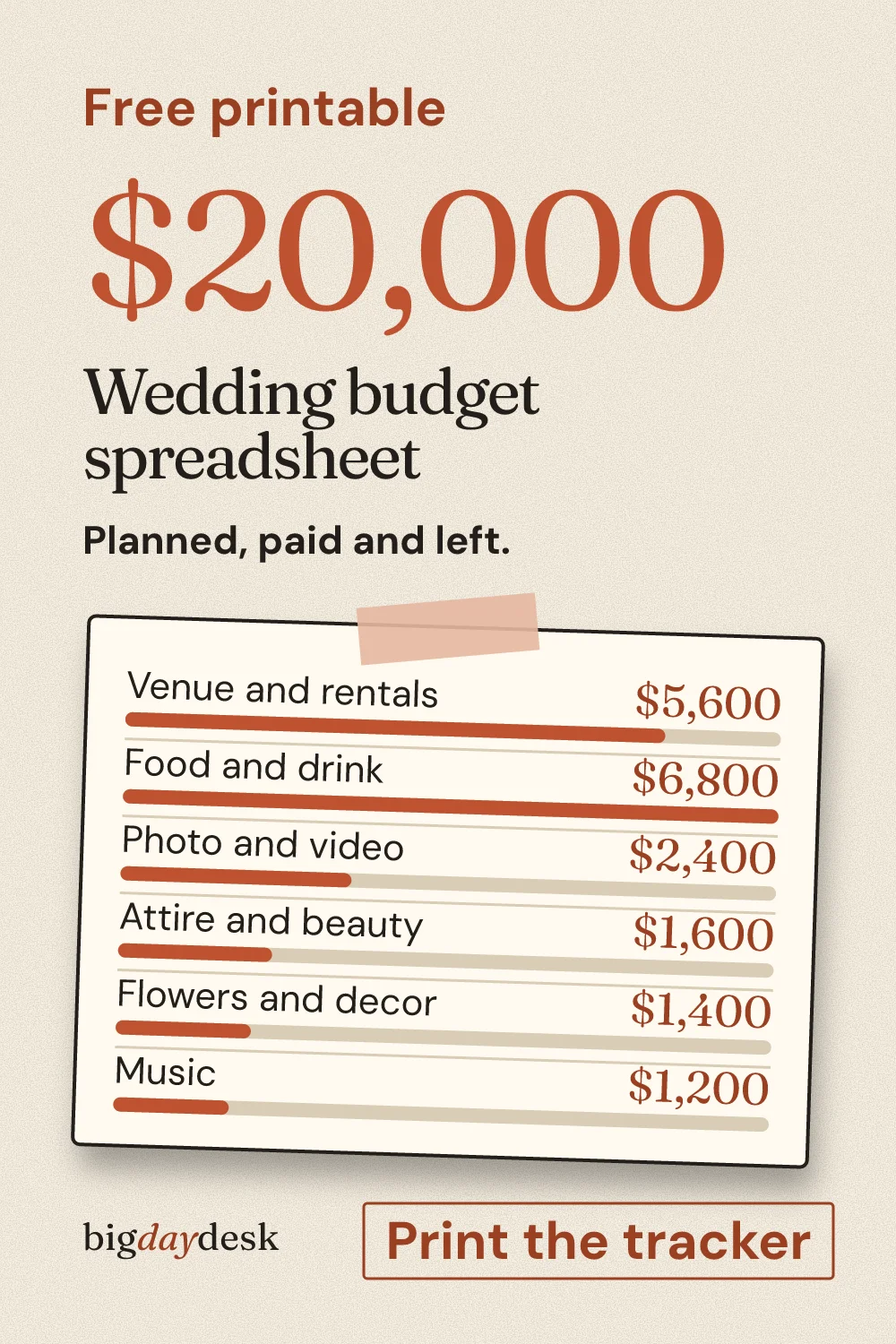
If you prefer to see tasks grouped under month headings, the month by month version lays them out that way. Need only a file to print or save? The PDF checklist is a single page. To track what each step costs, pair this sheet with the budget spreadsheet.
Pick one master copy, either the shared sheet or the link, and send everyone to that one. If each of you edits a separate copy, the owner column stops meaning anything.

Save for later
Pin it now and find it when you are ready to plan.
Questions people ask
Can I use this checklist in Google Sheets?
Yes. Press Copy as spreadsheet rows on this page, click cell A1 of a blank sheet and paste. The tabs split the text into columns on their own, with your wedding date in B1 and the header in row 3. Then follow the formula steps on this page: put =EDATE($B$1,-D4) in E4 and fill it down, and format column E as a Date. Share the sheet with your partner as an editor. Excel works the same way.
What columns belong in a wedding checklist template?
Five earn their place: step, owner, due date, status and notes. Owner stops tasks from belonging to everyone, which means no one. Due date should be calculated from the wedding date. Status needs a Waiting option for vendors who have not replied. An hours column helps you balance the split, but treat the numbers as your own guesses. Add a cost column only if you do not already track money in a separate budget.
How do I assign tasks to my partner?
Give every step one owner, never two. Mark a step Both only when you must decide together, like the budget or guest list, and then name who does the follow-up. Split by what each of you enjoys or has time for, not by tradition. On this page you can pick the owner for each step, then send your partner the link and they see the same split. Review the owner column together for ten minutes every week or two.
Should the template use dates or months out?
Use both. Months out is how you plan, because it works before the date is fixed. A calculated due date is what you act on, because you can sort by it. Keep the wedding date in one cell and compute every due date from it, so one change moves the whole sheet and you never retype a date.
Is a printed checklist better than a spreadsheet?
Neither wins on its own. A spreadsheet is better for sharing, sorting and sending reminders to a partner or planner. A printed sheet is better on the fridge, at a vendor visit or when one of you dislikes screens. Many couples keep the sheet as the master and print the next three months as a one page copy.
Sources
- cloudbridal.com/articles/wedding-dress-alterations-timeline (opens in a new tab) : Cloud Bridal: wedding dresses are typically ordered 8 to 12 or more months before the wedding, and made-to-order gowns commonly take 4 to 6 months; confirm the lead time with the shop.
- www.greenvelope.com/resources/when-to-send-wedding-invitations-and-save-the-dates (opens in a new tab) : Greenvelope: save-the-dates for a standard wedding go out about 6 to 8 months before.
- zola.com/expert-advice/when-should-you-send-out-your-wedding-invitations (opens in a new tab) : Zola: save-the-dates 7 to 10 months out, which overlaps Greenvelope's range at 7 to 8 months.
- withjoy.com/blog/questions-to-ask-wedding-venue (opens in a new tab) : Joy: venue questions on service charges, minimums, deposits and due dates, cancellation terms and a bad-weather plan.
Updated by bigdaydesk editorial
Keep planning
-
Wedding timeline planning
Turns the checklist into a calendar: enter the wedding date and every step gets a due date counted back from it.
-
Only the bride's own tasks (attire
Only the bride's own tasks (attire, beauty trial, paperwork, day-of bag), not vendor booking, which the main checklist covers.
-
Backyard wedding checklist
Adds the jobs a venue would do for you (power, restrooms, parking, rain plan) on top of the usual steps.
-
Adds planned
Adds planned, actual and paid columns to the split and exports as tab-separated rows for Sheets or Excel.