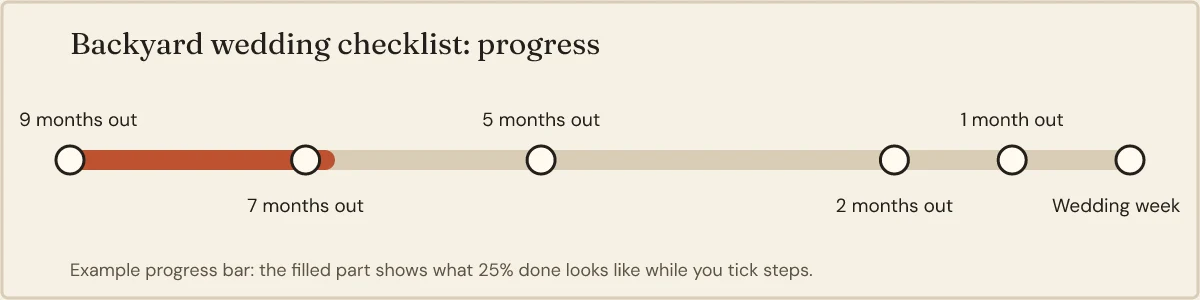
Your progress
Tick each step as you finish it. This device remembers your ticks.
0 steps done
A backyard wedding checklist is the usual planning list plus the jobs a venue does for you: cover for the weather, power, restrooms, parking, tables and someone in charge. Below are 24 of them, each with a lead time on a nine-month plan. Tick them as you book. Your ticks stay on this device. Print the list for the family hosting.
Send the link to the host first. The extra work is easier to share when everyone sees it on day one.
Checklist of home-venue jobs, with lead times for a nine-month plan
Lead time means how many months before the wedding the job should start. Time is our suggestion for how long the job takes you, not a rule. Venue question lists, such as the one from Joy, put the bad-weather backup, insurance and fee policies near the top. At home, each one becomes your job.
Decide the yard can do it (9 to 8 months out)
- Walk the yard with a tape measure and a phone. Note slope, shade at ceremony time, sprinkler heads, buried lines, and the width of the gate a delivery truck must pass. Photos help every vendor quote. Lead time: 9 months. Time: 1 hour.
- Get the host's yes in writing. Agree on the date, the end time, who pays for lawn damage and who holds the house keys. An email is enough. Lead time: 9 months. Time: 30 minutes.
- Call your city or county. Ask about tents, amplified music, street parking, alcohol and open flame. Ask for the answer by email. Lead time: 9 months. Time: 30 minutes, plus waiting.
- Check association rules and homeowners insurance. Ask the insurer if a one-day event policy is needed. Rental companies may ask for proof. Lead time: 9 months. Time: 30 minutes.
- Choose your rain plan. Pick one: a tent with sides, an indoor space that holds everyone, or a backup date. Name who makes the call. Lead time: 8 months. Time: 1 hour.
Book the jobs a venue would have done (8 to 6 months out)
- Get tent quotes. Ask whether the price includes sides, flooring, anchoring and takedown. The [tent size by guest count](/backyard-wedding/tent-size/) page shows how to match a tent to your headcount. Lead time: 8 months. Time: 2 hours.
- Book a caterer who works off site. Ask what they need: power, water, a prep table, cold storage and a hand-washing setup. Lead time: 8 months. Time: 3 hours.
- Plan power. List every plug-in item, ask each vendor for its wattage, then call an electrician or a generator rental. See the worked example below. Lead time: 7 months. Time: 2 hours.
- Decide on restrooms. Use the house, rent portable units, or both. Ask the rental company about service during the event and an accessible unit. Lead time: 7 months. Time: 1 hour.
- Book tables, chairs, linens and dishware. Ask about delivery and pickup windows. Price them in a [backyard budget split](/wedding-budget-planner/backyard-wedding/) before you sign. Lead time: 6 months. Time: 2 hours.
- Name a home manager. This is a friend or relative outside the wedding party who runs the site on the day. Lead time: 6 months. Time: 20 minutes.
Plan how guests move and stay comfortable (5 to 3 months out)
- Make a parking plan. Count driveway spots and legal street spots. If they fall short, ask a nearby church or business about a lot, or hire a shuttle. Lead time: 5 months. Time: 1 hour.
- Plan lighting. Guests leave after dark. Light the path, the restrooms and the bar, and mark where each plug is. Lead time: 4 months. Time: 1 hour.
- Plan lawn, bugs and heat. Book mowing for two days before. Plan shade, fans, drinking water and a bug plan that keeps products away from food. Lead time: 4 months. Time: 1 hour.
- Plan trash, recycling and cleanup. Count bins, choose who hauls and check your pickup day. Lead time: 4 months. Time: 30 minutes.
- Draw a site map. Mark ceremony, bar, food, restrooms, parking, power and the delivery path. Send it to every vendor. Lead time: 3 months. Time: 1 hour.
- Tell the neighbors. Share the date, hours and the time the music stops. Offer a phone number. Lead time: 3 months. Time: 30 minutes.
- Plan the walking path and seating. Heels sink into grass, so lay mats or a firm path. Keep a few chairs near the ceremony for guests who need them. Lead time: 3 months. Time: 1 hour.
Lock it down (2 months to the day)
- Confirm permits and insurance papers. Keep copies where the home manager can reach them. Lead time: 2 months. Time: 30 minutes.
- Send final counts and delivery times to rental companies. Ask for a delivery window in writing. Lead time: 1 month. Time: 1 hour.
- Walk the yard with the caterer and the tent crew. Check every path against the site map. Lead time: 1 month. Time: 1 hour.
- Set the weather call times. Choose two moments when you check the forecast and decide on the rain plan. Our suggestion is three days before and again the evening before. Lead time: 1 week. Time: 15 minutes.
- Prepare the yard in the final week. Turn off sprinklers for the delivery days, clear the space, free up fridge room and tell the neighbors the date again. Lead time: 1 week. Time: 2 hours.
- Hand the home manager the printed site map and vendor phone list. Agree on the end time and who stays for cleanup. Pack your [emergency kit](/wedding-emergency-kit/) for the same hand-off. Lead time: wedding day. Time: 20 minutes.

Worked example: due dates and a power check
Here is the same list placed on a real calendar, plus one calculation that shows why the power job starts early.
Example: wedding on Saturday, August 14, 2027. Dates are counted back from that day by our own logic.
Table: due dates for the 24 jobs on a nine-month plan (our estimate, assumptions below)
| Lead time | Due date | Jobs (by number) | Count |
|---|---|---|---|
| 9 months | November 14, 2026 | 1 to 4 | 4 |
| 8 months | December 14, 2026 | 5 to 7 | 3 |
| 7 months | January 14, 2027 | 8 and 9 | 2 |
| 6 months | February 14, 2027 | 10 and 11 | 2 |
| 5 months | March 14, 2027 | 12 | 1 |
| 4 months | April 14, 2027 | 13 to 15 | 3 |
| 3 months | May 14, 2027 | 16 to 18 | 3 |
| 2 months | June 14, 2027 | 19 | 1 |
| 1 month | July 14, 2027 | 20 and 21 | 2 |
| 1 week | August 7, 2027 | 22 and 23 | 2 |
| Wedding day | August 14, 2027 | 24 | 1 |
That is 24 jobs over 9 months, with the first 4 due in the first week of the plan.
Power check. Assume one household circuit is rated 15 amps at 120 volts. That is 15 x 120 = 1,800 watts. The loads below are invented for this example, so read the labels on your own gear.
- Coffee urn: 1,500 watts
- Two runs of string lights: 2 x 150 = 300 watts
- DJ speakers and mixer: 400 watts
- Cake fridge: 150 watts
The total is 2,350 watts, which is 550 watts over one circuit. The plan needs at least two circuits or a generator. That is a call to an electrician, and it is why job 8 starts 7 months out.
The dates assume a wedding on August 14, 2027 and a plan that starts on November 14, 2026. Move the date and every row moves with it. For due dates on your own calendar, use the wedding planning timeline.
If you have less than nine months
Shorter plans work. Fewer choices help most. This table counts the jobs already late at each point and says what to do first.
Table: jobs already late if you start with fewer months left (our estimate, assumptions below)
| Months left | Jobs already late | Do these in week one | Simplify |
|---|---|---|---|
| 6 | 9 | Jobs 1 to 5, then 6 to 9 in weeks two and three | Use pop-up canopies instead of a full tent |
| 4 | 12 | Jobs 1 to 5, caterer and restrooms by week two | Use house bathrooms and a simple menu |
| 3 | 15 | Jobs 1 to 7 | Cut the guest list to what one circuit and one canopy can serve |
| 2 | 18 | Permit call, rain plan, caterer, rentals | Rain date instead of a tent |
Assumptions: a job counts as late when its lead time on the nine-month plan is longer than the months you have left. Counts come from the numbered list above.
If you are choosing between a home and a hall, the backyard wedding layout and rentals page sorts the zones in your yard. For the standard steps this list skips, such as the dress, invitations and vows, use the 12 month wedding planning checklist.
Three mistakes at home venues
Starting with the tent. The tent depends on the yard, the permit answer and the rain plan. Jobs 1 to 5 come first because they can change every quote after them.
Treating power as someone else’s problem. Caterers, music and lights all draw power, and each assumes someone else solved it. Add the numbers yourself, as in the example, and ask about a generator before you book the band.
Leaving the day to the parents. The couple and their parents are guests that day. A named home manager with a printed map keeps the delivery, trash and cleanup questions away from them. Add the weather call to the manager’s sheet, and use the month by month checklist to see what else lands in each month.
What to do after the first week
Print this page and tick jobs 1 to 4. Put the due dates in a shared calendar. Then build your day-of timeline so the rental company, caterer and tent crew all work from the same hours.

Save for later
Pin it now and find it when you are ready to plan.
Questions people ask
What do I need for a backyard wedding?
You need everything a venue would have supplied: cover for rain or sun, power, restrooms, tables and chairs, parking, trash removal and someone in charge on the day. The checklist above turns each into a job with a due date. Start with the rain plan and power, because they decide most of the other choices.
Do I need a permit for a backyard wedding?
It depends on your city or county, so we cannot give one rule. Local offices often ask about tents, amplified music, street parking and alcohol. Call the planning or permits office, describe the event, and ask for the answer by email. Also check homeowners association rules and your homeowners insurance before you book anything.
What is the rain plan for a backyard wedding?
A rain plan is a decision made ahead of time: a tent with sides, an indoor space that holds your guests, or a backup date. Pick one at the start, not when the forecast turns. Name who makes the call and at what time, so nobody is guessing on the morning of the wedding.
How far ahead should I start planning a backyard wedding?
Our checklist assumes nine months, because tents, rentals and caterers can book up and permits can take time to answer. A shorter plan works if you simplify. The compression table below shows which jobs to do first when you have six, four, three or two months left.
Who is in charge of a backyard wedding on the day?
Name one home manager who is not the couple and not a parent of the couple. This person holds the site map and vendor phone list, answers delivery questions, watches the clock and handles trash and cleanup at the end. At a venue, a coordinator does this job. At home, somebody has to.
Sources
- withjoy.com/blog/questions-to-ask-wedding-venue (opens in a new tab) : Venue question lists include the bad-weather backup plan, vendor insurance requirements and which fees and policies a rental covers. Those are the items a home venue leaves to you.
Updated by bigdaydesk editorial
Keep planning
-
Wedding checklist bride
Only the bride's own tasks (attire, beauty trial, paperwork, day-of bag), not vendor booking, which the main checklist covers.
-
Curious about micro wedding checklist?
Decides headcount first, then books only the vendors a small day needs, in a six-month order.
-
Spreadsheet-shaped
Spreadsheet-shaped: owner, due and status columns, exported as tab-separated rows you paste into Sheets or Excel.
-
Guest-facing view of the timeline
Guest-facing view of the timeline: private steps like hair and makeup are removed and the sign is laid out for print.