Pick the sign size from your table count: a portrait 24x36 poster fits up to 12 tables of 8 at a 36 pt font, and 6 tables at 48 pt. Use the fit check below with your own sign size, orientation, table count and longest name. It tells you when names will not fit, before you pay for a print.
Sign fit check
The numbers are our estimate from the layout rules below. Nothing you type is sent anywhere. The link button copies a web address that holds your size, orientation, tables, seats, name length and font, so a partner or the print shop opens the same result.

Layout table: sign size against tables and names
This table is the check written out, so you can see why a size passes or fails.
Table: Tables and names that fit on a portrait sign, 8 seats per table, longest name 20 characters (our estimate, assumptions below)
| Sign size (inches) | Tables at 36 pt | Names at 36 pt | Tables at 48 pt | Names at 48 pt |
|---|---|---|---|---|
| 8.5 x 11 | 1 | 8 | 0 | 0 |
| 11 x 17 | 2 | 16 | 1 | 8 |
| 16 x 20 | 4 | 32 | 1 | 8 |
| 18 x 24 | 4 | 32 | 4 | 32 |
| 24 x 36 | 12 | 96 | 6 | 48 |
| 30 x 40 | 20 | 160 | 9 | 72 |
Assumptions: 1 inch margin on every side. The top 12 percent of the usable height is kept for the title. Each name line is 1.3 times the font size, and each table block has a header line and one blank line. An average letter is 0.52 times the font size wide, and there is 0.75 inch between columns. These are our layout rules, not a standard. A tight font or short names fit more.
Read the 36 pt columns first. They are the smallest size we call comfortable. The 48 pt columns show what you give up for bigger type.
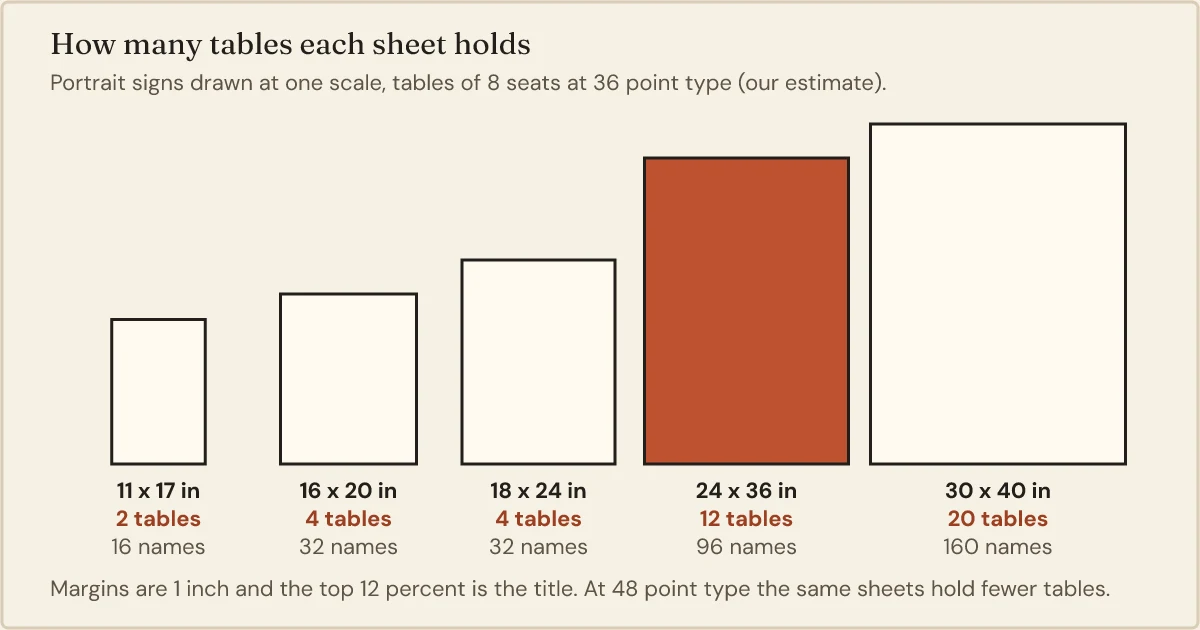
Each step up in size holds more tables, and a 24 by 36 sheet fits 12 tables of 8 at 36 point type.
Portrait or landscape
Many seating signs are landscape, such as a 30x20 frame, and the table above does not cover them. A wide sign gets more columns and fewer rows. That helps at large fonts and hurts at small ones. The same rules, rotated:
Table: Tables and names that fit on a landscape sign, 8 seats per table, longest name 20 characters (our estimate, same assumptions as above)
| Sign size (inches, wide by tall) | Tables at 36 pt | Names at 36 pt | Tables at 48 pt | Names at 48 pt |
|---|---|---|---|---|
| 11 x 8.5 | 0 | 0 | 0 | 0 |
| 17 x 11 | 2 | 16 | 0 | 0 |
| 20 x 16 | 3 | 24 | 2 | 16 |
| 24 x 18 | 6 | 48 | 2 | 16 |
| 36 x 24 | 10 | 80 | 8 | 64 |
| 40 x 30 | 18 | 144 | 10 | 80 |
At 48 pt a 36x24 landscape holds 8 tables where the portrait 24x36 holds 6. At 36 pt the portrait wins, 12 tables against 10. A 30x20 frame holds 8 tables at 36 pt by the same rules. If you already own a frame, set its width and height in the check by choosing the nearest listed size, then leave yourself some slack.
Worked example: 48 guests on one 24x36 sign
Say you have 48 guests at 6 tables of 8, and your longest name is 20 characters, such as “Alexandra Montgomery”.
Table: Fit check for 6 tables of 8 on a portrait 24x36 sign (our estimate)
| Check | Result |
|---|---|
| Largest font that fits 6 tables | 55 pt |
| Font we suggest | 48 pt |
| Layout at 48 pt | 2 columns, 3 rows |
| Letter height at 48 pt | about 0.47 inch |
| Readable distance, ceiling by vendor ratio | about 11.7 feet |
Assumptions: the layout rules above, letter height as 0.7 times the font size, and 25 feet of reading distance per inch of letter height. The last figure is a ceiling from a safety-sign guide, not a guarantee. We also assume guests stand 3 to 6 feet away in a queue, which has no source.
We suggest 48 pt rather than 55 pt on purpose. The last 7 points of font fill the sign to its edges, and one longer name then breaks the layout. A little slack is cheaper than a reprint.
By table or alphabetical: the same 100 guests on one sign
The choice changes what fits. Take 100 guests at 10 tables of 10, longest name 20 characters, on a portrait 24x36.
Table: 100 guests on a portrait 24x36 sign, two layouts (our estimate)
| Layout | What fits | Font |
|---|---|---|
| By table, 10 seats | 9 tables at most | 36 pt, one table short |
| By table on a 30x40 | 16 tables at 36 pt | up to about 44 pt for 10 tables |
| Alphabetical, 3 columns of 34 lines | all 100 guests | about 41 pt |
| Alphabetical, 2 columns of 50 lines | all 100 guests | about 33 pt, under our floor |
Assumptions: the layout rules above. Each alphabetical line is the name plus a table number, counted as 23 characters, with 0.75 inch between columns and no table headers. The font is the smaller of the height limit and the width limit.
So 100 guests do not fit by table on a 24x36, but they fit as an alphabetical list in three columns at 41 pt. Alphabetical also saves you the second sign. If you stay by table, the two-sign fix is two 24x36 signs of 5 tables each, split by table range, which fits at 36 pt with room left.
Print prep: file size, finish and placement
A print shop asks for a file at the final sign size. One trade printer recommends 150 DPI for large posters, and a university poster guide gives 150 as the minimum and 300 as the recommended maximum. Shops differ, so ask yours.
Table: File size in pixels for each sign at 150 and 300 DPI (our arithmetic, inches times DPI)
| Sign size (inches) | Pixels at 150 DPI | Pixels at 300 DPI |
|---|---|---|
| 11 x 17 | 1650 x 2550 | 3300 x 5100 |
| 18 x 24 | 2700 x 3600 | 5400 x 7200 |
| 24 x 36 | 3600 x 5400 | 7200 x 10800 |
| 30 x 40 | 4500 x 6000 | 9000 x 12000 |
Text exported as a vector PDF stays sharp at any size, so the pixel counts matter mainly for a photo or a background image. The rest is our suggestion, not a standard:
- Keep names inside the margin. Our layout uses a 1 inch margin. That also keeps names clear of a frame lip or a trimmed edge.
- Material. Foam board and a framed print behave differently. Ask the shop about weight and finish. A glossy finish under venue lights can hide letters from a side angle, so ask for matte.
- Easel and height. Put the first line at about eye level and the last above knee height, so a queue can read the whole board. A tall 24x36 on an easel can tip in a breeze outdoors, so weigh the legs or lean it on a wall.
- Check the proof. Read the longest name from where a guest will stand.
Steps
- Count your tables and the seats at each. A 60-inch round table is listed at 8 seats and a 72-inch round at 10, so ask your venue which you have.
- Find your longest name, spaces included. Use that count in the check, not the average.
- Pick the largest sign that your print budget and wall space allow, choose portrait or landscape to match your frame, then read the font size the check gives you.
- If the font is under 36 pt, shorten names, switch to an alphabetical layout or split the chart into two signs.
- Export at the sign size, hold a proof at that size, and read one name from the distance a guest will stand.
Three mistakes that waste a print
Fitting the average name, not the longest. The sign looks fine in your draft because the draft uses short names. Then one guest has a long double-barreled surname and the line wraps. Fix: test with your longest name, or shorten to a first name and last initial. “Alexandra M.” is 12 characters, and at 12 or 14 characters a portrait 24x36 holds 20 tables at 36 pt, up from 12 at 20 characters.
Letting the print shop scale it. Fit-to-page settings stretch or shrink the file, and your carefully checked font size changes with it. Fix: export at the sign size and ask for 100 percent. Check the proof for the same name you tested.
Stacking too many tables on one board. More than 12 tables on a portrait 24x36 forces the font under the comfortable floor. Fix: use a bigger sign, go alphabetical, or use two signs split by table range.
What changes with your wedding size
The sign matters less for small weddings. One planner guide says a seating plan is not essential under 30 guests but highly recommended from 30 up. Below that, a handwritten table list on a sheet works, or you can try a seating chart on a mirror as an alternative to paper.
Table: Smallest sign in the check that holds your tables at 36 pt, 8 seats each (our estimate)
| Tables | Guests at 8 per table | Portrait | Landscape |
|---|---|---|---|
| 1 | 8 | 8.5 x 11 | 17 x 11 |
| 2 | 16 | 11 x 17 | 17 x 11 |
| 3 | 24 | 16 x 20 | 20 x 16 |
| 4 | 32 | 16 x 20 | 24 x 18 |
| 5 to 6 | 40 to 48 | 24 x 36 | 24 x 18 |
| 7 to 10 | 56 to 80 | 24 x 36 | 36 x 24 |
| 11 to 12 | 88 to 96 | 24 x 36 | 40 x 30 |
| 13 to 18 | 104 to 144 | 30 x 40 | 40 x 30 |
| 19 to 20 | 152 to 160 | 30 x 40 | none in the check |
Large weddings are better served by a list people can scan. If your count runs past 120 guests, the alphabetical list by last name is quicker for guests than hunting through table blocks.
Use the sign with the rest of your plan
Build the table list first with the seating chart planner, then size the sign from it. Once the sign is set, you can try other ways to display the chart, from a framed board to hanging cards. If you also want names on the tables themselves, see place cards and table names that read well.
Your welcome board and the seating board often hang side by side. Use the same font and the same size system, which the welcome sign sizes page works through.
Print and send
Use the buttons in the check to copy a link to your result, share it, or copy a message for the print shop. The message carries your size, orientation, tables and font. Print this page to get the layout tables on one sheet.

Save for later
Pin it now and find it when you are ready to plan.
Questions people ask
What size should a seating chart sign be?
Match it to your table count. In our estimate, a portrait 24x36 sign holds 5 to 12 tables of 8 at 36 pt, and up to 6 tables at 48 pt. Up to 4 tables, 18x24 works. Past 12 tables, go to 30x40 or split the chart into two signs. We assume guests stand 3 to 6 feet away in a queue, which is our assumption, not a sourced figure.
Can I print a seating chart at home?
It is not a good fit for the main board. A 24x36 poster needs about 12 Letter sheets by our arithmetic (3 across, 4 down, ignoring margins), and the seams run through names. If you still want to try, our suggestion is to tile it only on a layout with wide gaps between table blocks. For a clean poster, export a PDF and send it to a print shop. Ask them to print at 100 percent, with no fit-to-page scaling.
How many names fit on a poster?
It depends on the longest name and the font size. We assume names up to 20 characters and 8 seats per table. At 36 pt, a portrait 24x36 poster fits about 96 names and a 30x40 fits 160. Raise the font to 48 pt and those counts drop to 48 and 72. A landscape layout changes the split, so use the fit check above.
What font size is readable on a seating chart sign?
We use 36 pt as the floor for names. Its letters stand about a third of an inch tall. By the vendor's 25 feet per inch ratio that is at most about 9 feet, so we treat it as a ceiling, not a guarantee. Guests in a queue stand about 3 to 6 feet away (our assumption), which 36 pt covers with margin. Go up to 48 pt when the sign allows.
Should the chart be by table or alphabetical?
Choose by table when you have few tables and guests find their own names quickly. Choose alphabetical when you have a long list, because guests scan one letter and stop. On the same sign the sizes differ: each alphabetical line carries a table number, but it uses fewer lines than table blocks with headers. The worked example below shows 100 guests both ways.
Sources
- www.safetysign.com/determine-correct-viewing-distances (opens in a new tab) : Vendor guide citing ANSI Z535 with a ratio of 25 feet of viewing distance per inch of text height, used only as a ceiling for our readable-distance estimate; the same page says OSHA sets no sign size or text size rule.
- www.webstaurantstore.com/blog/115/how-many-people-can-different-size-banquet-tables-seat-comfortably.html (opens in a new tab) : A 60-inch round table is listed as seating 8 guests and a 72-inch round table as seating 10; used for the seats-per-table choice.
- bridebook.com/uk/article/how-to-create-a-wedding-seating-plan-etiquette-top-tips (opens in a new tab) : A seating plan is described as not essential under 30 guests but highly recommended from 30 up; used for when you need a sign at all.
- help.tradeprint.co.uk/using-150-dpi-resolution-in-large-format-prints (opens in a new tab) : A trade printer recommends 150 DPI for large-format prints such as posters and banners; used for the file size lines in the print prep table. Print shops differ, so ask yours.
- bio.jhu.edu/wp-content/uploads/sites/57/2024/10/PosterPrintingGuidelines-4.pdf (opens in a new tab) : A university poster guide lists 150 dpi as the minimum and 300 dpi as the recommended maximum; used to show the range of file sizes for a poster.
Updated by bigdaydesk editorial
Keep planning
-
A mirror layout calculator
A mirror layout calculator: block grid, name capacity and lettering height from the mirror size, with chalk guide measurements to mark on the glass.
-
Wedding seating chart ideas: 20 ways to display it
Display ideas only: filter twenty styles by guest count, budget and effort, send the shortlist as a link, and see which still fit at 30, 80 and 150 guests.
-
Curious about seating chart alphabetical?
Takes the seated list and flips it: guests sorted by last name with table numbers, split into two print columns, with filing rules for messy names.
-
Work through checklist pdf
Print-first layout: two pages, big checkboxes, notes column and a paper-size choice, with a save-as-PDF button.