Paste your guest names, pick flat or folded, and print. On Letter paper you get 6 cards per page at the 3.5 x 3 in flat size, or 10 per page at 3.5 x 2 in. A4 gives the same counts with a bigger blank strip at the bottom. The table below shows every combination.
Layout table: cards per page for flat and folded styles
Start with the paper in your drawer. Then pick the card that fits it. Every row below is computed from the paper size and the card size.
Table: Cards per page by style, card size and paper, with margins fixed (our estimate, assumptions below)
| Style | Card size (flat sheet) | Letter | A4 | Paper covered on Letter |
|---|---|---|---|---|
| Flat, small | 3.5 x 2 in | 10 | 10 | 75% |
| Flat, large | 3.5 x 3 in | 6 | 6 | 67% |
| Folded, 2 in tall | 3.5 x 4 in, folds to 3.5 x 2 | 4 | 4 | 60% |
| Folded, 1.5 in tall | 3.5 x 3 in, folds to 3.5 x 1.5 | 6 | 6 | 67% |
Assumptions: 0.5 in margins on Letter (8.5 x 11 in) and 10 mm margins on A4 (210 x 297 mm). Cards sit in a grid with no gap, so you cut along shared lines. Two columns fit on both papers. A4 is taller, so the 3.5 x 2 in flat card leaves a strip of about 0.9 in at the bottom that Letter does not have.
The flat 3.5 x 3 in card and the folded 3.5 x 1.5 in card both give six to a page, and the folded 3.5 x 4 in card gives only four.
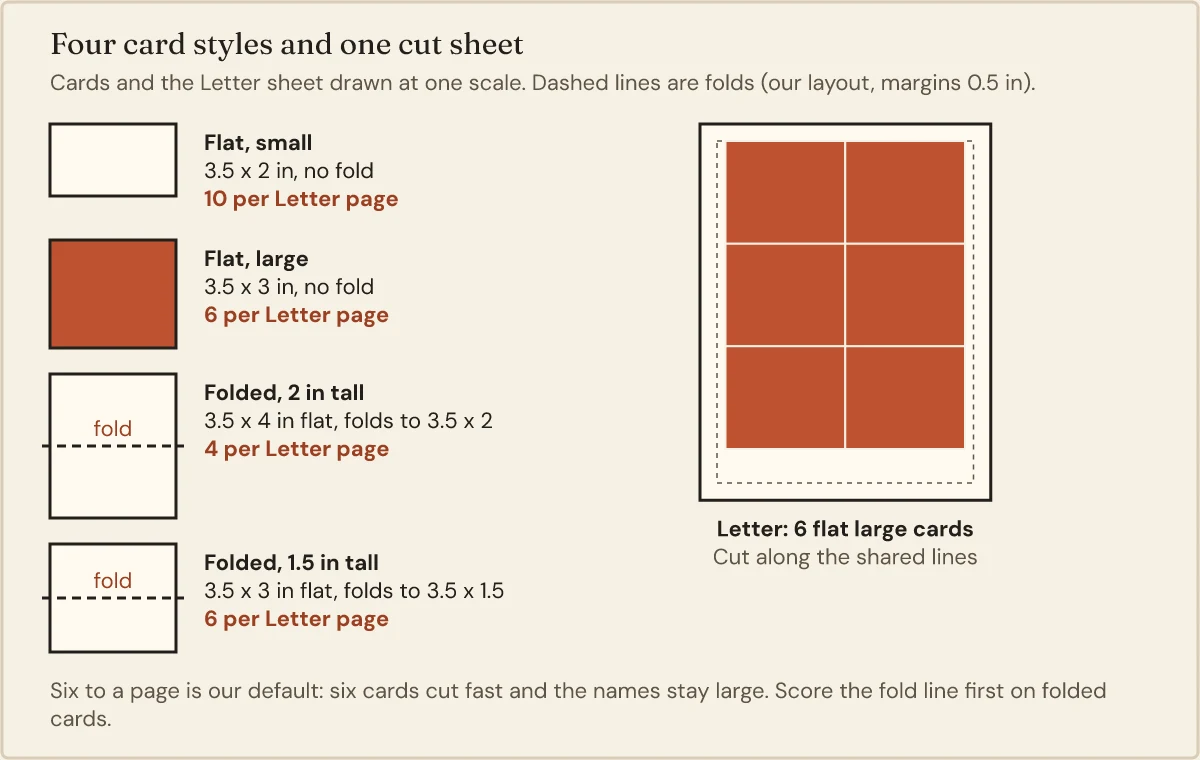
The 3.5 x 3 in flat card and the 3.5 x 1.5 in folded card both give six to a page. That is the layout we default to, because six cards cut fast and the names stay large.
If you only have a home printer, check the printable area before you commit. Many printers cannot reach the page edge. Our margins leave room for that.

Steps
- Count your guests, then add six spares for typos, late additions and a card that smudges.
- Paste the names, one per line, and add a table number after each one.
- Pick flat or folded. Use the table above to see how many sheets you need.
- Print one sheet on plain paper first and check the spelling against your guest list.
- Print the rest on cardstock, sorted by table so each table gets its own stack.
- Cut along the shared lines. Score the fold line first on folded cards.
Worked example: 116 guests
The Knot’s 2025 study put the average guest count at 116 for weddings held in 2024. We use that number so the example is a realistic size, not a number we made up. Your count will differ.
Table: Sheets needed for 116 guests plus six spares, by style (our estimate, example guest count)
| Style | Cards per Letter page | Cards to print | Sheets |
|---|---|---|---|
| Flat, small (3.5 x 2 in) | 10 | 122 | 13 |
| Flat, large (3.5 x 3 in) | 6 | 122 | 21 |
| Folded, 3.5 x 2 in finished | 4 | 122 | 31 |
| Folded, 3.5 x 1.5 in finished | 6 | 122 | 21 |
The spread is 18 sheets between the cheapest and the heaviest style. Folded 2 in cards cost the most paper because each card uses a 3.5 x 4 in flat sheet.
At 48 guests the same math gives 54 cards. That is 6 sheets of small flat cards, or 9 sheets at six per page.
Flat or folded: how to choose
Fold the card when guests sit at long tables, because a standing card reads from the other side. Fold it when the plates are already large and a flat card would slide under one.
Keep cards flat when they go on a napkin, in a glass, or on a charger plate. A flat card also works when you plan to write a meal choice or a note on the back.
One practical rule from us: the fewer sheets, the fewer mistakes. If you have no strong reason to fold, choose the flat large card at six to a page.
What goes on each card
Put the guest name in the largest type. Everything else is smaller and optional.
- Name. First and last, or first only. Use full names when two people at a table share a first name.
- Table number. A small number in a corner lets a guest who sits in the wrong place correct it themselves.
- Meal marker. A dot color or a single letter replaces a spoken question to the guest. Tell the caterer the code.
- Nothing else. Skip the date, the couple’s names and the monogram unless you want a keepsake. They crowd the name.
If you use escort cards for table assignments, your place cards can stay plain. If you use a seating chart sign instead, try our seating chart maker to get the table lists right first.
Example set: one table, eight cards
This is a fictional table so you can see the finished text. Names are invented examples.
Table: Eight example place cards for one table, text only (example names)
| Card text | Table | Meal marker | Why it is written this way |
|---|---|---|---|
| Maya Okafor | 4 | Beef | Full name, no other guest named Maya |
| Daniel Reyes | 4 | Fish | Full name, matches the guest list spelling |
| Dan Whitaker | 4 | Veg | Full name, because Daniel is also at the table |
| Priya | 4 | Beef | First name only, fine at a casual table |
| Jon and Alex | 4 | Fish, Veg | One card per person is cleaner, so split this |
| Grandma Rose | 4 | Chicken | Use the name she goes by, not the legal one |
| Elena Park | 4 | Veg | Full name, matches the invitation envelope |
| Sam | 4 | Beef | First name only, but check for a second Sam |
Look at the Jon and Alex row. A card with two names and two meals is a trap. Give each person their own card so each person has their own seat.
Three mistakes and how to fix them
Printing before checking the list. A wrong name on 122 cards costs a sheet at a time. Fix it by printing one test sheet on plain paper and reading every name against your guest list.
Trusting the spelling you remember. Names on envelopes often differ from names in your head. Copy the spelling from the RSVP, not from a text thread. Our guest list template gives you one place to keep the final spelling.
Cutting by eye. Hand cuts drift, and cards then look uneven in a row. Cut along the shared lines with a paper trimmer, or score each line with a ruler before you cut with scissors.
Cutting and setting out
A paper trimmer makes the straight cuts. Scissors work if you score first. Fold with a bone folder or the back of a butter knife, held against a ruler.
Set the cards out in the order of your table chart, one stack per table. Give the stacks to the person who is setting the tables, along with a copy of the chart. Mark each stack with its table number so nobody has to guess.
Keep spares in an envelope in the planning binder. The wedding planning binder has a place for proofs and a printer test sheet.
Match the rest of the room
Place cards are small, but guests read them up close. Match the type and the paper color to your other printed pieces.
- If tables are named instead of numbered, see table name ideas and print the name in the corner.
- A matching welcome sign makes the entrance and the table feel like one set.
- The rest of the room signage is in our printable wedding signs.
- More tools for the room and the day are in free wedding printables.
Send the sheet to whoever will cut
Use the Share row at the top of this page to send the layout to the friend who is cutting and setting the cards. The link keeps your layout, so they open the same sheet you did.

Save for later
Pin it now and find it when you are ready to plan.
Questions people ask
Do you need wedding place cards?
No. Nothing requires them. Place cards make sense when you want assigned seats, a choice of meals, or a seating plan that stops guests from wandering between tables. Skip them for a small, casual dinner where everyone fits at one or two tables. If you skip them, a table number is still helpful.
How do place cards work at a wedding?
A place card sits at one seat and names the person who sits there. Guests first find their table, usually from an escort display or a chart, then find their own name at the table. Set the cards out before guests arrive, one per chair, so the seating plan is already decided when the doors open.
Do place cards have surnames?
There is no fixed rule. Formal dinners often print full names or titles. Casual weddings usually print first names only. Use a first and last name when two guests at the same table share a first name, and when guests come from separate sides and may not know each other yet.
What is the difference between place cards and escort cards?
An escort card tells a guest which table to go to. A place card marks the exact seat at that table. You can use one, the other, or both. If you print table numbers on your place cards, a seating chart sign can do the escort job and you save a second set of cards.
Should I print place cards flat or folded?
Folded cards stand up and are easier to read from across a table. Flat cards lie on a plate or napkin and fit more to a page. Pick folded when the table is crowded and guests sit apart. Pick flat when you want fewer sheets to cut or when the cards go on a napkin.
Sources
- www.theknotww.com/press-releases/weddings-shine-bright-in-2025-the-knot-study-reveals-couples-prioritize-celebration-joy-and-connection-amid-socioeconomic-instability (opens in a new tab) : The Knot 2025 Real Weddings Study: average guest count of 116 at 2024 US weddings, used as the size of the worked example.
Updated by bigdaydesk editorial
Keep planning
-
Wedding welcome sign: type your names and print
Live sign preview with five layouts and our bundled fonts, exportable at poster sizes.
-
Print planning binder
A page set you choose from (contacts, budget, timeline, checklist) with a live print count and tab labels.
-
Print signs
A sign planner: venue type and guest count give a must-have list and sizes, so you print only what the day needs.
-
Wedding speech quotes
Every quote is either public domain with a linked source or an original line labeled as ours, never an unsourced attribution.