A rehearsal dinner needs at most three signs: a welcome sign at the door, a seating list and a menu. This page makes all three from one set of names and one date, so they match. Type your details in the maker above, pick the signs you want and print on Letter or A4.
Sign layout table: size and text for each sign
Each row is one sign. The size is the printed size, and the text column lists what the sign carries and nothing more.
| Sign | Printed size | Paper and orientation | Text it carries | Where it goes |
|---|---|---|---|---|
| Welcome | 8.5 x 11 in (A4: 8.27 x 11.69 in) | Full sheet, portrait | Both first names, “Rehearsal dinner”, the date | Entrance or host table |
| Seating | 8.5 x 11 in (A4: 8.27 x 11.69 in) | Full sheet, portrait | Table numbers with the names at each | Near the door, at eye level |
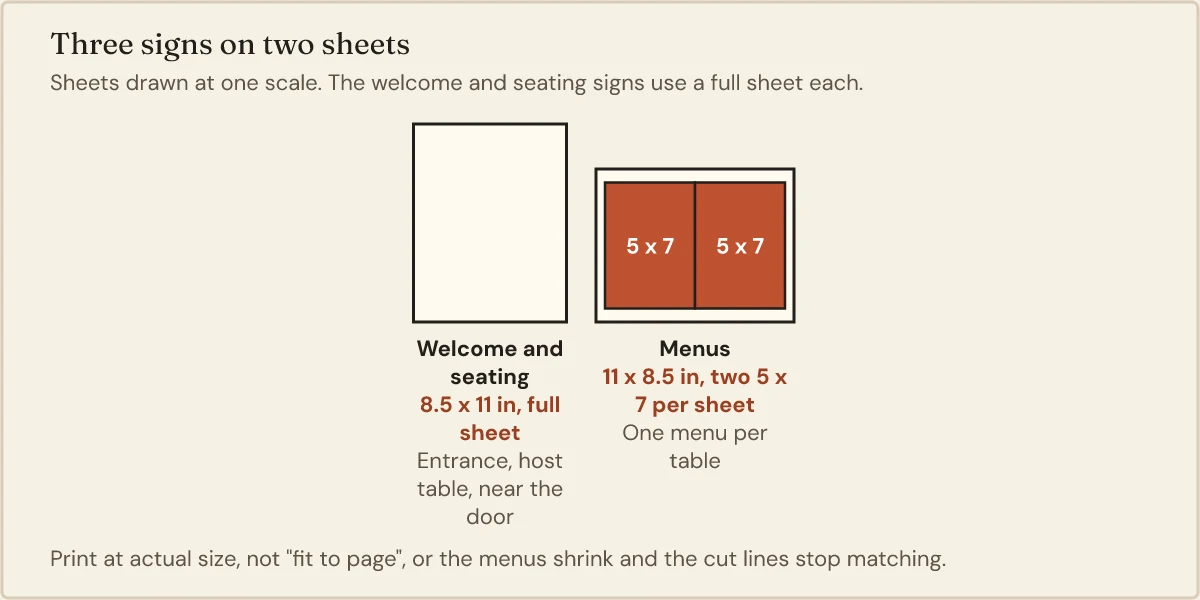
| Menu | 5 x 7 in | Two per sheet, landscape, with cut lines | Courses, one line each, plus any allergy note | One per table |
Table: the three rehearsal dinner signs with size, paper and text (our own layout, sizes in inches).
Two 5 by 7 menus side by side use 10 inches of an 11 inch landscape sheet, so each side keeps a 0.5 inch margin. That is inside what most home printers can reach. On A4 landscape you get about 0.85 inch to spare across.
Two 5 by 7 menus side by side use 10 of the 11 inches of a landscape sheet, so you cut one sheet into two menus.
Why three signs and not more
The rehearsal dinner is small. One etiquette guide describes the usual guests as immediate family, the wedding party, VIP relatives and the people who take part in the ceremony. These people mostly know each other, and many know the room too.
So skip the extras you see at weddings, such as a guest book sign, a drinks sign or a table number for every setting. They add paper and decisions. The three here cover the questions guests actually ask: where do I go, where do I sit and what are we eating.
Make the welcome sign readable from the door
A welcome sign should be read in a glance. One sign vendor offers a rule of thumb of about 1 inch of letter height per 10 feet of viewing distance. It was written for road and storefront signs, so it is a ceiling for a restaurant door. We treat it as an estimate.
Example, our own estimate with assumed numbers.
- Guests first read the sign from about 6 feet away.
- Rule of thumb gives 6 / 10 = 0.6 inch of letter height at minimum.
- A capital letter is about 0.7 of the font size, so we need 0.6 / 0.7 x 72 = about 62 pt.
- We set the names at 80 pt, which gives capitals of about 0.78 inch.
- If both names run wider than the 7.5 inch text area, drop to 72 pt.
Use “Rehearsal dinner” and the date in smaller type, about 36 pt, since guests already know who the dinner is for.
Worked example: Priya and Sam, Friday, May 14, 2027
They marry on Saturday, May 15, 2027. Dinner is Friday at 7:00 PM for 30 people in a restaurant back room. The room has round tables of 6.
Example, our own calculation with assumed numbers.
- Tables: 30 guests / 6 per table = 5 tables.
- Seating sign: 5 blocks of a heading plus 6 names is 7 lines each. We place 3 blocks in the top row and 2 in the bottom row, so each row is 7 lines tall.
- Line height at 16 pt text with 22 pt spacing: 14 lines x 22 pt = 308 pt, about 4.3 inches of the 11 inch page. It fits with space for a header.
- Menus: 1 per table is 5, plus 1 spare is 6, so 3 landscape sheets at 2 per sheet.
- Paper total: 1 welcome + 1 seating + 3 menu sheets = 5 sheets.
Five sheets is the whole job. Print a spare welcome sheet if you plan to use a frame, because the first print often needs trimming.
How to print them in five steps
- Type the two first names, the date and the dinner start time in the maker above.
- Tick the signs you need and paste the table list, one name per line.
- Check the preview against the guest list the host sent you.
- In the print dialog choose Letter or A4, set scale to 100 percent, and turn off headers and footers.
- Print one page first, hold it at arm’s length, then print the rest.
If the host wants to approve the signs first, use the share panel on this page to send them the preview.
Menu wording that fits on a card
A menu card has room for about six short lines. Write courses plainly: “Roasted chicken, lemon potatoes, green beans”. Put drinks on a separate last line, not in the courses.
Add one note if you know of an allergy: “Please tell your server about any allergies.” That gives the kitchen a reason to ask and spares the host from repeating it. If the restaurant prints its own menu, skip this sign and use the space for a table number instead.
For the rest of the evening, the rehearsal dinner run of show tells you when to bring out each sign and when toasts begin. The toasts guide covers who speaks, and the overview of the rehearsal dinner answers who hosts and who comes.
Mistakes that waste paper
- Printing at “fit to page”. The menus shrink below 5 by 7 inches and the cut lines no longer match. Set actual size.
- Names spelled two ways. Copy each name from one source so the welcome and seating signs agree.
- A seating list in alphabetical order. At a dinner of 30, guests look for their table, not a surname. List by table.
- Tiny type to fit more names. Below 14 pt a seating list is hard to read in dim restaurant light. Use a second page before a smaller font.
- Forgetting the date format. Use the same format on every sign, such as “Friday, May 14”.
If you also need the wedding signs
The dinner signs and the wedding signs are separate jobs. For the wedding day, the welcome sign for the wedding day and its size guide cover bigger frames and longer viewing distances. If the dinner has assigned seats, build the table list first in the seating chart maker, then paste it here. For small cards at each setting, the place cards for each setting page prints names on cards. Planning the dinner format first? The ideas for any budget and group size help you pick one.
Save for later
Pin it now and find it when you are ready to plan.
Questions people ask
Do you need signs at a rehearsal dinner?
No, none are required. The dinner is small, and a host can greet people at the door. Signs help when the room is shared with other diners, when guests arrive from out of town and do not know the host, or when you want assigned seats. One welcome sign plus a seating sign covers most dinners, and a menu is a bonus.
What size should the signs be?
Use a full Letter or A4 sheet for the welcome and seating signs, since people read those from several steps away. Use 5 by 7 inches for menus, which guests read at the table. If the sign goes in a frame, pick the nearest standard frame size and trim the printed sheet to fit it. Check the layout table above for exact sizes.
Can I print them at home?
Yes. A standard home printer handles Letter or A4 paper, and the signs are laid out to stay inside the usual printer margins. Use heavier paper if you have it, since thin paper curls in a frame. Choose actual size in the print dialog, not fit to page, or the menus will shrink and the cut lines will drift.
Should the signs match the wedding signs?
Matching helps if the same guests attend both events, but it is not needed. A rehearsal dinner is usually quieter and smaller, so plain black text on white paper looks right. If you do want a link between the two, reuse the same names and date format on both, and keep the wedding welcome sign for the wedding day only.
Sources
- www.signs.com/blog/?p=16381 (opens in a new tab) : Rule of thumb of about 1 inch of letter height per 10 feet of viewing distance. A commercial sign vendor writing about road and storefront signs, so we treat it as an upper bound and label our sizes as estimates.
- www.zola.com/expert-advice/rehearsal-dinner-etiquette (opens in a new tab) : The guest list usually covers immediate family, the wedding party, VIP relatives and ceremony participants, and the dinner often falls the night before the wedding. An etiquette guide from a wedding planning site, so it describes convention, not a rule.
Updated by bigdaydesk editorial
Keep planning
-
Print bachelorette party itinerary template
Editable itinerary with end times, a gap check, who books and who pays, three trip shapes, a blank sheet and a link that reopens your plan.
-
Print welcome sign
Live sign preview with five layouts and our bundled fonts, exportable at poster sizes.
-
Print welcome sign mirror
Fits your wording to the mirror: line breaks, letter height and a stencil you tape on the glass.
-
wedding speech order
A running order with minutes per speaker and a total, so the DJ and caterer can plan dinner around it.